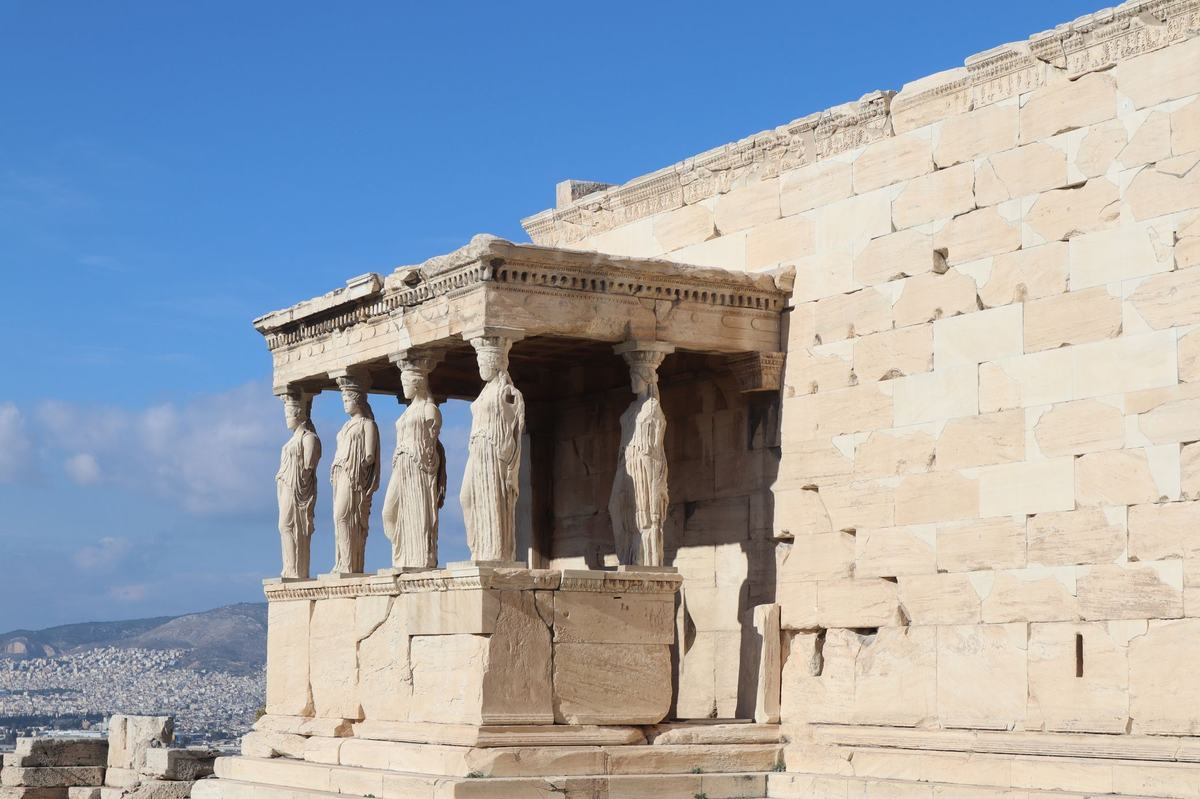
- Capital: Athens [1]
- Population: about 10.4 million [1]
- Area: 131,957 square kilometers (50,949 square miles) [1]
- Official language: Greek [1]
- Currency: Euro (EUR) [1]
- Home to roughly 6,000 islands and islets, only about 227 of which are inhabited [2]
I grew up thinking Greece was basically the Parthenon, a couple of myths I half-remembered from high school, and that one slow-motion shot from a yogurt commercial. Then I started reading about it for this series and realized I had been carrying around a postcard version of a country that's actually pretty strange. It has more coastline than the entire east coast of the United States. People still speak a version of the same language they were speaking three thousand years ago. About 80 percent of the place is mountainous, which means the famous beaches and the famous philosophers were both, essentially, side effects of geography.
Here's the thing about Greece. It sits at the southern tip of the Balkan Peninsula, jutting into the Mediterranean like it can't quite decide whether it's part of Europe, Asia, or its own thing. The mainland is rugged and broken, but the real story is offshore. Greek territory spreads across thousands of islands scattered through the Aegean and Ionian Seas, which is why you can land in Athens and be in a completely different climate, dialect, and dinner three hours later by ferry. No other country in Europe lives quite this way.
A Coastline Longer Than You'd Expect
Greece has about 13,676 kilometers of coastline, which is roughly 8,500 miles [2]. That's longer than the coast of the continental United States from Maine to Texas. For a country smaller than the state of Alabama, that's an absurd amount of shoreline. The reason is the islands. Of the roughly 6,000 islands and islets that fly the Greek flag, only about 227 have people living on them year-round. The rest are uninhabited rocks, monastic retreats, or seasonal fishing stops.
The big ones most people have heard of are Crete, Rhodes, Corfu, Santorini, and Mykonos. But the Greek archipelago has clusters most travelers never reach. The Sporades. The Dodecanese. The Cyclades. The Ionian. Each cluster has its own dialect, food, and architecture. Santorini's whitewashed houses, the ones every travel ad seems to feature, sit on the rim of a volcanic caldera that erupted catastrophically around 1600 BC. That eruption probably wiped out the Minoan civilization on nearby Crete and may have seeded the original Atlantis legend. Back home in Montana, I grew up next to mountains that were old. In Greece, the islands are old in a different way - they're inhabited old. People have been fishing the same coves for forty centuries.
The Oldest Language Still Spoken in Europe
Greek is the longest continuously documented Indo-European language in the world [3]. Written records of it go back about 3,400 years, to clay tablets found in the palace at Knossos on Crete, scratched in a script called Linear B. The language has changed, obviously. Modern Greek is not quite the Greek of Homer or Plato. But the alphabet that Greeks use today, the one with alpha, beta, gamma, and delta, is more or less the same alphabet that was being used in the eighth century BC. Every Latin alphabet, including the one I'm typing in right now, descends from it.
This is why so many English words look Greek even when they aren't ancient. Democracy, philosophy, biology, geometry, telephone, marathon, idiot, sarcasm, panic, cynic, atom. Roughly 150,000 English words trace their roots to Greek. Most of the scientific vocabulary, the medical vocabulary, and the political vocabulary of the modern world is Greek with a Latin coat of paint over it. I had to look this up twice. Greek isn't just an old language, it's the substructure under most of how educated speakers describe the world.
The Country That Invented Democracy, Approximately
Athens is usually credited as the birthplace of democracy, and the credit is mostly deserved, though it's worth noting that ancient Athenian democracy excluded women, slaves, and resident foreigners, which is to say it excluded the majority of the actual city. Still, around the year 508 BC, an Athenian reformer named Cleisthenes restructured the city's government so that decisions were made by an assembly of male citizens rather than by aristocrats. They voted on wars, laws, and trials. They sometimes voted to exile each other for ten years using broken bits of pottery called ostraka, which is where the word ostracize comes from.
That experiment ran for almost two hundred years before getting absorbed into successive empires - Macedonian, Roman, Byzantine, Ottoman. Modern Greece, the country, only became independent in 1830, after a brutal nine-year war against the Ottoman Empire. So the country with a 3,000-year cultural pedigree is, as a modern state, younger than the United States. That gap between the depth of the culture and the recency of the political nation is, I think, the most underappreciated thing about Greece.
Mountains, Olives, and the Origin of the Olympics
About 80 percent of Greece is mountainous or hilly [1]. Mount Olympus, where the gods supposedly lived, is a real mountain in northern Greece that tops out at 2,917 meters, around 9,570 feet. It's a serious climb, and the summit area is now a national park. The mainland's rugged terrain is the reason ancient Greek city-states stayed independent of each other for so long. You can't easily unify a region where every valley is walled off by limestone ridges. Geography made Greece a collection of strong-willed neighbors rather than a single empire, and that political fragmentation is part of why so many distinct schools of thought emerged from such a small population.
Greece is also the world's third-largest producer of olives and olive oil, after Spain and Italy [4]. The olive tree is so central to the country that it shows up on the national emblem. Some of the trees in Crete are estimated to be over 3,000 years old and still produce fruit. The relationship between Greeks and olives is the kind of thing that sounds like a stereotype until you realize the entire Mediterranean diet, the one nutritionists keep telling Americans to copy, is essentially built around what grows easily in Greek soil.
The ancient Olympic Games started in 776 BC at the sanctuary of Olympia in the western Peloponnese, and they ran every four years for nearly twelve centuries before a Christian emperor shut them down in 393 AD as too pagan. The modern Olympics were revived in Athens in 1896, the first international sports event of the modern era. The Olympic flame is still lit at Olympia using a parabolic mirror and the sun, then carried by torch relay to wherever the games are being held that year. The whole tradition, ancient and modern, started on a hillside in a country smaller than my home state of Montana.
The Country with More Archaeological Sites Than It Can Excavate
Greece has 19 UNESCO World Heritage Sites, which is a lot for a country this size [5]. The Acropolis in Athens. Delphi, where the famous oracle once sat. The medieval town of Rhodes. The monasteries of Meteora, perched on top of impossibly tall sandstone pillars in central Greece. Mount Athos, an entire peninsula in the north that has been a self-governing Orthodox Christian monastic republic since 1054 and still bans women from setting foot on it.
What you don't see in the official numbers is the unofficial ones. Archaeologists estimate that Greece has tens of thousands of identified ancient sites, and a lot of them sit basically untouched because the country doesn't have the budget or the time to excavate them all. Build a new subway in Athens and you'll hit ancient ruins. The country has a special agency, the Ephorate of Antiquities, that gets called every time someone tries to dig a foundation for a hotel and finds a 2,400-year-old kitchen floor.
Which, if you think about it, is its own kind of geography. Most countries are constrained by their living population. Greece is constrained by its dead one. The past keeps showing up underneath the present.
Frequently Asked Questions
What is the capital of Greece?
The capital of Greece is Athens, in the south-central part of the country. It has a population of about 660,000 in the city proper and roughly 3.6 million in the wider metropolitan area, making it the largest city in Greece and one of the oldest continuously inhabited cities in the world.
How many islands does Greece have?
Greece has approximately 6,000 islands and islets, though only about 227 are inhabited year-round. The major island groups include the Cyclades, the Dodecanese, the Ionian Islands, the Sporades, and Crete. Together they give Greece around 13,676 kilometers of coastline.
What language do they speak in Greece?
The official language is Greek, a member of the Indo-European family. It has been continuously written and spoken for over 3,400 years, making it the longest continuously documented Indo-European language. Modern Greek descends from ancient Greek through Byzantine and demotic stages.
Is Greece part of the European Union?
Yes, Greece has been a member of the European Union since 1981 and adopted the euro as its currency in 2002. It is also a member of NATO, the United Nations, and the Council of Europe, among other international organizations.
Where did the Olympic Games originate?
The ancient Olympic Games originated at Olympia in the western Peloponnese in 776 BC and were held every four years for nearly twelve centuries. The modern Olympic Games were revived in Athens in 1896, marking the first major international sporting event of the modern era.