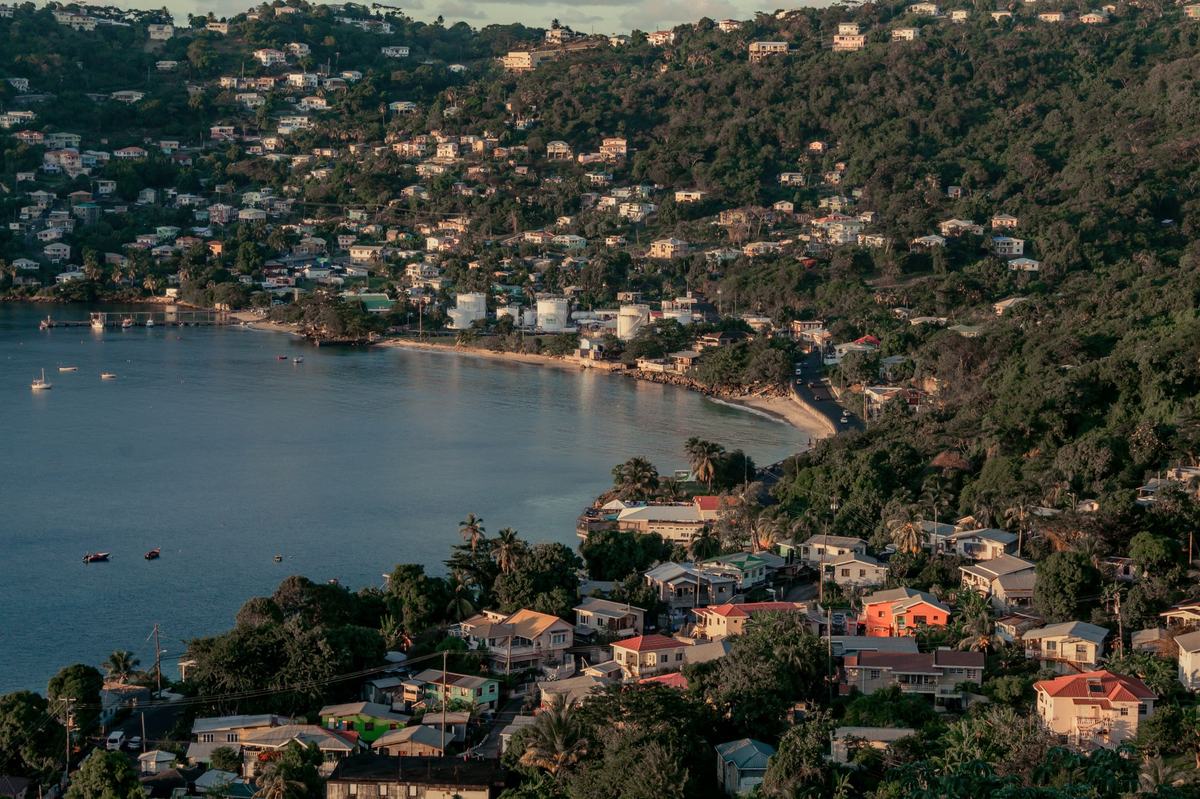
- Capital: St. George's [1]
- Population: about 114,000 [1]
- Area: 344 square kilometers (133 square miles) [1]
- Official language: English [1]
- Currency: East Caribbean Dollar (XCD) [1]
- Produces around 20 percent of the world's nutmeg, making it the second-largest exporter on Earth [2]
I read once that you can smell Grenada before you can see it. Boats coming in from the open Caribbean catch the scent of nutmeg and cinnamon on the wind before the island is even on the horizon. I figured that was the kind of thing travel writers say when they need a sentence with a little drama in it. Turns out it's basically true. Grenada is a country that produces so much nutmeg per square mile that the air actually carries it. The whole place smells faintly like a kitchen in December.
Here's the thing about Grenada. It's tiny. The main island is about twice the size of Washington, D.C., and the country is actually three islands strung together: Grenada itself, plus the smaller Carriacou and Petite Martinique to the north. The total land area is 344 square kilometers, which is smaller than the city of Tucson. About 114,000 people live there. And yet this country, smaller than a mid-sized American county, has had outsized influence on the global spice trade for two centuries, plus one of the strangest stories in Cold War history. I had to look this up twice to make sure I had the population right.
A Flag with a Spice on It
Grenada is one of only a handful of countries with a piece of food on its flag. In the red field on the left side of the flag, there's a stylized yellow nutmeg, split open to show the red mace inside. No other nation puts a spice on its national emblem. Cyprus has an olive branch. Lebanon has a cedar tree. Grenada went ahead and put the actual product on the banner, which tells you most of what you need to know about how the country sees itself.
The nutmeg story is part accident, part empire. Nutmeg is native to the Banda Islands in Indonesia, on the other side of the planet. The Dutch ran a brutal monopoly on the trade for almost two hundred years. In 1843, a British ship carrying nutmeg seedlings stopped in Grenada on the way somewhere else, and a few seeds got planted in volcanic soil. The trees took. By the late 1800s, Grenada was producing serious quantities, and today the country still grows about 20 percent of the world's supply. The industry was nearly wiped out by Hurricane Ivan in 2004, which destroyed roughly 90 percent of the nutmeg trees, but the country has spent two decades replanting and is back near pre-hurricane volumes.
The Underwater Sculpture Park
Off the west coast of Grenada, in Molinere Bay, there's a museum on the sea floor. It's called the Underwater Sculpture Park, and it was created in 2006 by British artist Jason deCaires Taylor. About 75 life-sized cement figures are arranged across the bottom of a protected marine area at depths between 5 and 8 meters. Snorkelers and divers swim among them. Over time, the sculptures have been colonized by coral, sponges, and algae, which was the whole point. The park was designed as artificial reef habitat as much as art.
It was the first underwater sculpture park in the world. Taylor has since built more elsewhere, but Grenada's was the original. National Geographic named it one of the world's 25 wonders. Which, if you think about it, is a strange thing for a country of 114,000 people to have invented. A nation that small does not usually get to define a new category of art and conservation. Grenada did.
The Smallest Country the US Has Ever Invaded
In October 1983, the United States invaded Grenada. The operation was called Urgent Fury. About 7,600 American troops landed on an island where, at the time, fewer than 90,000 people lived. The trigger was a political crisis. Grenada's leftist prime minister, Maurice Bishop, had been overthrown and executed by a more hardline faction within his own party, and the Reagan administration cited concerns about American medical students on the island and a Cuban-built airstrip that looked, to Washington, like a potential Soviet asset.
The fighting lasted a few days. About 19 American servicemen were killed, along with 25 Cubans and 45 Grenadians. The new government was installed, the students flew home unharmed, and Grenada returned to democratic rule. To this day, October 25th is celebrated in Grenada as Thanksgiving Day, in gratitude for the American intervention. Back home in Montana, I grew up vaguely aware of the invasion as a footnote in the Reagan years. In Grenada, it's a national holiday with a parade.
Volcanoes, Waterfalls, and a Crater Lake
Grenada is volcanic, like most of the eastern Caribbean. The interior of the main island is mountainous, covered in rainforest, and cut by waterfalls. Grand Etang Lake sits in the crater of a dormant volcano in the middle of the country, surrounded by national forest. Most visitors stick to the beaches, especially Grand Anse on the southwest coast, which regularly shows up on lists of the best beaches in the Caribbean.
There's also an active underwater volcano off the northern coast called Kick 'em Jenny. It rises from the sea floor about 8 kilometers north of the island and is one of the most active submarine volcanoes in the region. Last significant activity was in 2015. A 1.5-kilometer exclusion zone is enforced around its summit because the gases it releases can sink boats by making the water less dense than the boats are designed for. That is a hazard I had not previously known existed.
Frequently Asked Questions
What is the capital of Grenada?
The capital of Grenada is St. George's, located on the southwest coast of the main island. It has a population of around 38,000 in its urban area. The city wraps around a horseshoe-shaped harbor and is often called one of the prettiest capital cities in the Caribbean.
What language is spoken in Grenada?
The official language is English. Many Grenadians also speak Grenadian Creole English in everyday conversation, and a French-based creole called Patois is still spoken by some older residents, a legacy of French colonial rule before the island passed to Britain in 1783.
Why is Grenada called the Spice Island?
Grenada earned the nickname because of its enormous output of nutmeg, mace, cinnamon, ginger, and cloves relative to its size. The country produces about 20 percent of the world's nutmeg supply, making it the second-largest producer after Indonesia.
Is Grenada safe to visit?
Yes, Grenada is generally considered one of the safer Caribbean destinations for tourists. Violent crime rates are low compared with the regional average. The country has a stable parliamentary democracy and a tourism-dependent economy that prioritizes visitor safety.
What currency does Grenada use?
Grenada uses the East Caribbean Dollar (XCD), which is shared with seven other countries in the Organisation of Eastern Caribbean States. The currency is pegged to the US dollar at a fixed rate of approximately 2.70 XCD to 1 USD, so prices are easy to convert.