- Capital: Guatemala City [1]
- Population: about 18.1 million [1]
- Area: 108,889 square kilometers (42,042 square miles) [1]
- Official language: Spanish, plus 22 recognized Maya languages and 2 other indigenous languages [2]
- Currency: Guatemalan Quetzal (GTQ) [1]
- Home to 37 volcanoes, 3 of which are still active today [3]
I grew up thinking Central America was one long flat strip of jungle between Mexico and South America. Then I started reading about Guatemala and had to redraw the whole region in my head. The country is roughly the size of Tennessee and packs in 37 volcanoes, two oceans, a chunk of the Maya world that is still being excavated, and a capital that sits at 5,000 feet above sea level. Nothing about the place is flat, and nothing about it is simple.
Here's the thing. Guatemala is the most populous country in Central America, with about 18 million people, and more than 40 percent of them are indigenous Maya. That is not a historical footnote. The Maya civilization did not collapse and disappear the way grade-school textbooks used to suggest. It transformed, contracted, survived Spanish conquest and four centuries of upheaval, and is still here. Twenty-two Maya languages are recognized by the Guatemalan government alongside Spanish. Walk through a market in Chichicastenango on a Thursday or Sunday and you are hearing K'iche', spoken by more than a million people, and nobody in that market thinks of it as an ancient language. It is just the language they grew up speaking.
A Country Built on Volcanoes
Guatemala sits on the edge of three tectonic plates, which is why the ground there does a lot of dramatic things. The country has 37 volcanoes in total, stretched along a chain that runs parallel to the Pacific coast. Three of them are currently active: Pacaya, Fuego, and Santiaguito. Fuego is one of the most consistently active volcanoes in the world. It erupts on a near-daily basis and sometimes spectacularly, as in June 2018, when a pyroclastic flow killed more than 200 people in villages on its southern flank.
What surprised me when I dug into this is how casually Guatemalans live alongside the volcanoes. Antigua, the old colonial capital and now one of the most visited cities in Central America, sits in a valley ringed by three of them: Agua, Acatenango, and Fuego. You can stand in Antigua's central plaza and watch Fuego puff smoke. People hike Acatenango overnight to camp at the summit and watch Fuego erupt across the saddle between the two peaks. It is one of the most visceral experiences a tourist can have in the Americas, and it is essentially a regular weekend activity.
Chocolate Was Invented Here
The cacao tree is native to the rainforests of Mesoamerica, and the people who first figured out what to do with it were the Maya and, before them, the Olmec. Guatemala was at the heart of this, and recent archaeological work suggests cacao was being processed into a drink in the region as early as 1900 BCE. The Maya word for the drink was kakaw. The Spanish picked it up, brought it to Europe, and the rest is essentially the entire global chocolate industry.
The Maya did not eat chocolate the way we do. There was no chocolate bar. They mixed ground cacao with chili, achiote, and water, frothed it between two cups poured from height, and drank it bitter and spiced. Cacao beans were also used as currency. There is a colonial-era record of a hundred beans being worth one turkey hen. Walk into a market in Guatemala today and you can still find people drinking spiced hot chocolate the old way, especially in the highlands around Lake Atitlan. It tastes almost nothing like a Hershey bar, which is sort of the point.
The Lake That Scientists Keep Arguing About
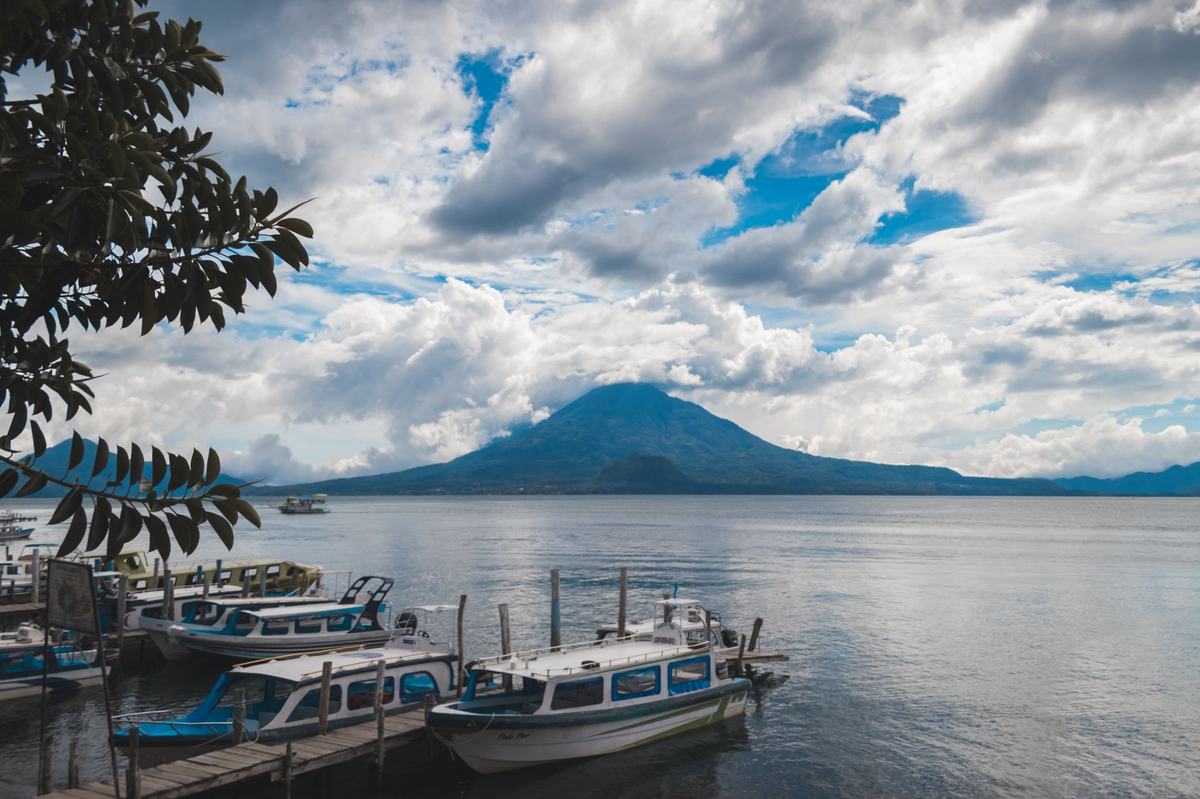
Lake Atitlan, in the western highlands, is a body of water that does not look real. It sits at 5,125 feet above sea level, is ringed by three volcanoes, and the German explorer Alexander von Humboldt called it the most beautiful lake in the world. He had been to a lot of lakes. The lake fills a massive volcanic caldera that was formed by an enormous eruption about 84,000 years ago, an event so violent that it deposited ash as far away as Florida and Ecuador.
Here is what nobody really agrees on. The lake has no visible outlet. Water flows in from rivers and rain, but no river flows out. It has to be draining somewhere, presumably through underground channels in the porous volcanic rock, but the hydrology is still not fully mapped. The lake level also rises and falls in cycles that do not match rainfall, sometimes by several meters over decades. Mayan villages on the shore have had to relocate buildings as the water creeps up. The town of San Pedro La Laguna has a hotel that is now partly submerged. The lake is doing something nobody has fully explained.
Tikal and the Sound of Howler Monkeys
In the northern lowlands of Guatemala, deep in the Peten jungle, sits Tikal. It was one of the largest cities of the Classic Maya period, with a peak population somewhere between 60,000 and 90,000 people around 700 CE. The city covered roughly 16 square kilometers and was the political and cultural center of a kingdom that traded with Teotihuacan, far to the north in central Mexico. Today most of it is still under the trees. The temples that have been excavated rise above the jungle canopy. Temple IV is 70 meters tall, the highest pre-Columbian structure in the Americas.
Tikal is also where, in 1977, the second unit for the original Star Wars film shot the Rebel base in A New Hope, with the Millennium Falcon parked in front of what is actually Temple I. That is a fun fact, but it is not the reason to go. The reason to go is the sound. Howler monkeys live in the canopy, and their call carries for kilometers. Standing on top of Temple IV at dawn, watching the mist burn off the jungle, listening to howlers in the distance, is one of those experiences that makes you understand why people built cities here in the first place.
A National Bird That Cannot Survive Captivity
Guatemala's national bird is the resplendent quetzal, a small, brilliantly colored bird from the trogon family. The males have iridescent green plumage and tail feathers up to a meter long. The Maya considered them sacred. The Aztec did too. Quetzal feathers were more valuable than gold in pre-Columbian Mesoamerica, and only royalty were permitted to wear them.
The bird is also the namesake of the Guatemalan currency, the quetzal, which makes Guatemala one of the few countries to name its money after a bird. And the quetzal, according to lore, will die if kept in a cage. The truth is more complicated. They are extremely difficult to keep in captivity for reasons related to their diet and stress levels, and historically they have rarely survived for long. The legend that they die rather than live in confinement is poetic, and it became a national symbol of Guatemalan independence. The bird appears on the flag.
Frequently Asked Questions
What is the capital of Guatemala?
The capital is Guatemala City, the largest city in Central America with about 3 million people in its metropolitan area. It sits in a valley at roughly 1,500 meters elevation. The city is the political, economic, and cultural center of the country.
What language is spoken in Guatemala?
Spanish is the official language, spoken by most Guatemalans. The country also officially recognizes 22 Maya languages, plus Xinka and Garifuna. K'iche', Q'eqchi', and Kaqchikel are the most widely spoken indigenous languages, each with hundreds of thousands of speakers.
Why is Guatemala called the Land of the Eternal Spring?
The nickname comes from Guatemala's mild, temperate climate in the central highlands, where most major cities sit. Cities like Guatemala City and Antigua hover around 70 degrees Fahrenheit year-round, with little seasonal variation in temperature, just a wet and dry season.
Is Guatemala safe to visit?
Tourist areas like Antigua, Lake Atitlan, and Tikal are generally safe and heavily visited. Some neighborhoods in Guatemala City and certain border regions have higher crime rates, and the US State Department advises caution. Most travelers who stick to main destinations have no problems.
What currency does Guatemala use?
Guatemala uses the Guatemalan Quetzal (GTQ), named after the national bird. The exchange rate has stayed relatively stable, hovering around 7.5 to 8 quetzales per US dollar in recent years. US dollars are accepted in some tourist areas but quetzales are needed almost everywhere else.