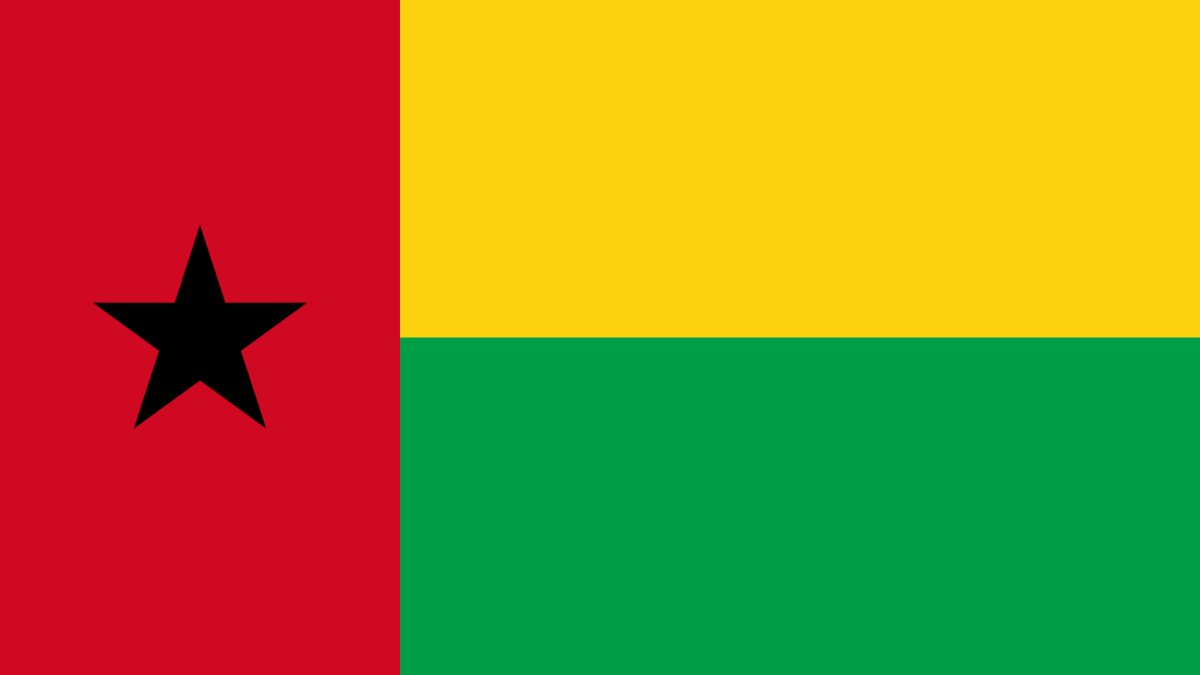
- Capital: Bissau [1]
- Population: about 2.1 million [2]
- Area: 36,125 square kilometers, roughly the size of Maryland [1]
- Official language: Portuguese, with Crioulo widely spoken [1]
- Currency: West African CFA franc (XOF) [3]
- One of the world's top producers of cashew nuts, which account for around 90% of exports [4]
I had to look this up twice. Guinea-Bissau is one of those countries that almost never makes the news, and when it does, the headline rarely sticks. But spend an hour reading about it and you start to feel like you've been missing something. A coastline scattered with 88 islands. A national economy built on a single nut. A capital city named after a river. A history that runs from medieval African kingdoms straight through to one of the longest anti-colonial wars in Africa. For a place so small, Guinea-Bissau carries a lot.
A Country Made of Islands
Look at a map of Guinea-Bissau and the first thing you notice is the coast - it's not really a coast at all. It's a fray. The Bijagós Archipelago sits off the mainland and includes 88 islands and islets, though only about 20 are permanently inhabited [5]. UNESCO designated the whole archipelago a Biosphere Reserve in 1996 because of its mangroves, saltwater hippos, and sea turtles. Yes, saltwater hippos. They live in the brackish channels and swim between islands, which is not something I'd have believed without seeing it written down by people who study them for a living.
The Bijagós people who live there have kept their own language, their own matrilineal traditions, and a system of age-grade initiations that anthropologists have been documenting for decades. Power on many of the islands runs through the women. Sacred forests are off-limits to outsiders. It's the kind of place that feels far older than the country it sits inside.
The Cashew Economy
Here's the thing about Guinea-Bissau's economy: it runs on cashews. Not partially. Almost entirely. Cashew nuts make up roughly 90% of the country's exports, and the cashew harvest sets the rhythm of the whole nation [4]. When the price is good, schools fill, markets buzz, and weddings happen. When the price drops, everything tightens.
The country is one of the world's top producers of raw cashew nuts, sending most of its harvest to India and Vietnam for processing [4]. Which, if you think about it, is a strange arrangement - the nut grows in Guinea-Bissau, gets shipped halfway around the world to be shelled and roasted, then comes back to Europe and America as a snack in a glass jar. The country has been trying for years to process more of its own crop and capture the value that currently goes overseas.
A Long Fight for Independence
Guinea-Bissau was a Portuguese colony for nearly 500 years, which is one of the longest colonial relationships anywhere in Africa. Portugal arrived in the 1450s, set up trading posts along the coast, and the territory became deeply entangled in the transatlantic slave trade.
Independence didn't come quietly. The PAIGC, founded by Amílcar Cabral, fought a guerrilla war against Portuguese forces from 1963 to 1974 [6]. Cabral was assassinated in 1973, just months before victory, but the movement he built declared independence that same year, and Portugal formally recognized it in 1974 after the Carnation Revolution back in Lisbon. Cabral remains one of the most influential African revolutionary thinkers of the 20th century, and his writings still get assigned in political theory courses around the world.
Language: Portuguese, Crioulo, and Everything Else
Portuguese is the official language, but most people don't speak it at home. Guinea-Bissau Creole, or Kriol, is the working language of daily life, markets, music, and politics [1]. It grew out of contact between Portuguese colonizers and West African populations, and it's now spoken by the majority of the country as a first or second language.
Beyond Crioulo, you'll hear Balanta, Fula, Mandinka, Manjaco, Papel, and a dozen others depending on the region. Walking through a market in Bissau, you'd hear three or four languages in a single transaction. Back home in Montana, the closest comparison I can offer is the way people switch between English and ranch-radio shorthand, except here the switches are between fully separate languages and they happen every couple of sentences.
Music That Travels Further Than the Country
For a country of two million people, Guinea-Bissau punches surprisingly hard in music. The national genre is gumbe, a polyrhythmic style that blends traditional Bijagós rhythms with Crioulo lyrics and Portuguese harmonic influence. Artists like Manecas Costa have toured Europe and recorded with British producers, and the gumbe sound shows up in playlists labeled "Lusophone Africa" alongside music from Cape Verde and Angola.
In Bissau, you'll hear it spilling out of taxis and beach bars. The lyrics often deal with political life, daily struggle, and pride in Crioulo identity. It's one of those musical traditions that hasn't fully gone global yet, which is part of what makes it feel alive.
A Quiet, Complicated Politics
Guinea-Bissau has had a turbulent political history since independence. Coups, attempted coups, and the brief but deadly civil war of 1998-1999 have all shaped the country [6]. International observers have at various points described it as a "narco-state" because of its location along cocaine trafficking routes between South America and Europe, though efforts to push back against that have made progress in recent years.
But none of that quite captures what daily life feels like there, by all accounts of people who've spent time on the ground. Bissau is a small, walkable capital. The Portuguese colonial architecture is faded and beautiful. The food leans on rice, fish, palm oil, and peanut sauce. People are warm, religious life is mixed between Islam, Christianity, and traditional animist practices, and the pace of things is slow in a way that makes Americans either restless or grateful.
Frequently Asked Questions
What is Guinea-Bissau known for?
Guinea-Bissau is known for being one of the world's top producers of cashew nuts and for the Bijagós Archipelago, a UNESCO Biosphere Reserve of 88 islands off its coast. It's also recognized for its long anti-colonial struggle led by Amílcar Cabral, who remains an influential African political thinker.
What language do they speak in Guinea-Bissau?
Portuguese is the official language, inherited from nearly 500 years of Portuguese colonial rule. However, most people speak Guinea-Bissau Creole, or Kriol, as their everyday language. Other widely spoken languages include Balanta, Fula, and Mandinka.
Is Guinea-Bissau the same as Guinea?
No. Guinea-Bissau and Guinea are two separate countries that share a border. Guinea-Bissau was colonized by Portugal, while neighboring Guinea was colonized by France. The "Bissau" was added to distinguish it from its larger neighbor and refers to the country's capital city.
What currency does Guinea-Bissau use?
Guinea-Bissau uses the West African CFA franc (XOF), the same currency shared by seven other West African countries in the WAEMU economic union. The country adopted the CFA franc in 1997, replacing the Guinea-Bissau peso.
Is Guinea-Bissau safe to visit?
Guinea-Bissau is one of the less-visited countries in West Africa, and travel requires preparation. Bissau and the Bijagós Islands are generally calm for tourists, but political instability has flared up in the past. Travelers should check current advisories from their home country's foreign ministry before going.