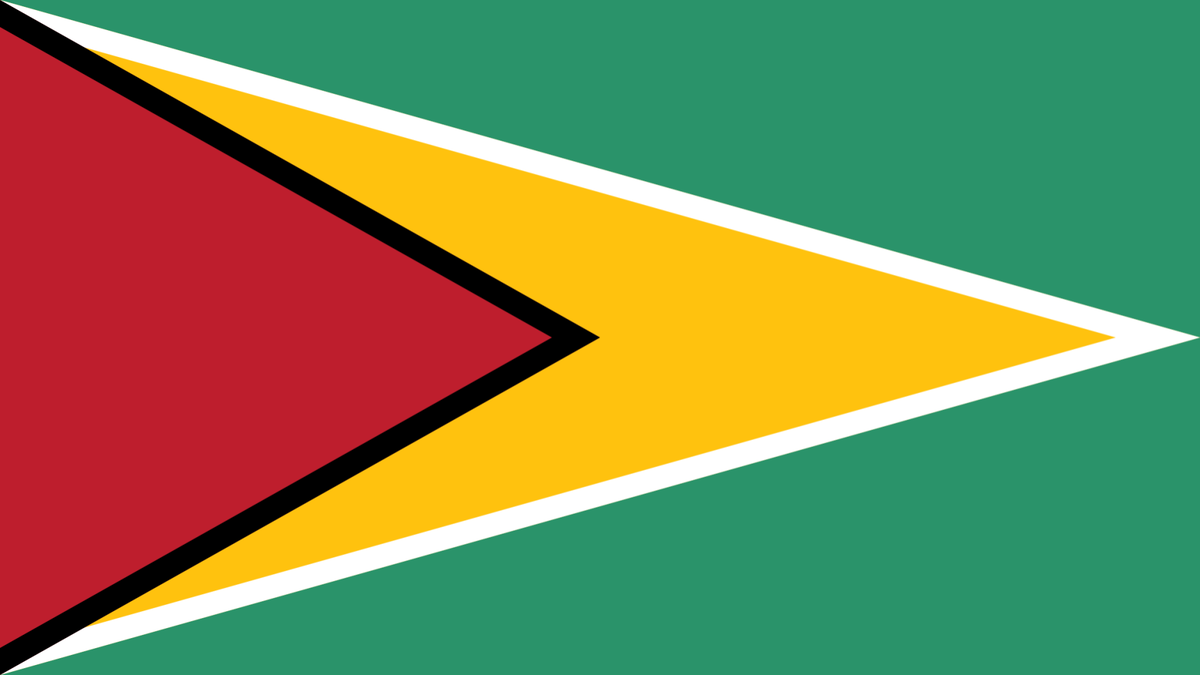
- Capital: Georgetown [1]
- Population: about 826,000 [2]
- Area: 214,969 square kilometers (83,000 square miles) [1]
- Official language: English [1]
- Currency: Guyanese dollar (GYD)
- Distinguishing claim: the only English-speaking country in South America, and home to Kaieteur Falls, one of the most powerful single-drop waterfalls on Earth [3]
I had to look this up twice. Guyana is in South America, but it does not speak Spanish or Portuguese. It speaks English. Most people I have asked guess it is in Africa, or somewhere in the Caribbean, or maybe a misspelling of Ghana. Turns out it sits right on the northern shoulder of South America, between Venezuela and Suriname, with the Atlantic on one side and the Amazon rainforest pressing in from the other. And almost nothing about it fits the picture most Americans have of "South America".
A Country That Looks More Caribbean Than Continental
If you flew into Georgetown without checking a map, you might think you had landed in Barbados. The food is curry and roti and pepperpot. The accent is closer to Trinidadian than anything you would hear in Lima. People listen to soca and chutney music. Cricket is the national sport, and a good Test match can shut down the workday.
The reason is history. Guyana was a British colony until 1966, and before that it changed hands between the Dutch and the British several times. The colonial economy ran on sugar plantations, and when slavery was abolished, the British brought in indentured laborers from India to keep the cane fields running. That migration shaped the country. Today roughly 40 percent of Guyanese trace their roots to India, and about 30 percent to Africa, with smaller populations of Indigenous peoples, Chinese, and Portuguese descendants [2]. It is one of the most ethnically layered countries in the Americas, and the cultural fingerprint shows up everywhere - in the cooking, the festivals, the music, the politics.
Kaieteur Falls Is the One Almost Nobody Talks About
Niagara Falls is famous. Iguazu is famous. Angel Falls in Venezuela is famous. And then there is Kaieteur, deep in the rainforest of central Guyana, which is taller than all of them in a single uninterrupted drop. Water falls 226 meters (741 feet) straight down a sandstone cliff into a gorge below [3]. That is about four times the height of Niagara, falling all at once.
What gets me is the setting. There are no tour buses. No railings, really. No fences. You can stand at the edge of the cliff and watch the river vanish into mist below your feet. The closest thing I have stood next to back home is the rim of the Grand Canyon, and even that has guardrails. Kaieteur sits inside a national park of the same name, surrounded by some of the oldest, most intact rainforest on the planet.
Most of Guyana Is Forest
About 85 percent of the country is forested [4]. Roughly 90 percent of the population lives on a narrow strip of coast, which means the interior is one of the least densely populated places in the world. Jaguars, harpy eagles, giant otters, capybaras, and a population of black caimans that grow over 13 feet long all live there. The Rupununi savannahs in the south support cattle ranches that feel like a tropical version of Montana - long horizons, dust, horses, very few people.
Guyana also shares a piece of the Guiana Shield, one of the oldest pieces of continental crust on Earth. The rock under those rainforests is around 1.7 billion years old. Most of the country drains through three major rivers: the Essequibo, the Demerara, and the Berbice. The Essequibo is the third largest river in South America after the Amazon and the Orinoco.
A Country Whose Economy Just Changed Overnight
Here is the thing nobody saw coming. In 2015, ExxonMobil announced a massive offshore oil discovery in Guyanese waters. By 2020 the country was pumping crude. By the mid-2020s, Guyana had become one of the fastest-growing economies in the world, with GDP expanding by double digits every year [5]. For a country of fewer than a million people, the scale is hard to process.
Which, if you think about it, creates a complicated picture. Guyana spent most of its independent history as one of the poorer countries in South America. Now it is suddenly flush. Roads are being built. Hospitals are being expanded. There is also a heated border dispute with Venezuela over the Essequibo region, which Venezuela claims and which happens to sit on top of much of the oil. How the country handles all of this, especially environmentally, will define the next generation.
Frequently Asked Questions
Is Guyana in South America or the Caribbean?
Guyana is geographically in South America, on the continent's northern Atlantic coast. Culturally and politically it is part of the Caribbean and a full member of CARICOM. The dual identity comes from its British colonial history and its ethnic ties to the Caribbean diaspora.
What language do they speak in Guyana?
English is the official language of Guyana, the only South American country where that is true. Most Guyanese also speak Guyanese Creole in everyday conversation, and you will hear Hindi, Urdu, and Indigenous languages like Akawaio in different communities.
Is Guyana safe to visit?
Guyana is generally safe for travelers who stick to organized tours and the main tourist areas like Kaieteur National Park and the Rupununi. Georgetown has higher crime rates and requires basic urban caution, especially at night. Check current State Department advisories before traveling.
Why is Guyana suddenly so rich?
Guyana's economy boomed after ExxonMobil discovered huge offshore oil reserves in 2015. Production started in 2019, and by the 2020s Guyana had become one of the fastest-growing economies in the world, with output projected to keep climbing for years.