- Capital: Budapest [1]
- Population: about 9.6 million [2]
- Area: 93,030 square kilometers (a bit smaller than Indiana) [1]
- Official language: Hungarian (Magyar), unrelated to any of its neighbors' languages [3]
- Currency: Hungarian forint (HUF) [1]
- Distinguishing claim: more than 1,500 thermal springs nationwide, with 123 in Budapest alone [4]
Here's something that'll ruin the next geography quiz you take: Hungarian is not related to Polish, German, Romanian, or any other language spoken by Hungary's neighbors. It belongs to the Uralic family, alongside Finnish and Estonian, both of which are spoken about a thousand miles to the north. The Hungarian-speaking ancestors arrived in the Carpathian Basin around 895 CE from somewhere east of the Ural Mountains, and they brought their language with them. They've kept it more or less intact for eleven centuries, surrounded on every side by languages that sound nothing like it. I had to look this up twice, because it doesn't quite make geographic sense until you read the history.
A Language Built Different
Hungarian has 14 vowels and 18 grammatical cases. English has, depending on how you count, between zero and three cases (one if you count the genitive 's, three if you're generous). Hungarian glues suffixes onto words instead of using prepositions, so "in my house" comes out as one word: "házamban". The language has separate verb endings depending on whether the object of the sentence is definite or indefinite. There's no grammatical gender at all. He, she, and it are all the same word ("ő"), which means Hungarians learning English have to consciously remember to pick a pronoun, while English speakers learning Hungarian have to memorize tables that look like spreadsheet errors [3].
Linguists love Hungarian because it's a puzzle. Tourists love Hungarian because not knowing a single word of it doesn't really matter in Budapest, where almost everyone under 40 speaks decent English. But you should learn to say "köszönöm" (thank you) before you go. It's worth it just to watch someone's face light up when you try.
Budapest, the City of Two Cities
Budapest is what happens when two old cities decide to stop being separate. Buda sits on the hilly west bank of the Danube, all winding medieval streets and castle walls. Pest sprawls flat on the east bank, with the grand boulevards, the cafes, the parliament building, and the nightlife. They were officially merged in 1873, along with Óbuda (Old Buda), which had been a Roman town called Aquincum back in the day [5]. The Romans had a settlement here in the second century AD because they wanted the thermal springs. Eighteen hundred years later, we still want the thermal springs.
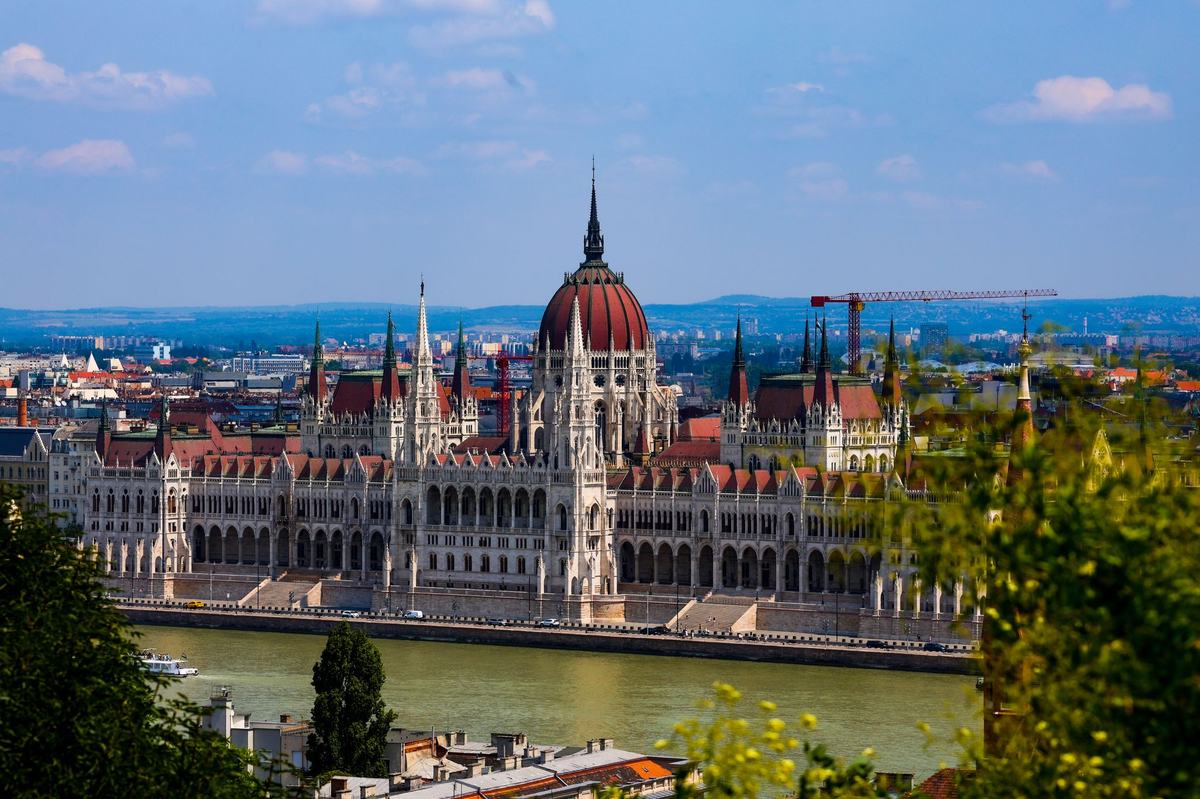
The Hungarian Parliament Building, which stretches along the Pest side of the Danube, was finished in 1902. It's the third-largest parliament building in the world, with 691 rooms and a dome modeled on the Houses of Parliament in London. It cost so much to build that Hungary was still paying it off decades later [1]. At night, lit up and reflected in the river, it looks like a wedding cake the size of a city block.
Thermal Baths and a Country Sitting on Hot Water
Hungary is, depending on how you measure it, one of the most thermally active countries on Earth that isn't on a major fault line. There are over 1,500 thermal springs nationally, and Budapest is built on top of an estimated 123 of them. The Romans bathed here. The Ottomans, who occupied Hungary from 1541 to 1686, built proper Turkish baths, some of which (Rudas, Király) are still operating today [4].
The Széchenyi Baths in Budapest are the largest thermal bath complex in Europe. The Gellért is the most beautiful, all Art Nouveau tile and stained glass. Locals play chess at outdoor tables in the steaming water in the middle of January, breath fogging in the cold air. It's one of those scenes that explains a culture better than any guidebook. Back home in Montana, the closest thing we have is a hot springs pool with a wooden deck. Here it's an institution.
Inventors Who Changed Daily Life
Hungary punches far above its weight in inventors and Nobel laureates. The country has produced 13 Nobel Prize winners despite never having had a population over 10 million [6]. Most of them did their major work elsewhere, but they grew up speaking Hungarian and going to Hungarian schools.
The ballpoint pen was invented by László Bíró, a Hungarian journalist who was tired of his fountain pen smudging his notes. He patented it in the late 1930s, fled Europe during the war, and eventually licensed the design to Bic. In the UK, people still call a ballpoint pen a "biro" without knowing the word is a man's last name [7].
The Rubik's Cube was invented in 1974 by Ernő Rubik, an architecture professor in Budapest, originally as a teaching tool for spatial reasoning. He had to take it apart himself the first time he scrambled it, because he hadn't figured out how to solve it yet. The cube has since sold more than 450 million units, making it one of the best-selling toys ever made [7]. And nobody talks about this, but the holography technique that won Dennis Gabor the 1971 Nobel Prize in Physics, the vitamin C work by Albert Szent-Györgyi, the early thinking behind nuclear chain reactions by Leó Szilárd: all Hungarian. Computer science owes a lot to John von Neumann, who was born in Budapest and went on to design the architecture that almost every computer in the world still uses [6].
Food: Paprika, Goulash, and Things That Aren't Goulash
The single ingredient that defines Hungarian cooking is paprika, the ground red powder made from peppers that arrived in Europe from the Americas in the 16th century. Hungarians took to it harder than anyone else and built a national cuisine around it. The peppers are grown mainly around Szeged and Kalocsa, the two paprika capitals, and there are eight official grades from "special" sweet to fiery hot [8].
Goulash, the dish everyone outside Hungary thinks they know, is actually a soup in Hungary, not a stew. The thick beef-and-noodle dish served as "goulash" abroad is closer to pörkölt, which Hungarians eat without confusion. The real gulyás is brothy, paprika-red, full of beef and potatoes, and traditionally cooked outdoors in a kettle over an open fire by shepherds. The word "gulyás" comes from "gulya", meaning a herd of cattle [8].
Then there's Tokaji Aszú, the sweet wine from the Tokaj region in the northeast, which Louis XIV called "the wine of kings and the king of wines". It was the first wine region in the world to be classified by official decree, in 1737, which is more than a century before Bordeaux got around to it [8].
Frequently Asked Questions
What is Hungary famous for?
Hungary is famous for Budapest's thermal baths and Parliament building, the Hungarian language (unrelated to its neighbors'), paprika and goulash, Tokaji wine, and inventions including the Rubik's Cube and the ballpoint pen. The country has also produced 13 Nobel laureates.
Is Hungarian one of the hardest languages to learn?
Yes, Hungarian is widely ranked among the hardest languages for English speakers to learn. It has 14 vowels, 18 grammatical cases, no grammatical gender, and almost no shared vocabulary with English or other European languages. The US Foreign Service Institute classifies it as a Category IV language, requiring around 1,100 class hours.
Is Hungary expensive to visit?
Hungary is one of the more affordable destinations in the European Union. Budapest is cheaper than Vienna, Prague, or Berlin for food, transit, and accommodation. A meal at a casual restaurant runs roughly 3,000 to 5,000 forint (about 8 to 14 US dollars), and public transport in Budapest is among the cheapest in Europe.
Does Hungary use the euro?
No, Hungary does not use the euro. The official currency is the Hungarian forint (HUF), even though Hungary has been a European Union member since 2004. The country is technically obligated to adopt the euro eventually but has not set a target date.
Sources
- CIA World Factbook: Hungary
- Hungarian Central Statistical Office
- Encyclopaedia Britannica: Hungarian Language
- Hungarian Tourism Agency: Thermal Baths
- UNESCO World Heritage Centre: Budapest, including the Banks of the Danube
- The Nobel Prize: Nobel Laureates and Country of Birth
- Encyclopaedia Britannica: László Bíró
- Hungarian Tourism Agency: Gastronomy