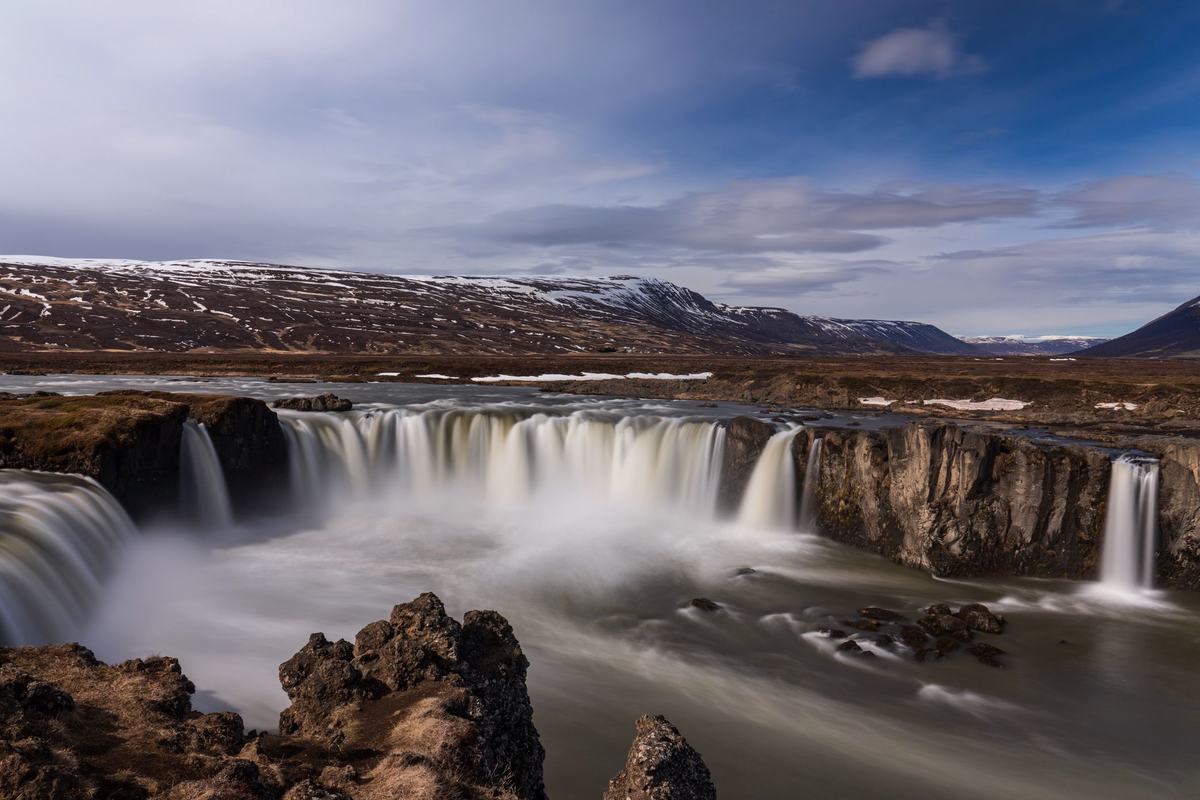
- Capital: Reykjavík, the world's northernmost capital of an independent state [1]
- Population: approximately 387,000 (2024), smaller than Wichita, Kansas [2]
- Area: 103,000 square kilometers, about the size of Kentucky [1]
- Official language: Icelandic, a North Germanic language closer to Old Norse than any other living tongue [3]
- Currency: Icelandic króna (ISK) [1]
- Distinguishing claim: roughly 85% of household energy comes from renewable geothermal and hydropower sources, the highest share in the world [4]
I grew up thinking volcanoes were rare. Like, you have to fly to Hawaii or Indonesia to see one rare. Then I read that Iceland sits right on top of a seam where two tectonic plates are pulling apart, and the country has around 130 volcanoes, 30 of which are still active. I had to look this up twice. A nation of 387,000 people lives on what is essentially the lid of a slow-cooking pot, and they've figured out how to plug into it for hot water, electricity, and even greenhouse tomatoes in January.
That last bit was what really got me. Back home in Montana, January is a month you survive. In Iceland, January is a month where they grow bananas indoors using free volcanic heat. Same latitude, completely different relationship with winter.
A Country Built on Fire
Iceland sits on the Mid-Atlantic Ridge, the underwater mountain range where the North American and Eurasian plates are slowly drifting apart at about two centimeters a year. That's the speed your fingernails grow. The island is one of the only places on Earth where you can stand on the boundary between two continents and watch it happening above the waterline. At Þingvellir National Park, there's a rift valley where the plates have pulled the ground apart so visibly that you can walk down into the gap.
The volcanic activity isn't theoretical, either. In 2010, Eyjafjallajökull erupted and grounded European air traffic for a week. In 2021, a fissure opened up near Reykjavík and started a Hollywood-style lava show that ran for six months. The Reykjanes Peninsula has been erupting on and off since 2023, with new fissures opening so close to the town of Grindavík that residents had to be evacuated multiple times. Turns out, living on a tectonic seam is less of a hazard and more of a feature most of the time. The country runs on it.
Roughly 85% of Iceland's total energy comes from renewable sources. Most homes are heated by piping naturally hot water directly out of the ground. Reykjavík has been doing this since 1930. If you visit, the tap water smells faintly like sulfur because it actually is geothermal. Cold tap water, on the other hand, is some of the purest in the world. Two different pipes, two different geological gifts.
A Country Built on Ice
About 10% of Iceland's surface is covered in glaciers. Vatnajökull, in the southeast, is the largest glacier in Europe by volume. It's so big that it has its own subsystem of volcanoes underneath it, which is exactly as strange as it sounds. When one of those subglacial volcanoes erupts, the meltwater can produce a flood called a jökulhlaup. The 1996 jökulhlaup from beneath Vatnajökull released as much water in a few hours as the Amazon River does in a single day.
The glaciers are also retreating. In 2014, Iceland declared a small glacier called Okjökull officially "dead" - no longer thick enough to move under its own weight, which is the technical definition of being a glacier. A plaque was placed at the site in 2019 with a letter to the future, written by Icelandic author Andri Snær Magnason. It's the first such memorial for a glacier anywhere in the world. The plaque says the next 200 years will determine whether the rest follow.
The Oldest Parliament Still Running
Here's something that'll ruin the next geography quiz you take: the world's oldest still-functioning parliament was founded in Iceland in 930 AD. It's called the Alþingi, and it met for the first time at Þingvellir, the same rift valley where the tectonic plates are pulling apart. Imagine the founders gathering at a place that was, quite literally, splitting in half. They picked the spot because the cliff acted as a natural amphitheater, and you could hear a speaker from far away.
The Alþingi has had some interruptions. It went dormant for a stretch in the 1800s under Danish rule. But the institutional thread, the name, the role, the location for centuries, makes it the longest-running parliamentary body on Earth. The current building sits in downtown Reykjavík, and the country's prime minister works in a small white house across the square that looks like it could be a Montana dentist's office.
Names Like the Vikings Used
Most Icelanders don't have family surnames. They use patronymics, the same system the Vikings used. If a man named Jón has a son named Magnús, Magnús's last name is Jónsson, meaning "Jón's son". His daughter Anna would be Jónsdóttir, "Jón's daughter". Their kids would then carry Magnúsdóttir or Magnússon as their last names. The "family tree" resets every generation, and there are no shared surnames in the way Americans think of them.
This causes some logistical quirks. The Icelandic phone book is sorted by first name. Two people with the same first name might be distinguished by their job or their parents. When the Icelandic football team beat England in 2016, English commentators kept trying to put the team in alphabetical order by last name, which doesn't really work when half the squad's last name ends in -son.
There's also a strict committee, the Icelandic Naming Committee, which has to approve names that don't already exist on the official register. The committee was set up to protect Icelandic grammar - every name has to be conjugatable in the country's complex case system. A few parents have lost public fights over names like "Harriet" because it couldn't be properly declined in Icelandic.
More Books Per Person Than Anywhere
And nobody talks about this, but Icelanders publish and read more books per capita than any country on Earth. The phrase you'll hear is "Að ganga með bók í maganum", which translates to "Everyone gives birth to a book". One in ten Icelanders is estimated to publish a book in their lifetime. The country has a Christmas tradition called Jólabókaflóð, the "Christmas Book Flood", where everyone exchanges books on Christmas Eve and then spends the night reading them with hot chocolate.
This makes sense when you think about the geography. Long, dark winters. A literate Norse tradition stretching back to the medieval Icelandic sagas, which are among the oldest prose narratives in European literature. A culture that, when you cut it off from outside influences for centuries, kept polishing its own stories. Halldór Laxness, the Icelandic novelist, won the Nobel Prize for Literature in 1955. A country of about 150,000 people at the time produced a Nobel laureate. Per capita, that's like the United States producing 600 of them.
A Few More Things Worth Knowing
The Icelandic language has been preserved with unusual care. Icelanders can still read the medieval sagas in something close to their original form. When new technology arrives, the language committee invents Icelandic words for it rather than borrowing English. "Computer" is "tölva", a portmanteau of "tala" (number) and "völva" (a Norse prophetess). The word literally means "number prophetess". I think that's the best translation of "computer" any language has come up with.
Iceland has no army. It joined NATO in 1949 anyway, and the United States kept a base there until 2006. National defense is essentially a coast guard and a friendly geopolitical neighborhood. There are also no mosquitoes in Iceland. Not zero biting insects - there are midges - but no mosquitoes anywhere on the island. Scientists aren't fully sure why, though theories involve the unusual freeze-thaw cycle that prevents larvae from completing their life cycle.
Beer was illegal in Iceland until March 1, 1989. Wine and spirits were fine, but full-strength beer was banned for most of the 20th century, the lingering aftermath of a 1915 prohibition vote. The country now celebrates "Beer Day" every March 1st. Which, if you think about it, is the kind of holiday that only makes sense if you remember what it replaced.
Frequently Asked Questions
Is Iceland a country or part of another country?
Iceland is an independent country. It became fully sovereign in 1918 and severed its last constitutional ties with Denmark in 1944, becoming a republic. It is a member of NATO, the European Free Trade Association, and the Schengen Area, but it is not a member of the European Union.
Why is Iceland so green and Greenland so icy?
The popular story is that Erik the Red named Greenland to attract settlers and that Iceland was named to discourage them. The real picture is more nuanced: Iceland's coastlines are genuinely lush in summer thanks to the Gulf Stream, while Greenland is much closer to the Arctic and 80% ice-covered.
What language do they speak in Iceland?
The official language is Icelandic, a North Germanic language with deep roots in Old Norse. It has changed very little over the past thousand years, so modern Icelanders can still read the medieval sagas in their original form. English is also widely spoken, especially in Reykjavík and the tourism sector.
Is Iceland expensive to visit?
Yes. Iceland is consistently ranked among the most expensive countries in the world for travelers, due to high import costs, a strong króna, and a small domestic market. Food, drinks, and accommodation are notably pricier than in most of Europe. Camping and shared housing can lower costs significantly.
Can you see the Northern Lights in Iceland?
Yes, from roughly September through April, when the nights are dark enough. The Aurora Borealis is visible whenever solar activity and clear skies align. Late autumn and winter offer the highest chance of seeing them, especially outside Reykjavík's light pollution. Iceland's Met Office publishes a daily aurora forecast.