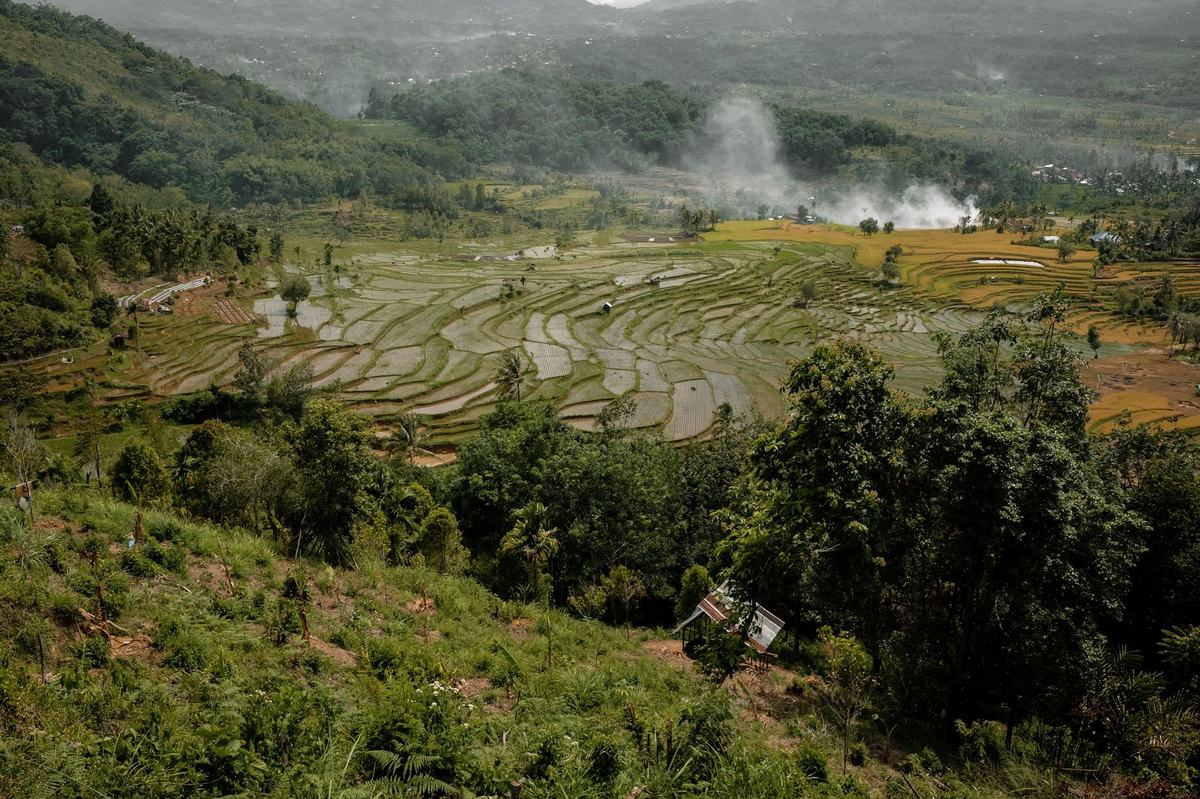
- Capital: Jakarta (with Nusantara being built as the new capital in Borneo) [1]
- Population: roughly 281 million, the fourth-most populous country on Earth [2]
- Area: about 1.9 million square kilometers of land, spread across more than 17,000 islands [1]
- Official language: Indonesian (Bahasa Indonesia), but over 700 living languages are spoken across the country [3]
- Currency: Indonesian rupiah (IDR)
- Distinguishing claim: home to the world's third-largest tropical rainforest, after the Amazon and the Congo [4]
I used to think of Indonesia as Bali. Just Bali, basically, with maybe a vague sense that there was more out there somewhere. Then I pulled up a map of the country one night and realized it stretches farther east-to-west than the continental United States. If you laid Indonesia over a map of North America, it would reach from Oregon to Bermuda. I had to look this up twice.
A Country Built from Islands
Indonesia is the largest archipelago on the planet. The official count sits at 17,508 islands, though only about 6,000 of them are inhabited [1]. The country is so spread out that it crosses three time zones, and the easternmost island, Papua, is in the morning while Sumatra in the west is still finishing breakfast.
The water-to-land ratio is wild. Indonesia's maritime territory is roughly three times larger than its land territory, which means most of what the country actually governs is ocean. Some islands are big enough to hold their own ecosystems, languages, and political histories. Others are sandbars with a coconut tree.
Sumatra, Java, Borneo (which Indonesia shares with Malaysia and Brunei), Sulawesi, and Papua are the five giants. Java alone holds more than half the country's population on just seven percent of its land area. Back home in Montana, you can drive for hours without passing another car. In Java, you can't go fifty feet without seeing another person. Different planet.
More Languages Than You'd Believe
Here's something that'll ruin the next geography quiz you take: Indonesia has over 700 living languages [3]. That's not dialects. Separate, distinct languages, many of them mutually unintelligible. Papua New Guinea is the only country in the world with more.
The national language, Bahasa Indonesia, is essentially a standardized form of Malay that was chosen specifically because it was nobody's native tongue. The thinking went that no ethnic group could feel privileged over another if everyone had to learn the official language equally. Which, if you think about it, is one of the smartest pieces of nation-building in modern history.
Roughly 270 million people now speak Indonesian, but most of them learned it as a second language. Their first is something like Javanese, Sundanese, Madurese, or Minangkabau, and that's just on Java and Sumatra. Once you get to Papua, you find languages that are still being documented for the first time by linguists.
Volcanoes Everywhere
Indonesia sits squarely on the Pacific Ring of Fire, and the country has about 130 active volcanoes - more than any other nation on Earth [5]. The most famous is Krakatoa, which erupted in 1883 with a blast so loud it was heard 3,000 miles away in Australia and even on islands in the Indian Ocean. The shockwave traveled around the globe seven times.
But Krakatoa wasn't even the biggest. Mount Tambora, on the island of Sumbawa, erupted in 1815 with such force that the volcanic ash caused a "year without a summer" in 1816. Crops failed across Europe and North America. Snow fell in June in New England. Mary Shelley, stuck indoors during the unusually cold summer in Switzerland, wrote Frankenstein. A single Indonesian volcano nudged Western literature into the Gothic.
Mount Merapi, near Yogyakarta, is still one of the most active volcanoes in the world. It erupts on average every two to five years. People farm on its slopes anyway, because the volcanic soil is some of the most fertile on Earth.
Komodo Dragons and the Wallace Line
Indonesia is the only place on Earth where you can find a wild Komodo dragon - the largest living lizard, growing up to 10 feet long and weighing as much as a grown man [6]. They live on a handful of islands in the country's center, mostly Komodo and Rinca, and they hunt by ambush. Their saliva contains a cocktail of bacteria and mild venom that helps bring down prey much larger than themselves.
But the deeper biological story is something called the Wallace Line. In the mid-1800s, the British naturalist Alfred Russel Wallace noticed that the animals on the western Indonesian islands (Sumatra, Java, Bali) looked Asian - tigers, rhinos, monkeys - while the animals just a short hop east (Lombok, Sulawesi, the rest) looked Australian - marsupials, cockatoos, weird stuff. The line runs between Bali and Lombok, two islands you can see from each other on a clear day, and yet the species on either side evolved in complete isolation for millions of years.
Wallace independently came up with the theory of evolution by natural selection at almost the same time Darwin did, and a lot of his thinking happened while sailing through Indonesia. The country basically gave us evolutionary biology. Nobody talks about this, but they should.
Food That Tells the Country's Story
Indonesian food is one of the great unrecognized cuisines of the world. Nasi goreng, rendang, satay, gado-gado - dishes that show up on traveler bucket lists once people actually try them. Rendang, a slow-cooked beef dish from West Sumatra, was voted the world's most delicious food by CNN readers in 2011 and again in 2017 [7].
The spice trade is the reason Indonesia exists in something like its current form. Nutmeg, cloves, and mace originally came from the Banda Islands and the Maluku Islands - places so remote that for centuries, Europeans had no idea where their spices were actually coming from. Once the Dutch figured it out in the 1600s, they spent the next 300 years controlling the islands with brutal force. The entire colonial history of Southeast Asia turns on a few small islands you've probably never heard of.
Modern Indonesian cooking still leans hard on those spices. The country also produces about a third of the world's nutmeg and remains a top exporter of cloves and cinnamon.
A New Capital Rising in the Jungle
Jakarta, the current capital, is sinking. Parts of the city drop by as much as ten inches a year because of groundwater extraction, and roughly 40 percent of it now sits below sea level [8]. Combined with rising oceans, the situation is bad enough that the government decided to do something nobody's really done before: move the capital.
The new capital, called Nusantara, is being built from scratch in the jungle of East Kalimantan on the island of Borneo. The plan is to have a fully functional government city by 2045, designed as a "smart forest city" with most of its area kept as protected rainforest. It's an extraordinary gamble. Whether it works or not, it's one of the largest planned urban projects in human history.
Frequently Asked Questions
How many islands does Indonesia have?
Indonesia has 17,508 islands, of which about 6,000 are inhabited. It is the largest archipelagic country in the world and stretches across more than 5,000 kilometers from east to west. Only around half of the islands have been officially named.
What language do people speak in Indonesia?
The official language is Indonesian (Bahasa Indonesia), spoken by about 270 million people. However, over 700 living languages exist across the country. Most Indonesians speak a regional language at home, like Javanese or Sundanese, and use Indonesian for school, work, and government.
Is Indonesia the same as Bali?
No. Bali is one of more than 17,000 Indonesian islands, and it is much smaller than most people realize. The country also includes Java, Sumatra, Borneo, Sulawesi, and Papua. Bali makes up less than one percent of Indonesia's land area.
Why is Indonesia moving its capital?
Jakarta is sinking due to excessive groundwater extraction and rising sea levels, with parts of the city dropping up to ten inches per year. The new capital, Nusantara, is being built in East Kalimantan on Borneo and is planned to be fully operational by 2045.
What is the population of Indonesia?
Indonesia has a population of roughly 281 million people, making it the fourth-most populous country in the world after India, China, and the United States. More than half of all Indonesians live on Java, the country's most densely populated island.
Sources
- Indonesia - The World Factbook (CIA)
- Indonesia Population - World Bank Data
- Indonesia - Ethnologue Languages of the World
- Indonesia Forests - World Wildlife Fund
- Volcanoes of Indonesia - Smithsonian Global Volcanism Program
- Komodo Dragon - National Geographic
- World's 50 Best Foods - CNN Travel
- Indonesia's New Capital Nusantara - Reuters