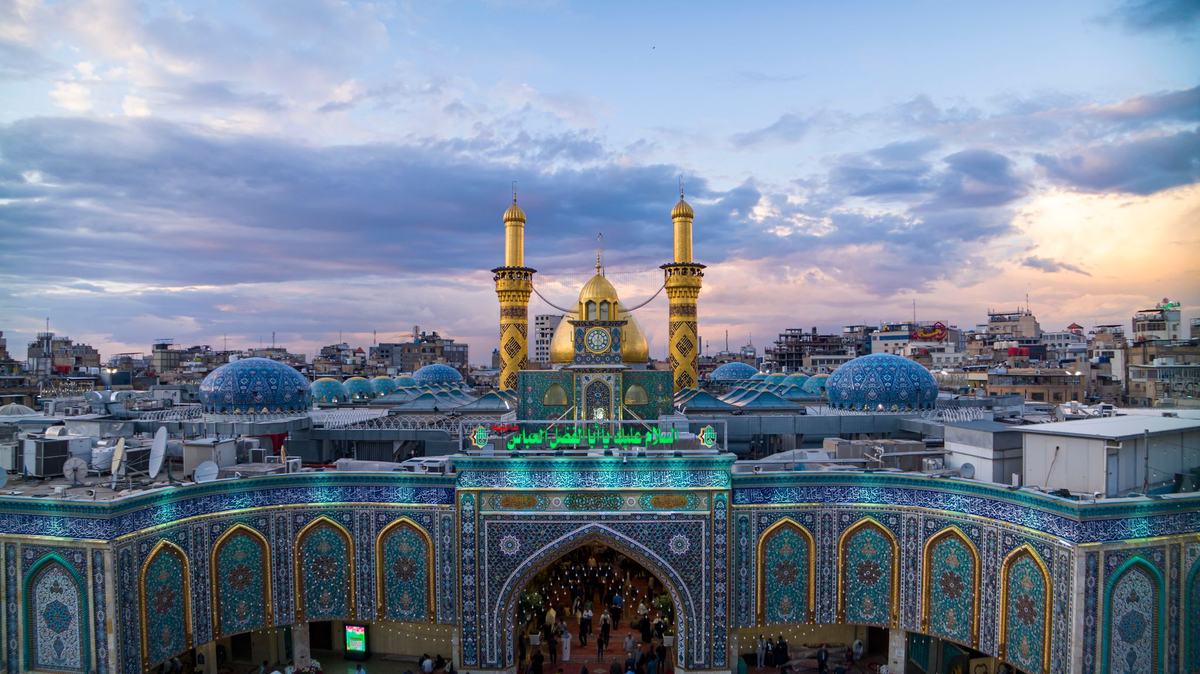
- Capital: Baghdad [1]
- Population: roughly 46 million, the 36th most populous country in the world [2]
- Area: about 438,000 square kilometers, slightly larger than the state of California [1]
- Official languages: Arabic and Kurdish [1]
- Currency: Iraqi dinar (IQD)
- Distinguishing claim: home to ancient Mesopotamia, where humans invented writing, the wheel, and the first cities more than 5,000 years ago [3]
Here's something that'll ruin the next geography quiz you take: pretty much every basic feature of modern life - written language, cities, the 60-minute hour, the legal contract, the recipe, even beer - was first put together by people living on the land we now call Iraq. The headlines of the past few decades have flattened the country into a single story, but the ground underneath those headlines is the oldest continuously occupied real estate in human history. Back home in Montana we have towns that brag about being a hundred and fifty years old. The Iraqis have been doing urban planning for fifty centuries.
The Land Between Two Rivers
Iraq sits in a region the ancient Greeks called Mesopotamia, which translates to "the land between the rivers" [3]. The two rivers in question are the Tigris and the Euphrates, and the wedge of land between them is some of the most fertile dirt on Earth. Most of the country is desert or semi-arid plain, but that ribbon of river valley turned out to be enough to launch civilization.
The Sumerians showed up around 4500 BCE and built the world's first cities along these rivers. Uruk, in southern Iraq, had a population of around 50,000 people by 2900 BCE, which made it the largest city on the planet at the time. The biblical Garden of Eden was traditionally placed somewhere in southern Iraq, in the wetlands where the Tigris and Euphrates merge before reaching the Persian Gulf.
That wetland still exists, more or less. The Mesopotamian Marshes were drained almost to nothing under Saddam Hussein in the 1990s, then partially restored after 2003. UNESCO added them to the World Heritage list in 2016, recognizing both the natural ecosystem and the fact that the Marsh Arabs, called the Ma'dan, have been living there in floating reed houses for at least 5,000 years [4]. Their architecture, woven from giant marsh reeds, is structurally similar to the temples you see on Sumerian cylinder seals from the third millennium BCE.
Writing Started Here
Cuneiform, the world's first writing system, was developed by the Sumerians around 3200 BCE [5]. They wrote by pressing the wedge-shaped end of a cut reed into wet clay tablets. The tablets were then either sun-dried for quick notes or baked hard for permanent records. Hundreds of thousands of these tablets have survived, and modern archaeologists are still translating them.
The oldest written stories in the world come from this tradition. The Epic of Gilgamesh, composed in Sumerian around 2100 BCE and later expanded in Akkadian, predates Homer by more than a thousand years. It contains a flood story so similar to the biblical Noah account that scholars have spent two centuries arguing about which one borrowed from the other. The answer turns out to be: the Bible borrowed from Mesopotamia.
The tablets cover everything you'd expect from a literate society and quite a few things you wouldn't. There are tax records, court cases, marriage contracts, hymns, love poems, math homework, and a famous customer complaint from a guy named Nanni who in 1750 BCE wrote to a copper merchant named Ea-nasir to complain about the quality of his copper. It's the oldest written customer service complaint in history, and it sounds exactly like a Yelp review.
The First Code of Laws
The Code of Hammurabi, carved onto a basalt stele around 1754 BCE, is one of the oldest deciphered legal codes in the world [6]. Hammurabi was a king of Babylon, the city whose ruins sit about 85 kilometers south of modern Baghdad. The code contains 282 laws covering trade, marriage, inheritance, theft, and what to do if a builder's house collapses on its owner.
The stele itself, taller than a person and inscribed in cuneiform, is now in the Louvre in Paris. The laws are famous for the "eye for an eye" principle, but they also include surprisingly modern ideas about presumption of innocence and the right of the accused to present evidence. The whole thing was set up in a public square so that any literate citizen could read what the rules were. That itself was a radical idea in the eighteenth century BCE.
A Country That Invented Time
The Sumerians and Babylonians used a sexagesimal counting system, based on the number 60. That's where the 60-second minute, the 60-minute hour, and the 360-degree circle come from. We're all still telling time the way the Iraqis were doing it 4,000 years ago.
Babylonian astronomers were the first to systematically track the movements of planets and stars, and they developed the zodiac of twelve constellations that western astrology still uses [7]. They predicted lunar eclipses with reasonable accuracy by the seventh century BCE. The mathematical tables they used to do this were still being copied by Greek astronomers like Ptolemy a thousand years later.
Baghdad Was the World's Knowledge Capital
Fast forward to the eighth century CE. The Abbasid Caliphate moved its capital to a new round city called Baghdad in 762 CE, and within a hundred years it had become the most populous and intellectually vibrant city on Earth [8]. The House of Wisdom, founded under the caliph al-Ma'mun in the early ninth century, was a research institution where scholars translated Greek, Persian, and Indian texts into Arabic, then built on them.
Algebra was developed here. The word itself comes from the title of a book by al-Khwarizmi, a mathematician working in Baghdad around 825 CE. His name, Latinized, became the word "algorithm". Hospitals, medical encyclopedias, accurate world maps, optics, and a lot of what later powered the European Renaissance ran through Baghdad first. When Europe was still trying to figure out what to do with the ruins of Rome, Baghdad had paper mills, paved streets, and street lighting.
The Mongol sack of Baghdad in 1258 ended that golden age abruptly. The Tigris, contemporaries reported, ran black for days from the ink of the books thrown into the river. It's one of the great cultural losses in human history.
Kurdish Mountains and Marsh Arabs
Iraq is not ethnically or geographically monolithic. The north of the country, in the Kurdistan region, is mountainous, green in spring, and culturally distinct from the Arab south. Kurdish is one of the two official languages of Iraq, and the Kurdistan Regional Government has substantial autonomy [1]. Erbil, the regional capital, is one of the oldest continuously inhabited cities in the world, with archaeological layers going back at least 6,000 years.
Down in the south, beyond the marshes, you've got Basra and the Shatt al-Arab waterway leading to the Gulf. Date palms cover the riverbanks. Iraq used to be the world's largest exporter of dates, and it still grows hundreds of varieties, some of them found nowhere else on Earth. A Basra date eaten fresh off the tree tastes nothing like the dried things you find in American grocery stores.
A National Sport That Predates the Country
Soccer is the most popular sport in Iraq, and the national team has produced some genuinely improbable victories given the circumstances. They won the AFC Asian Cup in 2007, just four years after the American-led invasion, with players from Sunni, Shia, and Kurdish backgrounds playing together. The country basically stopped what it was doing to celebrate. It remains one of the few moments since the 1980s where Iraqis of every community had something to cheer about at the same time.
Frequently Asked Questions
What is the capital of Iraq?
Baghdad is the capital and largest city of Iraq, with a metropolitan population of around 8 million people. It was founded in 762 CE on the banks of the Tigris River and became the intellectual and cultural center of the Islamic world during the Abbasid Caliphate, which lasted from the eighth to the thirteenth century.
What language do people speak in Iraq?
The two official languages of Iraq are Arabic and Kurdish. Arabic is spoken by the majority of the population in central and southern Iraq, while Kurdish is the primary language of the Kurdistan region in the north. Smaller communities speak Turkmen, Syriac, and Armenian.
Is Iraq the same as ancient Mesopotamia?
Iraq occupies most of the territory of ancient Mesopotamia, the region between the Tigris and Euphrates rivers where the Sumerian, Akkadian, Babylonian, and Assyrian civilizations developed. Writing, the wheel, the first cities, and codified law all originated in this area more than 4,000 years ago.
What is Iraq's most famous historical contribution?
Iraq is the birthplace of writing, which the Sumerians developed around 3200 BCE in the form of cuneiform script. The country was also home to the first cities, the first codified law (the Code of Hammurabi), the 60-minute hour, and the mathematical traditions that produced algebra during the Islamic Golden Age.
What religion is practiced in Iraq?
The majority of Iraqis are Muslim, with roughly 60 to 65 percent Shia and 30 to 35 percent Sunni. Small but historically significant communities of Christians, Yazidis, Mandaeans, and others have lived in Iraq for nearly 2,000 years. Some of the holiest sites in Shia Islam, including the shrines at Najaf and Karbala, are in central Iraq.
Sources
- Iraq - The World Factbook (CIA)
- Iraq Population - World Bank Data
- Mesopotamia - Encyclopaedia Britannica
- The Ahwar of Southern Iraq - UNESCO World Heritage
- Cuneiform - The Metropolitan Museum of Art
- Code of Hammurabi - Louvre Museum
- Babylonian Astronomy - Encyclopaedia Britannica
- The Abbasid Caliphate - The Metropolitan Museum of Art