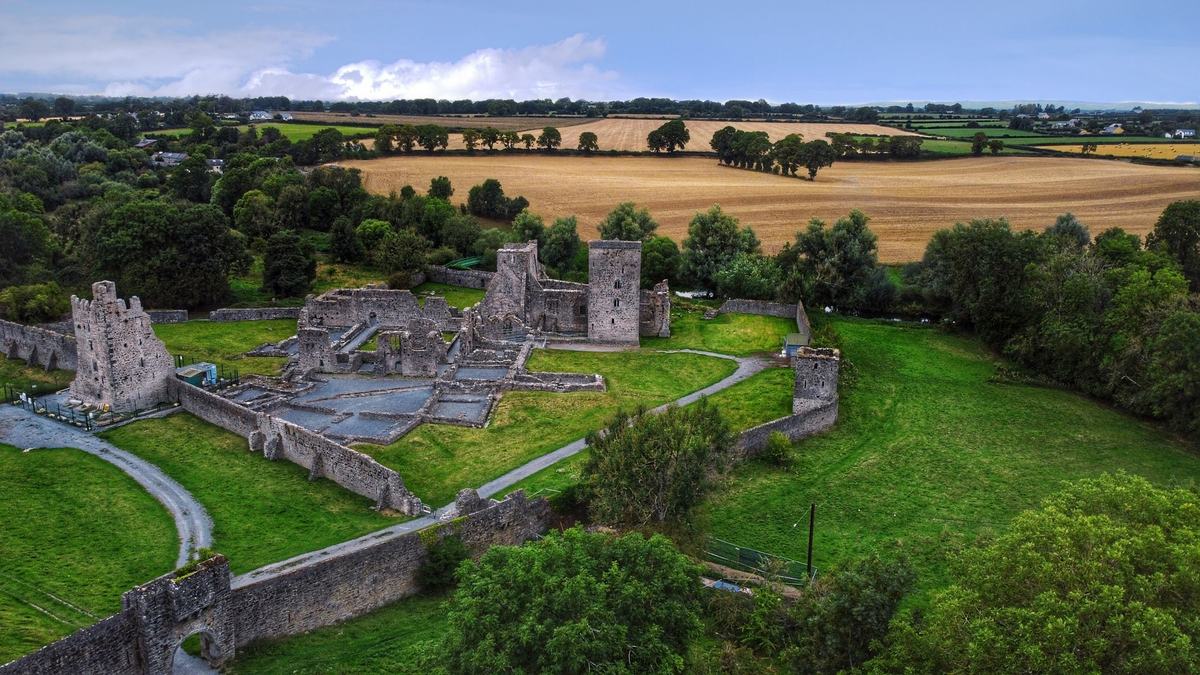
- Capital: Dublin, population around 1.46 million in the greater area [1]
- Total population: about 5.38 million as of the 2024 estimate [1]
- Area: 70,273 square kilometers (the Republic), making it roughly the size of West Virginia [1]
- Official languages: Irish (Gaeilge) and English, with Irish listed first in the constitution [2]
- Currency: Euro, adopted in 2002 [1]
- One in six Irish residents was born outside the country, a remarkable flip for a place that spent two centuries exporting its people [3]
I grew up thinking Ireland was basically Boston with sheep. Then I actually started reading about the place and realized I had been wandering around with a tourism brochure for a brain. Ireland is small, sure. About the size of West Virginia. But the density of stuff happening there, geological, linguistic, literary, agricultural, makes the rest of us look like we are coasting.
Here is the thing. Ireland exported around 70 million people over the last two centuries. That is roughly fourteen times the current population of the island still living there. Today's diaspora is bigger than the country it came from, which is the kind of fact that quietly rearranges how you think about a place. Most countries built their identity at home. Ireland built half of it abroad and shipped the rest back in songs.
The Land Itself: Older Than the Atlantic
Ireland's geology is genuinely strange. The northwest of the island and parts of Newfoundland used to be the same chunk of rock, separated about 60 million years ago when the Atlantic Ocean started opening up [4]. You can stand on a cliff in County Donegal and look at stone that has more in common with Canada than with Cornwall, which is a fact I had to look up twice before I believed it.
The Cliffs of Moher get all the postcards, and fair enough, they drop 214 meters straight into the Atlantic. But the geological showstopper is the Giant's Causeway in Northern Ireland. Around 40,000 hexagonal basalt columns, formed by cooling lava about 60 million years ago, packed together like someone tiled a coastline [5]. UNESCO named it a World Heritage Site in 1986. The local legend says a giant named Finn McCool built it to fight a Scottish rival. Geologists say cooling basalt cracks in hexagonal patterns. Both stories are doing real work.
Then there is the Burren, in County Clare. A 250 square kilometer plateau of bare gray limestone that looks like the surface of the moon if the moon had wildflowers. Arctic, alpine, and Mediterranean plants grow side by side in the cracks, which should not be possible and is one of those small ecological miracles that nobody talks about outside of botany journals.
Forty Shades of Green Is Not a Marketing Slogan
The "Emerald Isle" thing is real and there is a reason for it. Ireland gets between 150 and 225 rainy days a year depending on where you stand [6]. The Atlantic keeps the climate mild, the rain keeps the grass growing, and the grass keeps the cows fed. Roughly 65 percent of the land is used for agriculture, most of that pasture. Irish butter and beef end up everywhere precisely because the cows spend more time outside, on grass, than almost anywhere else in Europe.
Which, if you think about it, is why a country with five and a half million people exports food to twenty times that many. Back home in Montana, our ranchers feed cattle on grass too, but we have eight months of brown. Ireland is green every month. The difference shows up in the milk.
A Literary Output That Makes No Sense for the Size
Four Nobel Prizes in Literature. From an island with the current population of metro Phoenix. Yeats in 1923, Shaw in 1925, Beckett in 1969, Heaney in 1995. James Joyce, who somehow did not win one, wrote what plenty of critics call the most important novel of the 20th century, "Ulysses", set entirely on a single day in Dublin in 1904. Every June 16th, Dublin still celebrates Bloomsday by walking the same route Joyce's characters walked. Real people, in costume, eating the same lunch.
There is no neat explanation for why such a small place produced so many giants. Some people credit the oral storytelling tradition, the seanchaí, that goes back over a thousand years. Some credit the brutal history that gave writers something to wrestle with. Some credit the fact that the pubs are good and the conversation is constant. Probably all of it.
The Irish Language: Smaller Than It Used To Be, Refusing to Die
In 1841, before the Great Famine, around four million people on the island spoke Irish daily. Today it is closer to 73,000 native speakers, concentrated in regions called the Gaeltacht along the western coast [2]. That is a 98 percent collapse in less than two centuries. The famine and the emigration that followed killed the language faster than any policy could have.
But Irish is not extinct, and the constitution names it the first official language. Every road sign is bilingual. Every kid learns it in school. The government runs an Irish-language TV channel, TG4, which produces actual prestige drama. And the Gaeltacht regions, mostly in Donegal, Galway, Kerry, and Cork, hang on. The language survives partly because people stubbornly refuse to let it not.
Facts About Ireland Culture: Pubs, Music, and the National Sports
The traditional Irish music session, where musicians sit around a pub table and play tunes they all somehow already know, is not a tourist trap, even though tourists sometimes show up to watch. It is genuinely how communities have kept folk tunes alive for centuries. The bodhrán, tin whistle, fiddle, and uilleann pipes are the core, and a session can last six hours if the right people walk in.
The two big sports nobody outside Ireland has heard of are Gaelic football and hurling, run by the Gaelic Athletic Association since 1884. Hurling, played with a wooden stick called a hurley and a small leather ball, may be the oldest field sport still played anywhere. It is also, by most reasonable measures, one of the fastest. The all-Ireland finals fill Croke Park in Dublin, capacity 82,300, the third largest stadium in Europe.
A Country That Used to Be Poor and Suddenly Wasn't
Until the late 1990s, Ireland was one of the poorer countries in Western Europe. Then between 1995 and 2007, the GDP roughly doubled and the country picked up the nickname "Celtic Tiger" [3]. The 2008 financial crash hit hard, but Ireland has since become the European headquarters for Google, Apple, Microsoft, Meta, and a long list of others, mostly thanks to a 12.5 percent corporate tax rate. Dublin's Silicon Docks now houses more tech workers per square kilometer than most parts of California.
The result is one of the youngest, most educated, and most foreign-born populations in the EU. The country that once defined emigration now imports more people than it sends out. That is a complete reversal in one generation, and nobody really expected it.
Frequently Asked Questions
Is Ireland part of the United Kingdom?
The Republic of Ireland is an independent country and has been since 1922 (fully sovereign since 1937). Northern Ireland, six counties in the northeast, is part of the United Kingdom. The island is shared between two separate jurisdictions with an open border.
What language do people in Ireland speak?
Most people in Ireland speak English as their first language. Irish (Gaeilge) is the first official language under the constitution, with about 73,000 native daily speakers concentrated in Gaeltacht regions along the western coast. All public signs and government documents are bilingual.
Why is Ireland called the Emerald Isle?
Ireland is called the Emerald Isle because of its year-round green landscape, driven by a mild Atlantic climate and 150 to 225 rainy days per year. The grass essentially never goes brown, which is unusual at this latitude and gives the entire island its distinctive color.
What is the currency in Ireland?
The Republic of Ireland uses the Euro, adopted in 2002 when it replaced the Irish pound (punt). Northern Ireland, being part of the United Kingdom, uses the British pound sterling. Travelers crossing the border switch currencies even though there is no passport check.
Is Ireland a good place to visit?
Ireland is consistently ranked among the safest and most welcoming countries for travelers, with strong tourism infrastructure across Dublin, Galway, Cork, and the Wild Atlantic Way. The weather is mild but wet year-round, so the best months are typically May through September.