- Capital: Rome [1]
- Population: about 58.8 million [2]
- Area: 301,340 square kilometers [1]
- Official language: Italian [1]
- Currency: Euro (EUR) [1]
- Home to more UNESCO World Heritage Sites than any other country, tied with China [3]
I grew up thinking Italy was one place. Pizza, pasta, the Colosseum, done. Then I actually looked at a map and realized the distance from Milan to Palermo is roughly the same as Portland to Los Angeles, and the people on either end barely sound like they speak the same language. The country is shaped like a boot, sure, but it's also shaped like a thousand years of city-states that never quite agreed to be one nation. You can drive an hour in Italy and the bread changes. The wine changes. Sometimes the dialect changes so much that the older folks can't follow each other on TV. That's the thing about Italy nobody warns you about. It's not a country so much as a federation of regions that happens to share a passport.
A Country Younger Than the United States
Here's the thing. The Roman Empire is older than almost anything we know. Italy as a unified country is not. Italy only became one nation in 1861, which makes it younger than the United States by 85 years [4]. Before then, the peninsula was a patchwork of kingdoms, duchies, papal states, and Spanish or Austrian-controlled territories. Sicily was its own kingdom. Venice was its own republic for over 1,100 years. Even after unification, it took another nine years to add Rome, and most Italians still didn't speak Italian. They spoke Venetian, Neapolitan, Sicilian, Lombard, Piedmontese. The language we now call Italian was basically the Tuscan dialect, the one Dante wrote in, that won out because of literature, not politics.
I had to look this up twice when I first read it. The percentage of Italians who actually spoke standard Italian at unification was somewhere between 2 and 10 percent, depending on which historian you trust [4]. Most people learned it from TV in the 1950s and 60s. Back home in Montana, my grandparents grew up with German, English, and a little Norwegian floating around the kitchen, and that felt like a lot. In Italy that kind of linguistic layering is the default.
The Country Inside the Country
Rome contains an entire other country. Vatican City sits inside the city limits of Rome and is the smallest sovereign state in the world, at about 49 hectares, or roughly the size of a midsize American golf course [5]. It has its own post office, its own license plates, its own railway station (with one of the shortest national rail networks on Earth), and its own army, the Swiss Guard, who still wear the uniform Michelangelo allegedly helped design. Population: around 500 people, depending on the year [5].
And nobody talks about this, but there's a second microstate inside Italy too. San Marino, perched on a mountain in the north-central part of the country, claims to be the oldest surviving republic in the world, founded in 301 AD. It survived Napoleon, both world wars, and the collapse of every empire around it. Italy basically surrounds two other countries it has nothing to do with politically. Try explaining that on a road trip.
More UNESCO Sites Than Anywhere Else
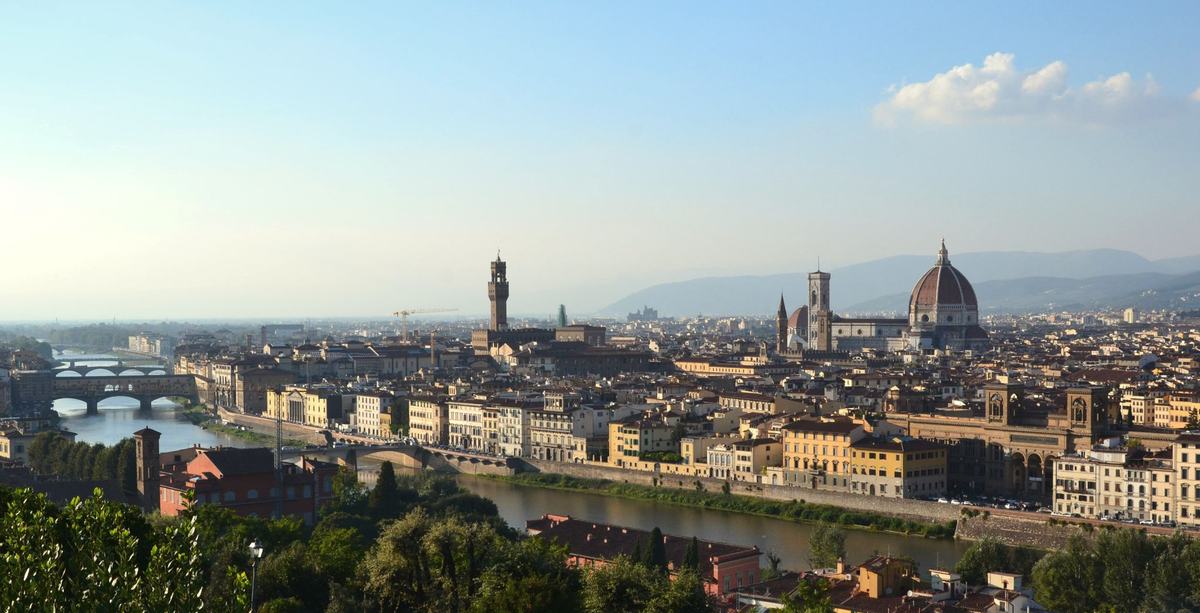
Italy and China are tied at the top of the UNESCO World Heritage list, with around 60 sites each [3]. That's not a list of pretty buildings. It's a list of places UNESCO has decided are genuinely irreplaceable in human history. Italy has the historic centers of Rome, Florence, Venice, Naples, Siena, San Gimignano, Urbino, and dozens more. It has the archaeological sites of Pompeii and Herculaneum, the rock drawings of Valcamonica, the Amalfi Coast, the Dolomites, the trulli of Alberobello, the Etruscan necropolises. The country is 301,000 square kilometers, smaller than California, and somehow contains all of that.
What strikes me is how casual Italians are about it. You'll find a 14th-century church being used as a parking garage office. A Roman aqueduct running through someone's backyard. In Verona you can walk past a small unmarked archway and realize it's a Roman gate that's been holding up traffic for two thousand years.
Earthquakes, Volcanoes, and a Restless Ground
Italy sits on the collision zone between the African and Eurasian tectonic plates, which means the ground is genuinely not at rest. Italy has more active and dormant volcanoes than any other country in continental Europe, including Mount Etna in Sicily (the most active volcano in Europe), Stromboli (which has been erupting nearly continuously for about 2,000 years), and Mount Vesuvius (the one that famously buried Pompeii in 79 AD) [6]. Vesuvius is still classified as active and overlooks a metropolitan area of three million people, which is one of those facts you read and immediately wish you hadn't.
The country also gets the most earthquakes of any nation in Europe. The 2009 L'Aquila quake, the 2016 Amatrice and Norcia quakes, the long sequence in central Italy through 2017. The geology that gave Italy its mountains, hot springs, and absurdly fertile volcanic soil also gave it real ongoing risk. Italians have built and rebuilt cities here for three millennia, and they keep going.
Food Is Regional, and the Regions Are Stubborn
Here's a thing Americans get wrong about Italian food: there is no such thing as Italian food. There's Sicilian food. There's Tuscan food. There's Emilian food. Pasta in Rome means cacio e pepe, carbonara, amatriciana, gricia, and the locals will fight about which restaurant does each one properly. Two hundred miles north in Bologna, those dishes basically don't exist; instead you get ragù, tortellini in brodo, tagliatelle. Go to Naples and pizza is something close to a sacred object with rules enforced by an association (the Associazione Verace Pizza Napoletana actually certifies pizzerias by ingredient and method) [7].
Olive oil from Puglia tastes different from olive oil from Liguria. Parmesan from Parma and Reggio Emilia is legally distinct from anything else; you can't call grated hard cheese "Parmesan" inside the EU unless it comes from those specific provinces [7]. The whole country runs on this kind of geographic protection. There are more than 800 Italian food products with protected designation of origin status, which is more than any other country in Europe.
Coffee is similar. Espresso is the default. If you order a cappuccino after 11am, the barista will politely serve it and silently judge you, because cappuccino is a breakfast drink. I made this mistake in Florence and the older man at the next table actually laughed.
A Country That Exports Style
Italy invented the modern fashion industry as we know it. Milan is one of the four global fashion capitals, alongside Paris, New York, and London, and Italian houses, Armani, Versace, Prada, Gucci, Valentino, Dolce and Gabbana, dominate the luxury market. The country is also the world's largest producer of wine by volume in most years, edging out France [8]. It produces more pasta than any other country on Earth, about 3.5 million tonnes a year, and Italians themselves eat around 23 kilograms per person per year, the highest per-capita consumption in the world [8].
There's a deep mechanical tradition too. Ferrari, Lamborghini, Maserati, Alfa Romeo, and Pagani are all Italian. So is Vespa. So is the Moka pot on half the stoves in the world. Italy makes things, and it makes them with a particular insistence on how they should look.
Frequently Asked Questions
What is the capital of Italy?
The capital of Italy is Rome, with a metropolitan population of about 4.3 million. Rome has been continuously inhabited for nearly 3,000 years and was the center of the Roman Empire. Italy unified in 1861, and Rome was added as the capital in 1871.
How big is Italy compared to the United States?
Italy is about 301,000 square kilometers, slightly smaller than the US state of Arizona. It is much smaller than the United States overall but stretches roughly 1,200 kilometers from north to south, giving it a wide range of climates from Alpine to Mediterranean.
How many UNESCO World Heritage Sites does Italy have?
Italy has about 60 UNESCO World Heritage Sites, tied with China for the most of any country in the world. The list includes the historic centers of Rome, Florence, and Venice, the archaeological sites of Pompeii and Herculaneum, and natural areas like the Dolomites.
Is Italian the only language spoken in Italy?
Italian is the only official language at the national level, but Italy recognizes 12 minority languages, and many regional dialects are still spoken daily. Sardinian, Friulian, Sicilian, and Neapolitan have millions of speakers, and German is co-official in South Tyrol.
What countries are inside Italy?
Two independent countries sit inside Italian territory: Vatican City, the world's smallest sovereign state, located inside Rome, and San Marino, a small republic on Monte Titano in north-central Italy. Both are fully independent nations with their own governments and laws.
Sources
- The World Factbook: Italy
- Italian National Institute of Statistics (ISTAT)
- UNESCO World Heritage List
- Encyclopaedia Britannica: Italy, History
- Vatican City State Official Website
- Istituto Nazionale di Geofisica e Vulcanologia (INGV)
- European Commission: Geographical Indications and Quality Schemes
- International Organisation of Vine and Wine: State of the Vitivinicultural Sector