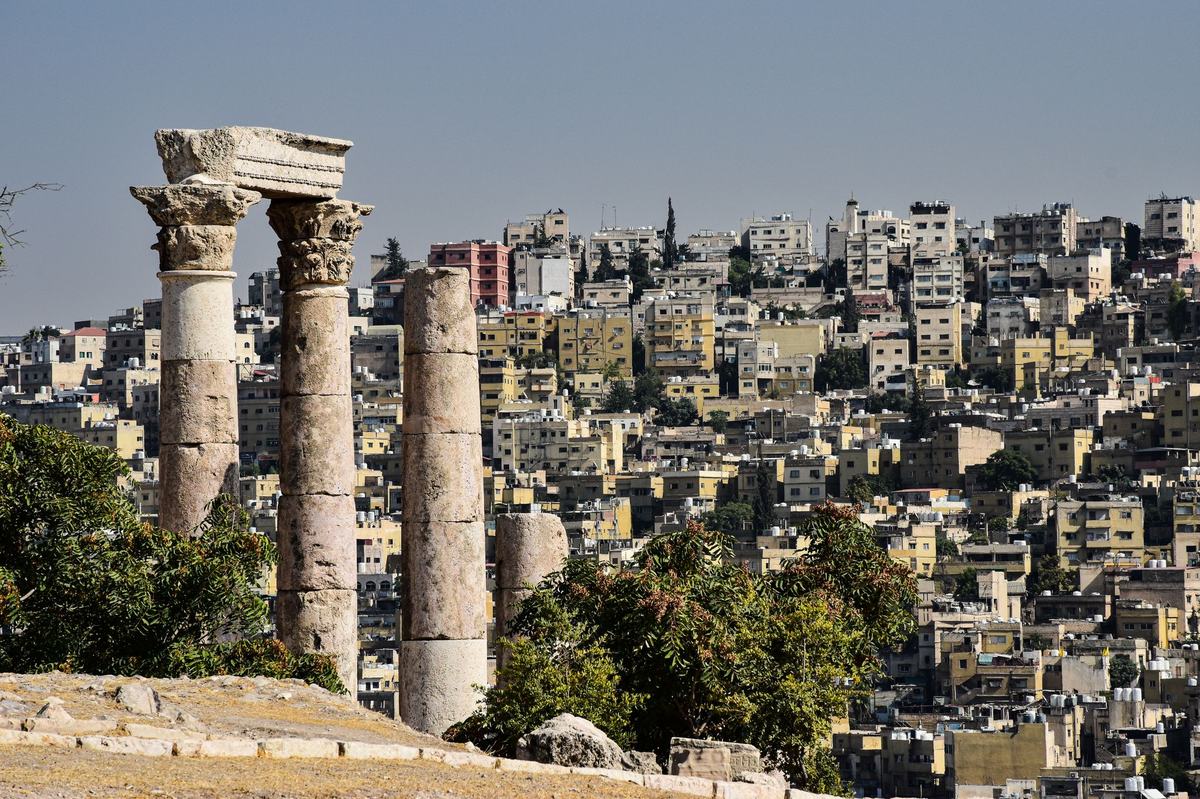
- Capital: Amman, with a population of roughly 4 million people in the metro area [1]
- Population: About 11.5 million [1]
- Area: 89,342 square kilometers, slightly smaller than Indiana [1]
- Official language: Arabic; English is widely used in business and tourism [1]
- Currency: Jordanian dinar (JOD), one of the strongest currencies in the world [2]
- Distinguishing claim: Home to Petra, the Dead Sea, and the lowest dry point on the planet's surface [3]
I had to look this up twice. Jordan, a country smaller than a lot of American states, has been continuously inhabited for something like 10,000 years. Think about that. While most of the world was still figuring out agriculture, people here were already building stone towers. There's a place called 'Ain Ghazal, just outside Amman, where archaeologists found human statues from 7250 BC. Statues. With painted eyes. They're the oldest large-scale human figures ever made.
That's the thing about Jordan. You think you're going to learn about a desert kingdom and instead you end up rearranging your sense of human history.
Petra Was Lost for a Thousand Years
Everybody has seen the photo. The narrow canyon, the carved facade at the end of it, that pink sandstone glowing like someone left a lamp on inside the rock. That's Al-Khazneh, the Treasury at Petra, and it was carved out of a cliff by the Nabataeans more than two thousand years ago.
Here's what nobody talks about. After the Romans took over and trade routes shifted, Petra was effectively forgotten by the Western world for about a thousand years. Local Bedouin knew it was there. They kept the secret. It wasn't until 1812 that a Swiss explorer named Johann Burckhardt talked his way in by claiming he wanted to sacrifice a goat at a nearby shrine.
The whole city is bigger than people realize. The Treasury is the postcard, but Petra has tombs, a Roman-style theater carved into rock, a monastery up a long stairway, and hundreds of other structures spread across a valley. Only a fraction has been excavated. Archaeologists figure most of it is still buried.
In 2007 it was named one of the New Seven Wonders of the World. That voting campaign was a little gimmicky, sure. But in Petra's case, the wonder is real.
The Dead Sea Is Dying
The Dead Sea sits at 430 meters below sea level. That's the lowest dry point on Earth. You can float on the surface like a piece of cork because the water is nine times saltier than the ocean. People come here to smear themselves with the black mineral mud and lie in the sun reading paperbacks.
The water level has been dropping by more than a meter a year for decades. The Jordan River, which used to feed it, has been almost entirely diverted for agriculture and drinking water by Jordan, Israel, and Syria. Sinkholes have started swallowing up the shoreline. Hotels that used to be beachfront now sit hundreds of meters from the water.
There's a Red Sea-to-Dead Sea pipeline project that's been talked about for years to slow the decline. Whether it actually happens is a different question. For now, it's a strange thing to swim in something that's becoming a memory.
Wadi Rum Looks Like Mars
If you've seen "The Martian", "Lawrence of Arabia", "Dune", "Rogue One", or "The Last Days on Mars", you've seen Wadi Rum. Hollywood keeps coming back because nowhere else looks quite like it. Massive sandstone mountains rising out of red desert. Canyons. Natural arches. A horizon that goes on forever and doesn't feel like Earth.
The Bedouin have lived here for centuries. You can still spend a night in one of their tents, eat zarb (meat slow-cooked underground in a sand oven), and watch the stars come out without a single competing light source. The first time I read about this, I thought of camping in eastern Montana - the same stunning emptiness, the same sky. But Wadi Rum has a weight of human history to it that the American West, for all its drama, just doesn't.
T.E. Lawrence wrote about Wadi Rum in "Seven Pillars of Wisdom". He called it "vast, echoing, and god-like". It still is.
Amman Is Built on Seven Hills
Like Rome. Like Lisbon. Like a lot of cities that have been around for a really long time. Amman's hills, called jabals, each have their own neighborhood character, and the city has spilled out across many more hills since the original seven.
The Citadel sits on the highest one, Jabal al-Qal'a. It's been occupied for over 7,000 years. You can walk through ruins of a Roman Temple of Hercules, a Byzantine church, and an Umayyad palace, all on the same hilltop, looking down at a Roman amphitheater that's still used for performances. The layering of empires here is just absurd.
Modern Amman, though, isn't a museum. It's a young, fast-growing capital with a coffee culture that rivals anywhere I've been. The neighborhoods of Jabal Amman and Jabal al-Weibdeh are full of galleries, bookstores, falafel joints, and rooftop bars. The pastry shops sell knafeh - a cheese pastry soaked in sweet syrup that I would absolutely move countries for.
A Refugee Record Nobody Quite Believes
This one I had to read several times. Jordan hosts more refugees per capita than almost any country on Earth. Roughly 700,000 registered Syrian refugees, plus more than 2 million Palestinian refugees who arrived over decades of regional conflict, plus Iraqis, Yemenis, Sudanese, and others [4].
For a country of about 11.5 million people with limited water and few natural resources, that's an extraordinary load. The Zaatari refugee camp in northern Jordan, opened in 2012, became one of the largest Syrian refugee camps in the world. At its peak it had around 150,000 people. It has its own shops, schools, a main street locals nicknamed the Champs Elysees.
The economic strain is real. Jordan's unemployment is high and water is scarce. Yet the country has kept its borders open through wave after wave. Which, if you think about it, says something about Jordan that no list of monuments can.
A Monarchy That Plays the Long Game
Jordan is a constitutional monarchy. King Abdullah II, who took the throne in 1999, is the great-grandson of the man who founded the country. The Hashemite royal family traces its lineage back to the Prophet Muhammad, which gives the monarchy a religious legitimacy that complements its political one.
Jordan has stayed remarkably stable in a region that has not. It signed a peace treaty with Israel in 1994, the second Arab state to do so after Egypt. It maintains close ties with the United States and the European Union. It has avoided the wars that have devastated most of its neighbors - Syria, Iraq, Lebanon, the Palestinian territories. The trick has been a kind of quiet diplomacy that doesn't always make headlines but does keep the country in one piece.
The royal family is unusually visible. King Abdullah has piloted helicopters in search-and-rescue missions and appears on social media with his kids. Queen Rania is one of the most followed Arab figures on Instagram. It's a monarchy that has learned how to be modern without giving up on tradition.
Frequently Asked Questions
Is Jordan safe to visit?
Yes, Jordan is generally considered safe for tourists. It has remained politically stable for decades and has no recent history of terrorism affecting tourist areas. Tourist sites like Petra, Wadi Rum, and the Dead Sea are well-protected, and locals are known for their hospitality. Standard travel precautions apply, especially near Syrian and Iraqi borders.
What is Jordan most famous for?
Jordan is most famous for Petra, the ancient Nabataean city carved into pink sandstone cliffs and named a New Seven Wonders of the World. It is also known for the Dead Sea (the lowest point on Earth), the dramatic desert landscapes of Wadi Rum, and the Roman ruins at Jerash, one of the best-preserved Roman provincial towns anywhere.
What language do they speak in Jordan?
The official language of Jordan is Arabic, specifically the Levantine Arabic dialect used in everyday conversation, with Modern Standard Arabic used in formal writing and media. English is widely spoken in business, tourism, and among educated Jordanians. Road signs in major cities and tourist areas are typically posted in both Arabic and English.
What is the currency of Jordan?
Jordan's currency is the Jordanian dinar (JOD), one of the most valuable currencies in the world by exchange rate, typically worth around 1.41 US dollars. The dinar is divided into 100 piastres or 1,000 fils. Cash is still common for smaller purchases, but cards work in hotels, restaurants, and shops in cities and tourist sites.
Is Jordan an Arab country?
Yes, Jordan is an Arab country and a member of the Arab League. About 98 percent of Jordanians are Arab, with small minorities of Circassians, Chechens, and Armenians. The official religion is Islam (Sunni), practiced by around 93 percent of the population, while Christians make up most of the remainder and live alongside the Muslim majority.