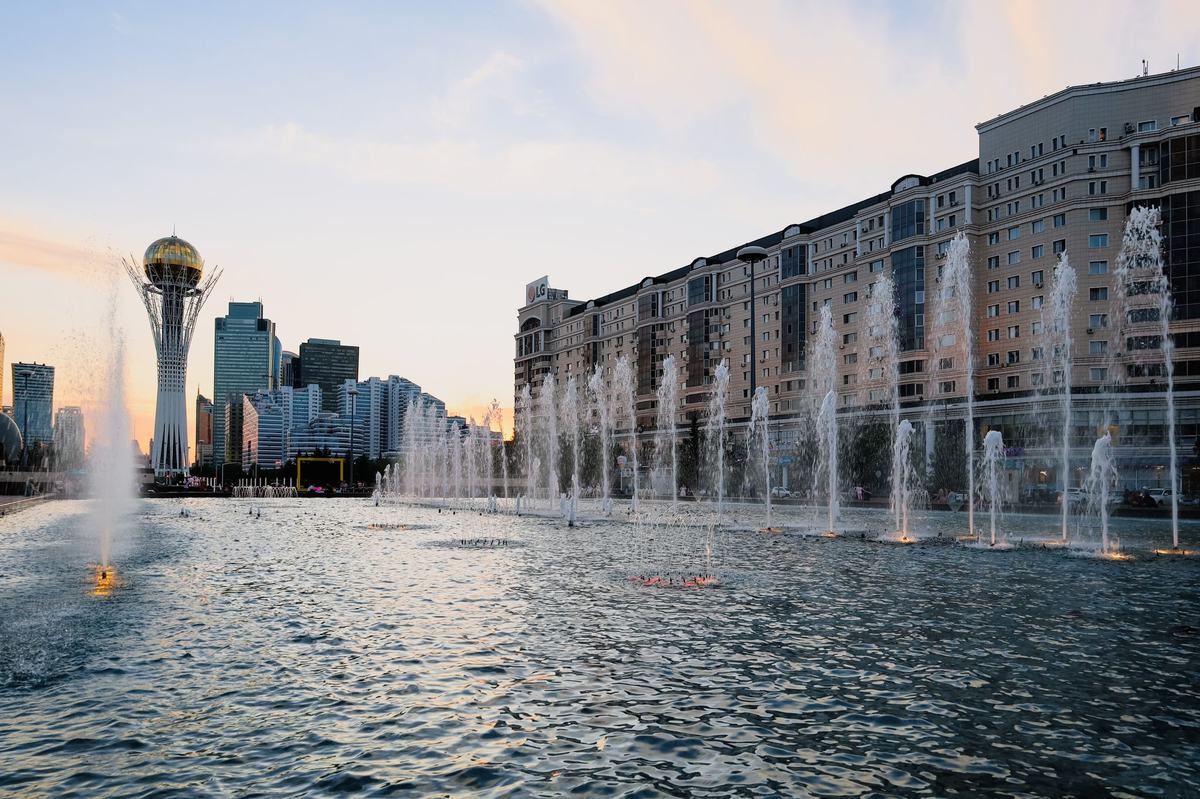
- Capital: Astana (renamed back from Nur-Sultan in 2022) [1]
- Population: about 20 million [2]
- Area: 2,724,900 square kilometers, ninth largest in the world [1]
- Official languages: Kazakh (state language) and Russian (official) [1]
- Currency: Kazakhstani tenge (KZT)
- Distinguishing claim: the largest landlocked country on Earth [1]
I grew up thinking landlocked countries were small. Switzerland small. Bolivia small. Then I pulled up a map of Kazakhstan one night and just stared at it. The country is bigger than all of Western Europe, and not one inch of it touches an ocean. Turns out the biggest landlocked nation on the planet is one most Americans couldn't place within a thousand miles.
A Country the Size of Western Europe
Kazakhstan covers 2.7 million square kilometers [1]. That puts it ninth on the global size chart, ahead of Argentina and just behind Argentina's continent-sized neighbors. To give you a feel for it: if you laid Kazakhstan over the United States, it would stretch from the Atlantic coast almost to Denver. The drive from the western city of Atyrau to the eastern city of Oskemen is roughly the same as Los Angeles to New York.
And here's the thing about that scale. Most of it is empty. Kazakhstan has about 20 million people in a country bigger than India [2]. Outside the cities, you can drive for hours without seeing a house. The steppe, that flat grassland that defines so much of Central Asia, just opens up and keeps going. Back home in Montana, I thought I knew what big sky looked like. The Kazakh steppe is on another scale entirely.
Two Names, One Capital
The capital is Astana. It was Astana, then Nur-Sultan, and now it's Astana again. The city was renamed in 2019 to honor the country's first president, Nursultan Nazarbayev, who had stepped down after nearly thirty years in office. Then in 2022, after political shifts inside the country, the parliament voted to restore the original name [3]. Most maps still need to catch up.
Astana itself is something to see. The government moved the capital here from Almaty in 1997, and built a futuristic skyline almost from scratch on the cold northern steppe. Glass pyramids. A tower with a giant golden orb on top. A shopping center shaped like a Bedouin tent. Winters there regularly drop below minus 30 Fahrenheit. It is one of the coldest capital cities in the world, second only to Ulaanbaatar in Mongolia.
The Largest Landlocked Country on Earth
No coastline. The closest thing Kazakhstan has to a sea is the Caspian, which is technically the world's largest enclosed body of water, salty and below sea level, but not connected to any ocean. Kazakhstan shares its Caspian coast with Russia, Azerbaijan, Iran, and Turkmenistan, and a chunk of the world's caviar and offshore oil comes from those waters.
Then there's the Aral Sea, or what's left of it. In the 1960s the Aral was the fourth-largest lake on Earth. Soviet planners diverted the rivers that fed it to irrigate cotton fields, and the lake started dying. By the 2000s, it had lost about 90 percent of its surface area. Rusted fishing boats now sit on dry sand miles from any water. The northern part, the Kazakh side, has actually been recovering thanks to a dam project, and the fish have come back in places. Which, if you think about it, is one of the rare environmental disasters where the trend line is bending the right way again.
Where Humans First Rode Horses
This one I had to look up twice. The earliest known evidence of horse domestication comes from the Botai culture, which lived in what's now northern Kazakhstan around 3500 BCE [4]. Archaeologists found wear marks on horse teeth consistent with bridles, and residues of mare's milk in pottery. Five and a half thousand years ago, on the Kazakh steppe, somebody figured out you could climb on the back of a wild horse and not die. That changed pretty much everything about human history afterward: warfare, trade, migration, the spread of language. All of it traces back, in part, to this patch of grassland.
The horse culture never really went away here. Modern Kazakh cuisine still leans heavily on horse meat (kazy is a smoked horse sausage that shows up at any serious feast) and on fermented mare's milk, called kumis. Drinking kumis is one of those experiences that everyone tells you to try at least once. It is tangy, slightly fizzy, mildly alcoholic, and absolutely not what you were expecting.
Baikonur and the Birth of the Space Age
The first human being to leave the Earth left from Kazakhstan. Yuri Gagarin launched from the Baikonur Cosmodrome on April 12, 1961 [5]. So did Sputnik, four years earlier. So did Valentina Tereshkova, the first woman in space, in 1963. Pretty much every Soviet milestone in spaceflight blasted off from the Kazakh desert.
The strange part is that Baikonur is still in Kazakhstan, but Russia leases it. The arrangement runs through 2050. For decades, even American astronauts heading to the International Space Station launched from there, because after the Space Shuttle program ended in 2011, the Russian Soyuz rocket was the only ride available. There is something genuinely strange about the fact that the gateway to space for most of human history sits in a country a lot of people couldn't find on a map.
Culture: Nomads, Apples, and the Silk Road
Kazakhstan is where the apple comes from. Not figuratively. The wild ancestor of every apple in your grocery store, Malus sieversii, still grows in the mountains around the southern city of Almaty. The name Almaty itself comes from a Kazakh word meaning "father of apples". Genetic studies traced our domestic apple back to those forests, and the trees there still produce fruit in every color and flavor profile you can imagine, including some that taste like rosewater or honey.
The country sits along the old Silk Road, and that history shows up everywhere. Kazakh culture is a blend of Turkic nomadic tradition, Persian influence, Russian colonial legacy, and a more recent push toward a distinct national identity. The eagle hunters of the Altai Mountains in the east still train golden eagles to bring down foxes and rabbits in winter, a practice that goes back thousands of years and survives, just barely, as a living tradition rather than a tourist show.
Kazakhstan officially switched its alphabet to Latin script after centuries of using Arabic and then Cyrillic, with full transition scheduled through the 2020s and into the 2030s. That kind of move, changing an entire country's reading system, is something most nations have not done in living memory. It tells you a lot about how seriously Kazakhstan is rebuilding its identity post-independence.
Frequently Asked Questions
Is Kazakhstan in Europe or Asia?
Kazakhstan is mostly in Asia, but a small portion west of the Ural River is geographically in Europe. The country is considered a transcontinental state, similar to Russia and Turkey. Culturally and politically, Kazakhstan is most often classified as part of Central Asia, though it participates in European sporting and cultural organizations.
What language do they speak in Kazakhstan?
Kazakh is the state language and Russian is the official language used in business and government. Most Kazakhs are bilingual, and Russian remains widely spoken in cities. The government is gradually transitioning the Kazakh language from Cyrillic to a Latin-based script over the 2020s and 2030s.
Is Kazakhstan a safe country to visit?
Kazakhstan is generally considered safe for travelers, with low rates of violent crime and a stable tourism infrastructure in major cities. Almaty and Astana have well-developed services for foreign visitors. As with anywhere, common precautions around pickpocketing and unofficial taxis apply.
What is Kazakhstan known for?
Kazakhstan is known for being the world's largest landlocked country, the home of the Baikonur Cosmodrome where the first human spaceflight launched, and the original birthplace of the domesticated apple. It is also known for its vast steppe landscapes and its nomadic horse culture.
What currency is used in Kazakhstan?
The currency is the Kazakhstani tenge, abbreviated KZT. It has been the national currency since 1993, when it replaced the Soviet ruble after independence. Cash is still widely used, though card payments are common in cities.