- Capital: Nairobi [1]
- Population: about 56 million (2024 estimate) [2]
- Area: 580,367 square kilometers (about the size of Texas) [1]
- Official languages: Swahili and English [1]
- Currency: Kenyan shilling (KES) [1]
- The word "safari" comes from Swahili and just means "journey" [3]
I grew up thinking Kenya was a place that existed only on the back covers of National Geographic. Acacia trees, golden grass, a lion looking at the camera like it had somewhere to be. Then I actually started reading about the country, and the postcards fell apart fast. Kenya is one of those places where the more you learn, the more the cliches feel embarrassing. Mobile banking was basically invented here. So was, arguably, humanity itself. And the running thing? That's not a stereotype. That's a measurable phenomenon happening in one specific county.
Let me try to do this country some justice.
The Great Rift Valley Runs Right Through It
The Great Rift Valley is a 6,000-kilometer scar across East Africa where the continent is literally tearing itself apart. Kenya sits right on top of it. Two tectonic plates are slowly pulling away from each other under the country, and in a few million years, a piece of East Africa will break off and drift into the Indian Ocean. That sounds like a dramatization, but geologists genuinely talk about it that way [4].
What this means for the landscape is wild. You get freshwater lakes, soda lakes pink with flamingos, dormant volcanoes, escarpments that drop a thousand feet, and the highest density of large mammals anywhere on Earth. Back home in Montana we have the Rockies, and they feel ancient and immovable. The Rift Valley feels alive. It is alive. It's moving while you're standing on it.
Mount Kenya, the country's namesake peak, sits just south of the equator and still has glaciers on top. Or had. They're shrinking fast - scientists expect them to disappear entirely within a couple of decades. The second-highest mountain in Africa, after Kilimanjaro right next door in Tanzania, and most travelers never make it up there. They go to the parks instead.
Where "Safari" Actually Comes From
Here's the thing about the word "safari". It's a Swahili word that just means "journey" or "trip". A guy heading to the next town for groceries is technically on safari. The word got borrowed into English in the 1800s, and over time it acquired this whole package of meaning - khaki, jeeps, big cats, expensive lodges - that wouldn't make sense to a Swahili speaker at all [3].
The modern safari industry was largely invented in Kenya, though. The first wildlife conservation areas in East Africa were established here in the early 20th century, and Nairobi National Park, established in 1946, is the only national park in the world located inside a capital city. You can be in a downtown traffic jam and twenty minutes later watch a rhino grazing with skyscrapers as the backdrop. I had to look this up twice the first time I read about it.
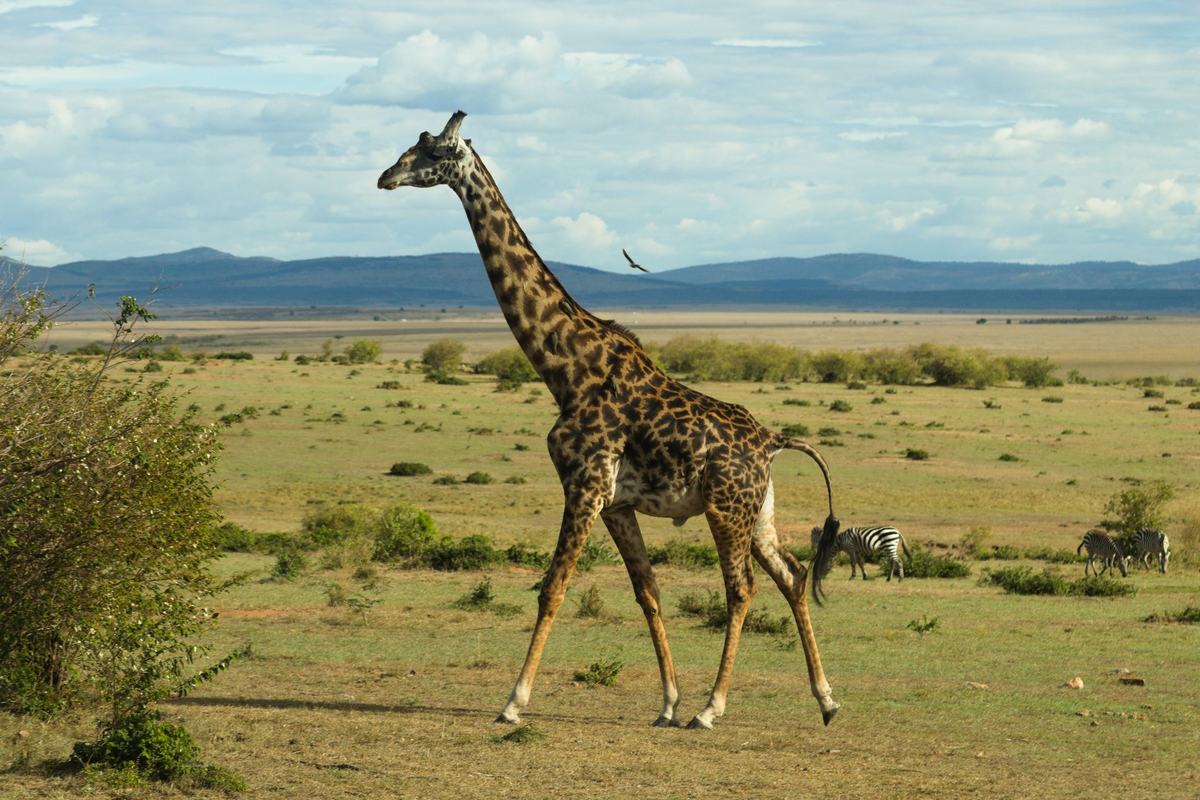
The Maasai Mara, the country's most famous reserve, sits at the northern end of the Serengeti ecosystem. Every year, about 1.5 million wildebeest, plus hundreds of thousands of zebras and gazelles, walk a giant clockwise loop across the Mara and back into Tanzania. This is the largest land mammal migration on the planet, and it has been happening, more or less unchanged, for over a million years [5].
The Cradle of Humankind
If you go far enough back, every human alive descends from people who lived in East Africa. Kenya is a huge part of that story. The Turkana Basin in the country's north has produced some of the most important hominin fossils ever discovered. Turkana Boy, found near Lake Turkana in 1984, is the most complete early human skeleton ever recovered. He was about nine years old when he died, around 1.6 million years ago, and he was already tall, lean, and built for running long distances in the heat [6].
Which, if you think about it, connects to something happening in Kenya right now. The country produces an absurd number of the world's best distance runners. Not "a lot". Not "more than its share". A genuinely absurd number. The vast majority come from one ethnic group, the Kalenjin, and within that group, from one county - Nandi - in the western highlands. There's been a lot of research into why. Some of it is altitude. Some of it is the fact that kids run several kilometers to school every day from a young age. Some of it is body proportions - long, thin legs and low body mass. But honestly, no one has fully cracked it. The runners themselves usually shrug and say it's just how they grew up.
Eliud Kipchoge, the man who broke the two-hour marathon barrier in 2019 (in a controlled event, not record-eligible, but still), is Kenyan. Most of the top times in the world for distances over 5,000 meters belong to Kenyans. The country has won more Olympic medals in distance running than the United States, Russia, and Germany combined.
M-Pesa: Why Kenya Skipped the Banks
In 2007, a mobile network called Safaricom launched a service called M-Pesa. The idea was simple - let people send money to each other using basic feature phones, no bank account required. You'd walk into a shop, hand them cash, and they'd credit your phone. You could text the credit to anyone else with a phone, and they'd cash it out at a shop on the other end.
Nobody expected what happened next. Within a few years, M-Pesa was being used for everything. Paying rent. Paying for taxis. Paying utility bills. Sending money home to the village. By 2024, the value of M-Pesa transactions in Kenya was equivalent to a huge percentage of the country's GDP, and over 30 million Kenyans were active users [7]. The country leapfrogged the whole brick-and-mortar banking system that the rest of the world spent two centuries building. Most Kenyans don't have a bank account. They don't need one.
This isn't a small fact about a tech rollout. It rewired the economy. Sending money used to mean a bus ride and a paper envelope. Now it takes ten seconds. Small businesses got access to capital. Rural farmers could be paid digitally. Aid organizations could transfer money to disaster victims directly, no middlemen. Other countries are still trying to copy the model, and most of them haven't pulled it off the way Kenya did.
A Country of 40-Plus Ethnic Groups
Kenya is one of the most ethnically and linguistically diverse countries in Africa. There are over 40 distinct ethnic groups, each with their own language, customs, and cuisine. The Kikuyu are the largest. The Maasai are probably the most internationally recognized, in their red shukas. But there's also the Luo, the Kalenjin, the Luhya, the Kamba, the Turkana, the Samburu, the Mijikenda, the Swahili along the coast, and many others.
Swahili itself is fascinating - it's a Bantu language that absorbed a huge amount of Arabic vocabulary over centuries of trade along the East African coast, and it's now spoken by over 100 million people across East and Central Africa as a lingua franca. In Kenya it shares official status with English, and most urban Kenyans speak at least three languages - their mother tongue, Swahili, and English. Often more.
Kenyan cuisine reflects all this. Ugali (a stiff cornmeal porridge) is the everyday staple. Nyama choma, grilled goat or beef, is the national obsession. The coast has its own thing entirely - coconut rice, fish curries, samosas, biryani, all the influences of centuries of Indian Ocean trade. Chai, the spiced milky tea, came with Indian railway workers in the colonial period and never left.
Frequently Asked Questions
What is Kenya famous for?
Kenya is famous for wildlife safaris (especially the Maasai Mara), Mount Kenya, the Great Rift Valley, and producing many of the world's best distance runners. It's also where the mobile money service M-Pesa was launched, transforming how Kenyans handle finances.
Is Kenya a safe country to visit?
Most of Kenya's main tourist areas, including Nairobi, the coast, and the major safari parks, are considered safe for travelers when standard precautions are followed. The government and travel advisories flag specific border regions, particularly near Somalia, as higher risk and best avoided.
What languages do they speak in Kenya?
Kenya has two official languages: Swahili and English. Beyond these, Kenyans speak more than 40 indigenous languages tied to specific ethnic groups, including Kikuyu, Luo, Kalenjin, and Maasai. Most urban Kenyans are multilingual from childhood.
Why are Kenyan runners so fast?
Kenyan distance runners, most from the Kalenjin community in the western highlands, benefit from a combination of high-altitude living, an active childhood that often includes running long distances to school, favorable body proportions, and a strong running culture with deep coaching traditions.
When was M-Pesa launched in Kenya?
M-Pesa launched in March 2007 through Safaricom, Kenya's largest mobile network. It allows users to send, receive, and store money using basic mobile phones without needing a bank account. It has since become one of the most successful mobile money systems in the world.