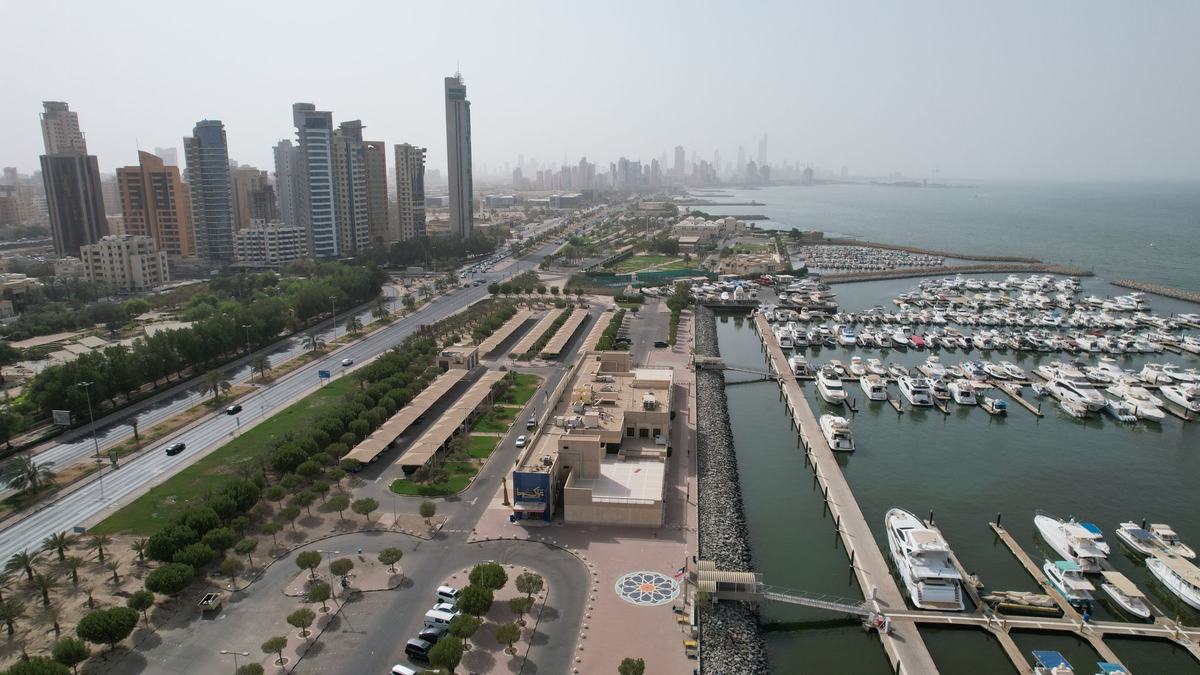
- Capital: Kuwait City
- Population: about 4.9 million, with roughly 70% of residents being foreign nationals [1]
- Area: 17,818 square kilometers, smaller than the U.S. state of New Jersey [2]
- Official language: Arabic; English is widely spoken in business and education
- Currency: Kuwaiti dinar (KWD), the highest-valued currency unit in the world [3]
- Coastline: about 499 km along the northwestern Persian Gulf [2]
Here's something that'll ruin the next pub-quiz round you sit through: the most valuable currency on the planet isn't the dollar, the euro, or the British pound. It's the Kuwaiti dinar. One dinar trades for more than three U.S. dollars, and it has held that crown for decades. I had to look this up twice the first time I saw it, because it just doesn't fit the mental map most of us carry around about money.
That single fact is a pretty good doorway into Kuwait. The country is small, dense, hot, and quiet in the way that small wealthy places often are. But the deeper you go, the stranger and more specific it gets.
A Country Built on a Bay
Kuwait sits at the very top of the Persian Gulf, wedged between Iraq and Saudi Arabia, with a coastline that curves inward like a cupped hand. That bay - Kuwait Bay - is the whole reason the country exists. In the 1700s, a small group of families from central Arabia migrated north and settled on the shore because the natural harbor made it possible to trade, fish, and pearl-dive in a part of the world where most coastlines are open and brutal.
For about two centuries, Kuwait was basically a port town with a wall around it. Boats called dhows hauled dates, horses, and pearls between India, East Africa, and Mesopotamia. Then in 1938, geologists found oil at a place called Burgan, and everything changed. Burgan turned out to be one of the largest oil fields ever discovered, and it's still pumping today [4].
The Dinar and the Sovereign Wealth Fund
The dinar's strength isn't an accident. It's pegged to a basket of currencies weighted by Kuwait's trading partners, and it's backed by oil revenue that the government has spent the last seventy years carefully not spending.
Kuwait set up the world's first sovereign wealth fund in 1953, before it was even fully independent from Britain. The Kuwait Investment Authority now manages an estimated 800-plus billion dollars in assets parked all over the world - real estate in London, equity in Tokyo, infrastructure in Frankfurt [5]. The idea was simple and ahead of its time: the oil will run out, but the money it generated shouldn't.
Which, if you think about it, is the opposite of how most resource booms have gone. Back home, every Montana mining town I drove through as a kid had the same arc - boom, bust, boarded windows. Kuwait quietly looked at that pattern and decided not to play.
The Towers That Became a Skyline
If you've ever seen a photo of Kuwait City at dusk, you've probably seen the Kuwait Towers. Three slim spires on the waterfront, two of them topped with blue-green spheres that look like planets caught mid-orbit. The biggest sphere is actually a water reservoir with a revolving observation deck on top. The whole complex opened in 1979 and has been the country's visual signature ever since.
It's worth knowing that the towers got shot up badly during the Iraqi occupation in 1990-1991. The Iraqi army used them as an anti-aircraft position, and the spheres took heavy damage. When Kuwait was liberated in February 1991, restoring the towers became one of the first national projects. They reopened in 1992. There's something quietly defiant about a country that puts its water tanks on a skyline.
Summer Is Not a Metaphor
Kuwait regularly logs some of the hottest reliably-measured temperatures on Earth. In July 2016, the town of Mitribah recorded 54.0 degrees Celsius, or 129.2 Fahrenheit - one of the highest temperatures ever verified by the World Meteorological Organization [6]. That's not a heat wave, that's a regular summer afternoon.
The heat shapes everything. Schools start early and finish before the worst of the day. Construction work pauses in the middle of summer by law. Malls aren't just shopping centers, they're refuge - air-conditioned town squares where people walk laps, drink coffee, and let kids burn off energy. And the dust storms, called "tooz", can roll in fast enough to turn noon into a brown twilight.
Food, Tea, and the Diwaniya
Kuwaiti food sits at a crossroads of Persian, Indian, Bedouin, and East African cooking, because the dhow trade dragged ingredients home from everywhere. The national dish is machboos, a spiced rice-and-meat plate that's a close cousin of biryani but cooked with dried lime, called loomi, that gives it a sour, almost smoky depth.
Tea, called chai, is the social glue. Black tea, often with cardamom and a startling amount of sugar, served in small glasses at any hour. Turn down a second cup at your own risk.
The thing nobody really talks about, though, is the diwaniya. It's a room - usually a separate sitting room or a small attached building - where men gather in the evenings to talk politics, gossip, business, and family. It's older than the modern state. Members of parliament hold informal diwaniyat, and so do plumbers and professors. If you want to understand how decisions actually get made in Kuwait, this is where it happens, not in the legislature.
A Parliament with Real Teeth
Most Gulf countries are absolute monarchies. Kuwait isn't quite. It has a hereditary emir from the Al-Sabah family, but it also has an elected National Assembly that has, over the decades, blocked ministers, forced cabinet resignations, and pushed back hard on royal initiatives. Women got the vote and the right to run for office in 2005, and they've held cabinet seats since.
The relationship between the emir and the assembly is famously messy. Parliaments get dissolved, then re-elected, then dissolved again. It's frustrating and slow. It also means Kuwait has a louder, more public political culture than almost anywhere else in the region.
Frequently Asked Questions
What language do they speak in Kuwait?
Arabic is the official language of Kuwait. The local variety is Kuwaiti Arabic, a Gulf dialect with Persian and South Asian loanwords from centuries of sea trade. English is taught from a young age and used widely in business, healthcare, and higher education, so most professionals are functionally bilingual.
Is Kuwait a rich country?
Yes. Kuwait has one of the highest GDP-per-capita figures in the world, driven by oil exports and returns from its sovereign wealth fund. Citizens receive generous state benefits including subsidized housing, free healthcare, and free public education through university level.
Is Kuwait safe to visit?
Kuwait is generally considered one of the safer countries in the Middle East for visitors, with low violent-crime rates and strong policing. Tourists should respect local laws, particularly around alcohol (which is fully prohibited) and modest dress in public spaces.
How big is Kuwait compared to other countries?
Kuwait is small - about 17,800 square kilometers, roughly the size of Wales or the U.S. state of New Jersey. Despite its size, it sits on roughly 6% of the world's proven oil reserves, which is the central reason it punches so far above its geographic weight.
What is the currency of Kuwait?
The currency is the Kuwaiti dinar (KWD), the highest-valued currency unit in the world. One dinar trades for more than three U.S. dollars. The dinar is pegged to a weighted basket of currencies rather than to a single foreign currency, which helps insulate it from shocks.