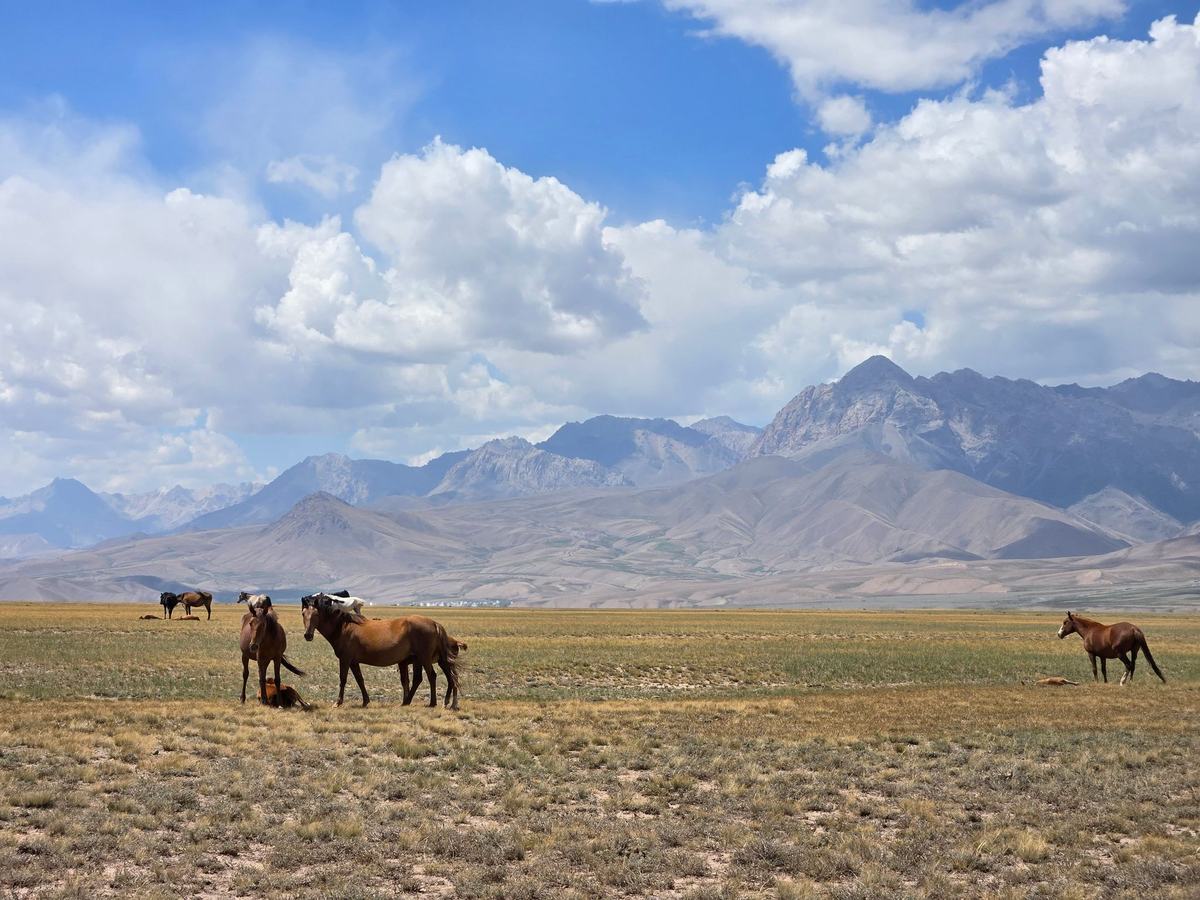
- Capital: Bishkek [1]
- Population: about 7 million [2]
- Area: 199,951 square kilometers [1]
- Official languages: Kyrgyz (state language) and Russian (official) [1]
- Currency: Kyrgyz som (KGS)
- Distinguishing claim: roughly 90 percent of the country sits more than 1,500 meters above sea level [1]
Most people couldn't find Kyrgyzstan on a map. That's probably exactly how it has stayed the way it is. The country is wedged between Kazakhstan, China, Tajikistan, and Uzbekistan, and almost the entire thing is mountain. Not rolling hills. Real mountains, the kind with glaciers and high alpine lakes and shepherds still moving their flocks up to summer pasture the way their great-grandparents did. I spent an afternoon looking at photos of the Tien Shan range and had to remind myself I was looking at a country, not a national park.
A Country Made Almost Entirely of Mountains
Kyrgyzstan is small by Central Asian standards, about the size of South Dakota, but the topography does a lot with that footprint. Roughly 90 percent of the land sits above 1,500 meters, and the highest peaks in the Tien Shan and Pamir ranges climb past 7,000 meters [1]. Jengish Chokusu, the country's tallest mountain on the border with China, reaches 7,439 meters. That is taller than anything in North America by a comfortable margin.
The flat parts, what little of them there are, sit in two narrow valleys. The Chuy Valley in the north holds Bishkek and most of the industry. The Fergana Valley in the south, which the country shares with Uzbekistan and Tajikistan, is the agricultural heart and one of the most densely populated places in Central Asia. Everything in between is rock and ice and grass.
Issyk-Kul, the Lake That Never Freezes
In the eastern part of the country sits Issyk-Kul, the second largest alpine lake in the world after Titicaca [3]. It sits at about 1,600 meters of elevation, stretches roughly 180 kilometers end to end, and is slightly salty. The name means "warm lake" in Kyrgyz, because despite the altitude and the surrounding peaks, the water never freezes. A combination of mild salinity, thermal activity, and sheer depth keeps it liquid all winter.
The lake has been a sort of summer escape for the region for a long time. Soviet sanatoriums lined the northern shore in the twentieth century, and Russian families still vacation there. Underwater archaeology has turned up traces of ancient Silk Road settlements submerged near the coastline, which suggests the lake has risen and fallen significantly over the centuries. Back home in Montana, the biggest natural lake I knew growing up was Flathead. Issyk-Kul could swallow it whole and ask for seconds.
Manas: A National Poem Longer Than the Odyssey and Iliad Combined
This one I had to look up twice. The Epic of Manas is a traditional oral poem that, in its longest recorded versions, runs to more than half a million lines [4]. That makes it roughly twenty times longer than Homer's Odyssey and Iliad put together. It tells the story of the hero Manas and his descendants, weaving together legend, history, genealogy, and Kyrgyz cultural memory across three generations.
Manas was traditionally performed by special bards called manaschi, who would recite from memory in a kind of trance-like cadence for hours at a stretch. The art has been recognized by UNESCO as part of the world's intangible cultural heritage. There are still working manaschi today, and the epic has the same kind of foundational status for Kyrgyz identity that the Mahabharata has in India or the Iliad once had in Greece. It is, on a per-capita basis, probably the largest single piece of literature any nation has produced.
A Living Nomadic Tradition
Most Central Asian countries have nomadic roots, but Kyrgyzstan still wears them on the surface. Every summer, families move their livestock up into high mountain pastures called jailoo, sometimes for months at a time, living in yurts (the local word is boz uy) and making cheese and fermented mare's milk called kymyz. This is not a folk performance. It is how a meaningful chunk of the rural economy still works.
The boz uy is on the national flag, which tells you how seriously the culture takes its yurt heritage [1]. The red field with the central yellow sun and the crown of the yurt roof beams. Few flags in the world reference a piece of architecture that people are still actively building and living in.
National sports keep the tradition alive in another way. Kok boru is a horseback game played with a goat carcass instead of a ball, and it is genuinely intense to watch. Eagle hunting still happens in the high country, mostly with golden eagles trained to take foxes and hares. Horse-back archery, ulak tartysh, and various wrestling styles round out a sporting culture that has changed surprisingly little since the days of the Mongol confederations.
A Quiet Democracy in a Tough Neighborhood
Kyrgyzstan is the most politically open country in Central Asia, which is not saying nothing. Since independence from the Soviet Union in 1991, the country has had several genuine transitions of power, including two revolutions, in 2005 and 2010, that pushed out sitting presidents [5]. The 2010 events also brought in a parliamentary system, unusual for the region, though more recent constitutional changes have shifted power back toward the presidency.
This is not Switzerland. Politics here are messy and sometimes violent. But compared to its neighbors, where leadership transitions are mostly choreographed or hereditary, Kyrgyzstan has held something closer to real elections. Outside observers tend to describe it, with some hedging, as a hybrid regime with genuine political competition.
Walnut Forests and a Strange Soviet Border Map
The Arslanbob walnut forest in the south is the largest naturally growing walnut forest in the world. It covers more than 600 square kilometers in the foothills of the Fergana range, and the trees there are believed to be the wild ancestors of nearly every cultivated walnut in Eurasia. Alexander the Great's armies reportedly carried walnuts from this region back west, which is how the tree spread across the Mediterranean.
And here's the thing about the border. Soviet planners in the 1920s drew the lines between Kyrgyzstan, Uzbekistan, and Tajikistan in ways that left small chunks of one country completely surrounded by another. Several of these enclaves still exist, and they have produced more than a few diplomatic headaches and occasional shooting incidents over water and pasture rights. The map of the Fergana Valley, if you zoom in, looks less like a border and more like a jigsaw puzzle somebody finished with the pieces upside down.
Frequently Asked Questions
Where is Kyrgyzstan located?
Kyrgyzstan is a landlocked country in Central Asia, bordered by Kazakhstan to the north, China to the east, Tajikistan to the south, and Uzbekistan to the west. The country sits along the western end of the Tien Shan mountain range and is one of the highest-elevation nations in the world.
What language do people speak in Kyrgyzstan?
Kyrgyz is the state language, and Russian is the official language used in business and government. Both are widely spoken in cities. Kyrgyz is a Turkic language closely related to Kazakh, and Russian remains common from the Soviet era.
Is Kyrgyzstan safe for tourists?
Kyrgyzstan is generally considered one of the safer Central Asian destinations for travelers, with low rates of violent crime and a growing tourism sector focused on trekking and horseback travel. Visitors should be cautious in border regions and during occasional political demonstrations in Bishkek.
What is Kyrgyzstan known for?
Kyrgyzstan is known for its dramatic mountain landscapes, the alpine Lake Issyk-Kul, the Epic of Manas, and its living nomadic culture with summer yurt camps in high pastures. It is also recognized as the most politically open country in Central Asia.
Do you need a visa to visit Kyrgyzstan?
Citizens of more than sixty countries, including the United States, the United Kingdom, Canada, Australia, and most European Union member states, can visit Kyrgyzstan visa-free for up to sixty days. Other nationalities can apply for an electronic visa online before traveling.