- Capital: Vientiane [1]
- Population: about 7.6 million [2]
- Area: 236,800 square kilometers [1]
- Official language: Lao [1]
- Currency: Lao kip (LAK)
- Distinguishing claim: the most heavily bombed country per capita in the history of warfare [3]
I grew up thinking Southeast Asia meant beaches. Thailand, Vietnam, the Philippines, all those long coastlines on the National Geographic maps in the school library. Then I read about Laos and had to recalibrate. The country has no ocean at all. It is the only landlocked nation in Southeast Asia, a long curving strip of mountains and river valleys tucked between China, Vietnam, Cambodia, Thailand, and Myanmar. Almost everyone who travels the region skips it. The people who do go tend to describe it the same way: quiet, slow, and unlike anywhere else they have been.
A Country Held Together by One River
The Mekong River runs the entire length of Laos, more than 1,800 kilometers of it, and the country basically exists in the valleys it carves [1]. Most of the population lives within a day's walk of the water. Vientiane, the capital, sits right on the riverbank, with Thailand visible on the other side. So does Luang Prabang, the old royal capital, and most of the major towns south of there.
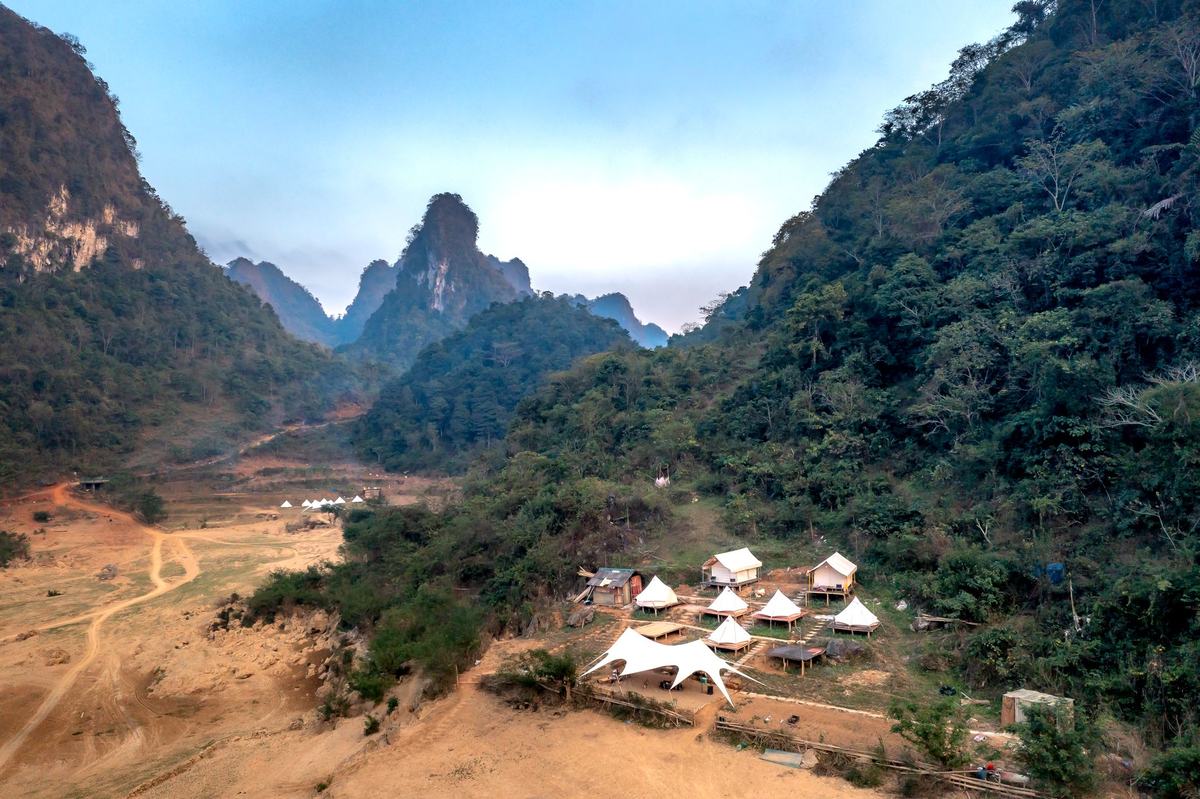
Outside the river valleys, the country is mountain and forest. The Annamite Range runs along the eastern border with Vietnam, and the northern provinces fold up into highlands that touch China and Myanmar. Roads are slow. Some villages are still easier to reach by boat than by car. The terrain is the reason Laos has stayed rural longer than its neighbors, and it is also why the country still has some of the most intact forest cover in mainland Southeast Asia.
The Most Bombed Country in History
Here is something that will ruin the next geography quiz you take. Between 1964 and 1973, the United States dropped more than two million tons of bombs on Laos as part of a secret campaign tied to the Vietnam War [3]. That is more than was dropped on Germany and Japan combined during all of World War II, on a country roughly the size of Utah, with a population that was then under three million people. On a per-capita basis, no country in history has been bombed harder.
A lot of those bombs did not explode on impact. The estimates suggest that around 80 million unexploded cluster bomblets, locally called "bombies", are still scattered across the countryside [3]. Farmers occasionally hit one while plowing. Children sometimes find them and mistake them for toys. Clearance organizations like the Mines Advisory Group have been working through the country for decades, and at the current pace it will take generations to finish. This is not ancient history. It is a present-tense problem that shapes where people can build, plant, and walk.
I had to look this up twice when I first read it. The scale of it is the kind of thing that should be in every textbook and somehow is not in most of them.
Luang Prabang and the Saffron Procession
The old royal capital of Luang Prabang sits at the confluence of the Mekong and the Nam Khan rivers, and the whole town is a UNESCO World Heritage Site [4]. The historic center is a tight grid of French colonial shophouses and Buddhist temples, hemmed in by water on two sides. Most cities that get the UNESCO label end up overrun by tour buses and souvenir shops. Luang Prabang has commercialized, sure, but it has done so in a way that still leaves the place feeling like a working town rather than a stage set.
Every morning before dawn, a procession of monks in saffron robes walks barefoot through the streets to collect alms from local residents who kneel along the curb with baskets of sticky rice. This is not a tourist performance. It is a daily devotional practice that predates the colonial era and has continued, with brief Soviet-influenced interruptions, for centuries. If you go, the rule is to watch quietly from a respectful distance.
A Buddhist Country That Eats Sticky Rice With Its Hands
Lao culture is shaped almost entirely by Theravada Buddhism, the same branch practiced in Thailand and Cambodia. Roughly two-thirds of Lao men spend at least some time as a monk during their lives, often as teenagers in a short novitiate that lasts a few weeks to a few months [1]. Temple complexes called wats anchor most villages, and the major festivals follow the Buddhist calendar.
The other unmissable thing about Lao culture is the food. Laotians eat more sticky rice per capita than any other nation on earth [1]. The rice is steamed in woven bamboo baskets, served in similar baskets at the table, and eaten with the hands. You pinch off a small ball, roll it briefly between your fingers, dip it in something flavorful, and pop it in. The national dish, larb, is a salad of minced meat, herbs, lime, fish sauce, and toasted rice powder. The cuisine punches well above its weight and is almost completely unknown outside the region.
The Plain of Jars
In the north central province of Xieng Khouang, scattered across hilltop meadows, sit thousands of large stone jars. Some are small enough to step over. Others are taller than a person, weighing several tons each. Nobody is entirely sure who made them or why [5]. The leading archaeological theory is that they are part of an Iron Age burial culture from about 2,500 years ago, with the jars used as funerary urns or transitional vessels for the dead. Local legend says they were used to brew rice wine for a giant army.
The Plain of Jars was added to the UNESCO World Heritage list in 2019. It is also one of the most heavily bombed parts of the country, so much of the site is still being cleared of unexploded ordnance. Visitors stick to marked paths, and the contrast of ancient stone jars and modern bomb craters in the same field is unsettling in a way that lingers.
A Land of Many Peoples
Laos is officially home to forty-nine recognized ethnic groups, often loosely organized into three highland-based categories: Lao Loum (lowland), Lao Theung (midland), and Lao Soung (highland) [1]. The lowland Lao make up roughly half the population and dominate the river valleys. The other half is a patchwork of Hmong, Khmu, Akha, Yao, and dozens of smaller groups, each with their own language, dress, and village traditions.
This diversity is one of the things that makes traveling through the country feel less like visiting a single nation and more like crossing a series of overlapping cultural worlds. Markets in the highlands sell embroidered jackets that take months to make. Hmong New Year celebrations involve courtship ball-tossing games that go back centuries. Which, if you think about it, is a lot of cultural variety for a place most outsiders cannot point to on a map.
Frequently Asked Questions
Where is Laos located?
Laos is a landlocked country in Southeast Asia, bordered by China to the north, Vietnam to the east, Cambodia to the south, and Thailand and Myanmar to the west. It is the only country in the region without a coastline, and the Mekong River forms much of its western border.
What language do people speak in Laos?
Lao is the official language, a tonal Tai-Kadai language closely related to Thai. Many Laotians also understand Thai due to overlapping media, and French remains in limited use from the colonial era. Dozens of minority ethnic languages are spoken in highland regions.
Is Laos safe for tourists?
Laos is generally considered one of the safer countries in Southeast Asia for travelers, with low rates of violent crime. The main hazard is unexploded ordnance left from the Vietnam War era in rural areas, so visitors should stay on marked paths in affected regions.
What is Laos known for?
Laos is known for the Mekong River, the UNESCO-listed town of Luang Prabang, daily Buddhist alms-giving processions, the mysterious Plain of Jars, and its quiet, slow-paced rural culture. It is also widely cited as the most bombed country per capita in history.
Do you need a visa to visit Laos?
Most travelers can obtain a visa on arrival at major international entry points, typically valid for 30 days. Citizens of several ASEAN countries can enter visa-free, while many others can apply for an electronic visa online before traveling.