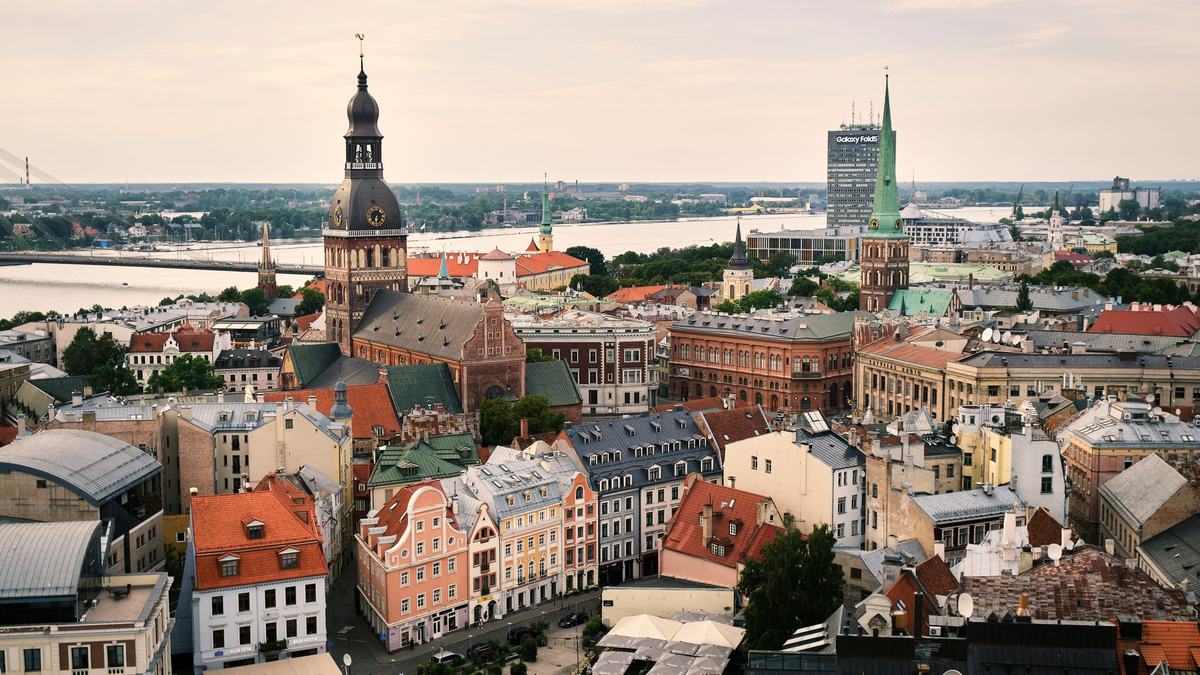
- Capital: Riga [1]
- Population: About 1.86 million [2]
- Area: 64,589 square kilometers (24,938 sq mi) [1]
- Official language: Latvian [1]
- Currency: Euro (since 2014) [3]
- Distinguishing claim: Roughly 52% of the country is covered in forest, one of the highest shares in the European Union [4]
Here's something that'll ruin the next geography quiz you take: Latvia is more forest than anything else. Over half the country. I had to look this up twice because I kept thinking of Latvia as one of those flat, bookish little Baltic states with a pretty capital and not much else going on. Turns out you can drive for an hour and see almost nothing but pine and birch and the occasional moose road sign. It's the kind of place where the trees outnumber the people by a wide margin, and somehow that fact tells you most of what you need to know about how Latvians live.
A Country That Sang Its Way to Independence
In 1989, two million people across Latvia, Estonia, and Lithuania joined hands in a single unbroken human chain that stretched roughly 675 kilometers from Tallinn through Riga to Vilnius [5]. They called it the Baltic Way. Latvians had been doing a quieter version of this for years already, gathering in massive choirs and singing songs the Soviets had banned. It became known as the Singing Revolution, and it actually worked. By 1991, Latvia was independent again, and the Soviet tanks that rolled into Riga that January were met by unarmed people building barricades out of cobblestones and concrete blocks [6].
Which, if you think about it, is a strange and beautiful way to take a country back. No shots fired on the Latvian side. Just singing, and standing there, and refusing to leave.
Riga's Astonishing Architecture
Riga has the largest collection of Art Nouveau buildings in the world. Not one of the largest. The largest [7]. Roughly a third of the buildings in the city center are in that style, all curling vines and stone faces and dramatic women carved into facades like the building is trying to flirt with you. The whole historic center is a UNESCO World Heritage Site, and a lot of it is the work of one architect, Mikhail Eisenstein, whose son Sergei went on to direct "Battleship Potemkin". So if you ever wondered where a Soviet filmmaker got his sense of theatrical excess, you can blame his father's day job.
Walk down Alberta Street some morning when the light hits right and the place feels less like a city block and more like someone's fever dream made of stone. Back home in Montana, the oldest building in my hometown was a feed store from 1947. Riga's old town has 800-year-old churches with chickens on the weathervanes.
The Coast Is Made of Amber
The Baltic Sea coast is one of the world's main sources of amber, the fossilized tree resin that's been traded out of this region for at least 4,000 years [8]. The Roman writer Pliny the Elder mentioned a Roman expedition that traveled all the way to the Baltic in the first century just to get amber, and the kids he bought from local traders apparently came back with so much of it that they used it to decorate gladiator gear. Latvian kids still find pieces of it washed up after storms. It glows orange in the sun, and sometimes you'll find one with a 40-million-year-old mosquito frozen inside.
Latvians have made jewelry and decorative inlays out of amber for as long as anyone can remember. You'll see it in every souvenir shop and also in the small museum-quality galleries where serious artisans turn it into pieces that are genuinely beautiful and have nothing to do with tourist kitsch.
A Pagan Streak That Never Quite Died
Latvians officially converted to Christianity in the 13th century, but the old gods never fully left. The biggest holiday of the year is not Christmas. It's Jāņi, the Midsummer festival on June 23rd and 24th. People drive out of the cities, light bonfires that burn all night, wear oak leaf crowns, eat caraway cheese, drink homemade beer, and refuse to sleep until the sun comes back up [9]. The whole point is to stay awake through the shortest night of the year, and it traces back to pre-Christian solstice rituals that the Catholic and later Lutheran churches mostly just gave up trying to suppress.
There's also a long-running collection of folk songs called dainas, four-line poems passed down orally for centuries. A 19th-century Latvian named Krišjānis Barons spent his life cataloguing them and ended up with over 200,000 [10]. They're now in UNESCO's Memory of the World register. Think about that number. Two hundred thousand poems, in a country with fewer than two million people. Nobody talks about this, but per capita, Latvia might be the most poetically dense place on earth.
Storks, Lynx, and the Quiet Wilderness
Because so much of Latvia is forest and wetland, the wildlife is genuinely wild. Around 10,000 pairs of white storks nest here every summer, one of the densest populations in Europe [11]. You'll see them on power poles, on chimneys, on the tops of barns. Latvians consider it lucky if a pair builds a nest on your property. Lynx, wolves, brown bears, and beavers all live in the forests too. Gauja National Park, the country's oldest and largest, covers a stretch of river valley that locals call the Latvian Switzerland, which is a bit of a stretch on the elevation but absolutely fair on the beauty.
Frequently Asked Questions
Is Latvia part of the European Union?
Yes. Latvia joined the European Union in 2004 and adopted the euro in 2014. It's also a member of NATO and the Schengen Area, so travel from most of Europe is passport-free. Riga is the largest city and the main international gateway.
What language do they speak in Latvia?
Latvian is the official language and is spoken by most of the population. It's one of only two surviving Baltic languages, the other being Lithuanian. Russian is also widely understood, especially in Riga, due to the country's Soviet-era history. English is common among younger people.
Is Latvia a safe country to visit?
Latvia is generally considered safe for travelers, with low rates of violent crime. Riga's old town is well-policed and walkable, though normal precautions against pickpocketing in tourist areas apply. Roads are good, public transport is reliable, and tap water is safe to drink.
What is Latvia famous for?
Latvia is best known for Riga's Art Nouveau architecture, its Baltic Sea amber, its Singing Revolution against Soviet rule, and the Midsummer festival of Jāņi. It also has the highest forest cover of any EU country apart from Finland and Sweden, and a remarkable folk-song tradition.
When is the best time to visit Latvia?
Late June through August offers the warmest weather, long daylight hours, and the Jāņi festival on June 23rd to 24th. May and September are quieter and pleasant. Winter is cold, often below freezing, but Riga's Christmas markets and the snowy forests have their own appeal.
Sources
- The World Factbook: Latvia
- Official Statistics of Latvia: Population
- European Central Bank: Latvia and the euro
- Eurostat: Forests, forestry and logging
- Encyclopaedia Britannica: Baltic Way
- BBC: How the Baltic states broke free of the USSR
- UNESCO World Heritage Centre: Historic Centre of Riga
- Encyclopaedia Britannica: Amber
- Latvian Institute: Midsummer in Latvia
- UNESCO Memory of the World: The Dainu Skapis
- BirdLife International: White Stork