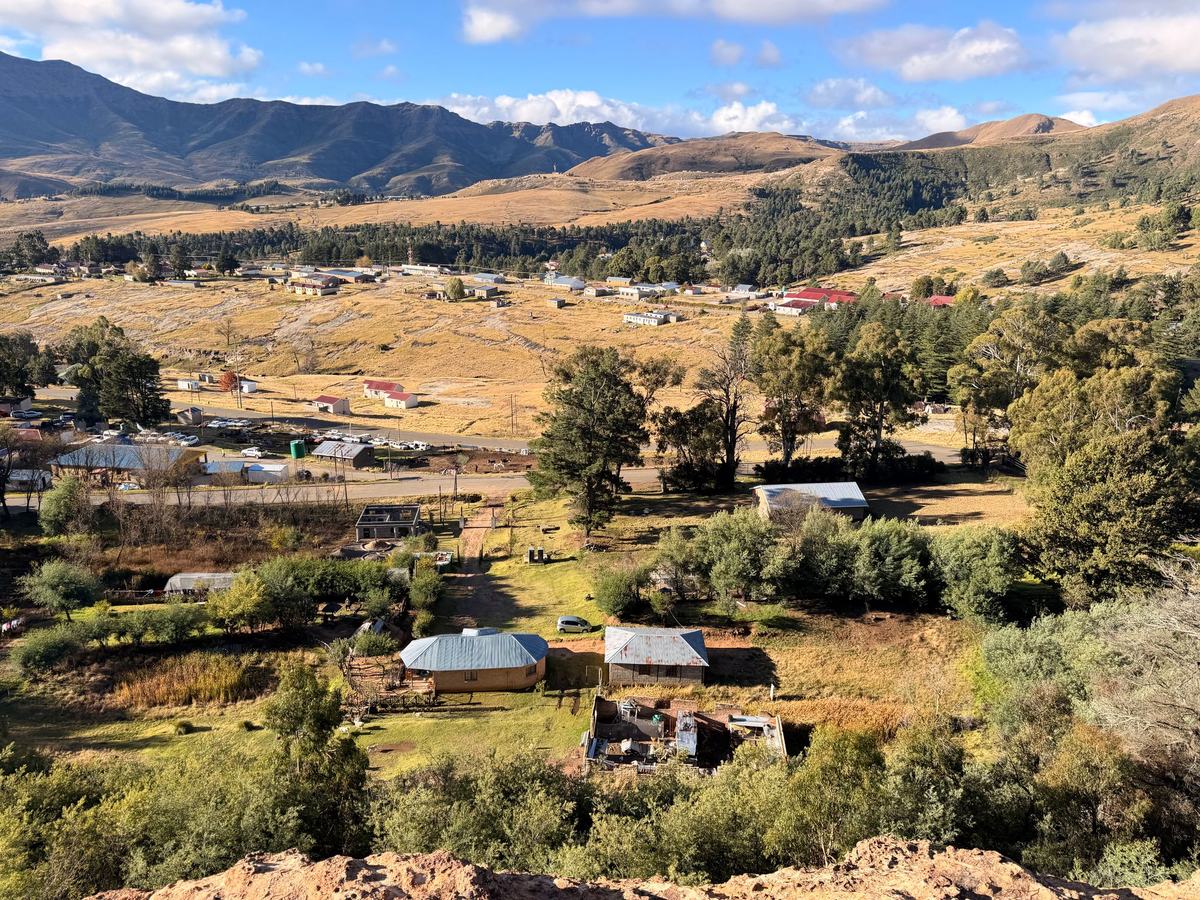
- Capital: Maseru [1]
- Population: about 2.3 million [2]
- Area: 30,355 square kilometers (11,720 sq mi) [1]
- Official languages: Sesotho and English [1]
- Currency: Loti (LSL), pegged to the South African rand [3]
- Lowest point above sea level of any country on Earth: 1,400 meters [4]
Here's something I had to look up twice: there's a country where you literally cannot stand below 1,400 meters of elevation. Not a mountain range, not a national park. A whole country. That's Lesotho, and the more I read about it, the more I wondered how a place this strange and beautiful stays so quietly off the radar.
A Country That Sits Entirely Above 1,400 Meters
Most countries have a coast, a valley, somewhere low you can drive down to. Lesotho doesn't. Its lowest point, where the Senqu and Makhaleng rivers meet, sits at 1,400 meters above sea level, which is higher than the highest point in 14 US states [4]. That's the lowest spot in the entire country. The high point, Thabana Ntlenyana, climbs to 3,482 meters [1].
This is why Lesotho gets called "the Kingdom in the Sky". It's not marketing. It's geography being honest. The whole country is essentially the roof of southern Africa, an island of mountains pushed up between the Drakensberg and the Maloti ranges.
Back home in Montana we measured altitude in feet and felt smug about anything over 5,000. Lesotho's capital sits at roughly 1,600 meters - around 5,200 feet - and that's the low ground.
Completely Surrounded by Another Country
Lesotho is one of only three countries in the world that's entirely encircled by a single other nation. The other two are Vatican City and San Marino, both tucked inside Italy. Lesotho is wrapped on every side by South Africa [1].
Which, if you think about it, is a wild situation. You can't drive to Lesotho from anywhere except through South African territory. Every road in, every flight, every shipment of fuel or food crosses the same border. The country has had to build a national identity inside someone else's geography, and it has done that well. The Basotho people have their own language, their own monarchy, their own flag, and a strong sense of where they end and South Africa begins.
The capital, Maseru, sits right on the Caledon River, which forms the western border. Stand on the bridge and you can watch trucks roll between two countries that look, from a distance, like the same brown hills.
The Basotho Blanket Is a National Uniform
If you've seen a photograph of Lesotho, you've probably seen the blanket. Thick wool, patterned with corn cobs or crowns or geometric shields, worn pinned at the shoulder. It's not a costume for tourists. People wear Basotho blankets to work, to weddings, to herd sheep, to inaugurations.
The blankets arrived in the 1860s, reportedly when King Moshoeshoe I received one as a gift and started wearing it instead of the traditional animal-skin kaross [5]. Within a generation, the wool blanket had become a marker of Basotho identity. Today the designs carry meaning. The "Seanamarena" - the king's blanket - is the prestige piece. Corn cob patterns signal fertility and abundance. Specific blankets are worn for initiation, for marriage, for mourning.
It's a rare thing, a traditional garment that didn't fossilize into folk costume. People still buy them new. The factories that weave them, mostly across the border, design new patterns every year.
A King Who Studied at Oxford
Lesotho is a constitutional monarchy. The current king, Letsie III, took the throne in 1996 and has held it ever since [1]. He studied at the National University of Lesotho, then at Bristol and Cambridge, then Oxford for postgraduate work in agricultural development.
The royal role is mostly ceremonial. Parliament does the governing, the prime minister runs the country day to day. But the monarchy carries the cultural weight. The king is the symbolic head of the Basotho nation, and that matters in a country where national identity has been hard-won.
The kingdom traces its founding to Moshoeshoe I, who in the early 1800s gathered scattered Sotho-speaking clans onto a flat-topped mountain called Thaba Bosiu and defended them through decades of regional war. Moshoeshoe is the reason there's a Lesotho at all. Every Basotho child learns his name the way American kids learn Washington's.
Snow in Africa: Yes, Actually
People are surprised that Lesotho has a ski resort. It does. Afriski, in the Maloti Mountains, runs a small slope from June through August with manmade snow and the occasional natural dump [6]. In winter, temperatures in the highlands drop well below freezing and snow can blanket the peaks for weeks.
This still throws me. I grew up thinking Africa was the continent of savannas and deserts, which is the kind of flat-footed mental map that ignores how mountains work. Elevation beats latitude. Lesotho is roughly the same latitude as Buenos Aires, but it's so high that summer afternoons in Maseru can be warm while the peaks 100 kilometers away are getting hammered by snow.
The cold is part of why the Basotho blanket caught on so fast. You need a wool blanket up there. You really do.
Water Is the Export
Lesotho has one big natural resource and it isn't gold or diamonds, though it has some of both. It's water. The Lesotho Highlands Water Project, a massive engineering effort that started in the 1980s, captures rainfall and snowmelt in highland reservoirs and pipes it under mountains to South Africa, mostly to thirsty Johannesburg [7]. In exchange, Lesotho gets royalties and hydroelectric power.
The project includes some of the tallest dams in Africa - Katse Dam stands 185 meters high - and tunnels that bore through dozens of kilometers of mountain rock. For a small country, it's a serious piece of infrastructure, and it makes water Lesotho's most valuable export by a long stretch.
There's something quietly satisfying about it. The country that sits highest sells what gravity gives it.
A Pony Culture in the Mountains
The Basotho pony is its own small chapter of world horse history. Bred from horses brought to southern Africa in the 1800s, the Basotho pony is sturdy, sure-footed, and adapted to high altitude. For people living in remote mountain villages with no roads, the pony is still the practical way to get anywhere.
Pony trekking has also become one of the few tourism draws the country actively markets. You can ride for days through the highlands, sleep in village huts, and not see a paved road. It's the kind of trip that doesn't really exist most places anymore.
Frequently Asked Questions
Is Lesotho a country?
Yes, Lesotho is an independent sovereign nation in southern Africa. It gained independence from the United Kingdom in 1966 and is a member of the United Nations and the African Union. It is a constitutional monarchy with King Letsie III as head of state.
Why is Lesotho inside South Africa?
Lesotho is entirely surrounded by South Africa because of how its borders were drawn during the colonial era. The kingdom of Moshoeshoe I sought British protection in 1868 to avoid annexation by the surrounding Boer republics. It became Basutoland under British rule and kept those borders at independence in 1966.
What language do they speak in Lesotho?
The two official languages of Lesotho are Sesotho and English. Sesotho is the first language of the vast majority of the population, and English is widely used in government, business, and education. Most Basotho are bilingual from school age.
Is Lesotho safe to visit?
Lesotho is generally considered safe for travelers, especially in tourist areas like Maseru, Semonkong, and the highland trekking regions. Petty crime occurs in the capital, so standard precautions apply. The mountain roads can be challenging in winter due to snow and ice, so plan accordingly.
What is the climate like in Lesotho?
Because of its high elevation, Lesotho has a cooler climate than most of southern Africa. Summers (November to February) are mild and rainy. Winters (June to August) are cold and dry, with frost most nights and snow common in the highlands. Maseru averages around 15°C annually.