- Capital: Monrovia [1]
- Population: about 5.4 million [2]
- Area: 111,369 square kilometers (43,000 sq mi) [1]
- Official language: English [1]
- Currency: Liberian dollar (LRD), used alongside the US dollar [3]
- Founded in 1847 by formerly enslaved Black Americans repatriated from the United States [4]
I had to look this up twice. There is a country in West Africa whose capital is named after James Monroe, whose flag has stars and stripes, and whose constitution was modeled on the one signed in Philadelphia. That's Liberia, and the story behind how it got there is one of the strangest threads in nineteenth-century history.
A Country Founded From the Other Side of the Atlantic
Liberia was created in the early 1800s by the American Colonization Society, a group that wanted to resettle free Black Americans in Africa [4]. The motives were tangled. Some members were abolitionists who believed a free Black population could never achieve equality in the United States. Others were slaveholders who simply wanted free Black people out of the country. The result was the same: starting in 1822, ships began carrying settlers to a stretch of coast that would become Liberia.
The settlers, who came to be called Americo-Liberians, declared independence in 1847 and wrote a constitution that borrowed heavily from the American one [4]. The flag they raised had eleven stripes and a single white star on a blue square. The capital they built was named for the US president who had supported the colonization effort.
Which, if you think about it, is a kind of geography I had no template for. A country that exported people back across the ocean and then declared itself a republic.
The Flag Looks American on Purpose
Liberia's flag is the most direct visual quotation of the US flag flying anywhere in the world. Eleven red and white stripes representing the eleven signers of the Liberian Declaration of Independence. A blue canton in the corner. A single white star, which is where the design quietly diverges, standing for Liberia as the first independent republic in Africa [1].
Stand on a beach near Monrovia and watch one flap in the trade winds, and you have to do a small mental adjustment. It looks like home and it isn't.
The similarity is not an accident or a flattering imitation. It's an architectural choice by founders who saw themselves as carrying American republican ideals into a new place.
Monrovia and a Map Full of American Names
The capital, Monrovia, was named after President James Monroe in 1824 and is one of only two world capitals named after a US president [4]. Washington, DC is the other.
The naming did not stop at the capital. Drive around Liberia and you'll pass towns called Buchanan, Greenville, Harper, and Robertsport. The counties have names like Maryland, Grand Bassa, and Montserrado. These are not random. Many were named for American supporters of the colonization movement, or for the home states of settler groups who arrived together and founded their own communities.
It's a layer of American place names dropped onto West African geography. The local Indigenous communities, who had lived in the region for centuries before the settlers arrived, kept their own names for their own places, and the result is a country where two naming systems run in parallel.
The Oldest Republic in Africa
When Liberia declared independence in 1847, no other African nation was a sovereign republic. Ethiopia had a long imperial history but was a monarchy, not a republic. Most of the continent was either independent in fragmented ways or already being carved up by European powers [4].
This matters more than it sounds. Throughout the colonial scramble of the late 1800s, Liberia held onto its independence, although it lost significant territory to neighboring British and French colonies in negotiations it did not really have the leverage to win. It was never colonized by a European power, which makes Liberia and Ethiopia the two African nations that can make that claim.
The trade-off was that political power inside Liberia stayed concentrated in the hands of the Americo-Liberian minority for more than a century, while the much larger Indigenous population was excluded from full citizenship until the mid-twentieth century. That tension shaped the country's later history and is still part of the conversation today.
Rubber, Iron, and the Firestone Plantation
For decades, the Liberian economy was tied to one company. In 1926, the Firestone Tire and Rubber Company signed a 99-year lease on a million acres of Liberian land and built what became the largest rubber plantation in the world [5]. Rubber from Liberia helped roll American cars through most of the twentieth century.
The country also sits on significant iron ore deposits, which were a major export through the 1960s and 1970s. Like a lot of resource economies, Liberia rode booms and busts that were not entirely in its control.
The Firestone concession is still operating, although the terms have been renegotiated and reformed several times. Driving past the plantation, you see endless rows of rubber trees in perfect lines, each one scored with a diagonal cut that drips white latex into a small cup. It looks like a piece of industrial agriculture lifted straight out of the American South.
Two Civil Wars and a Long Recovery
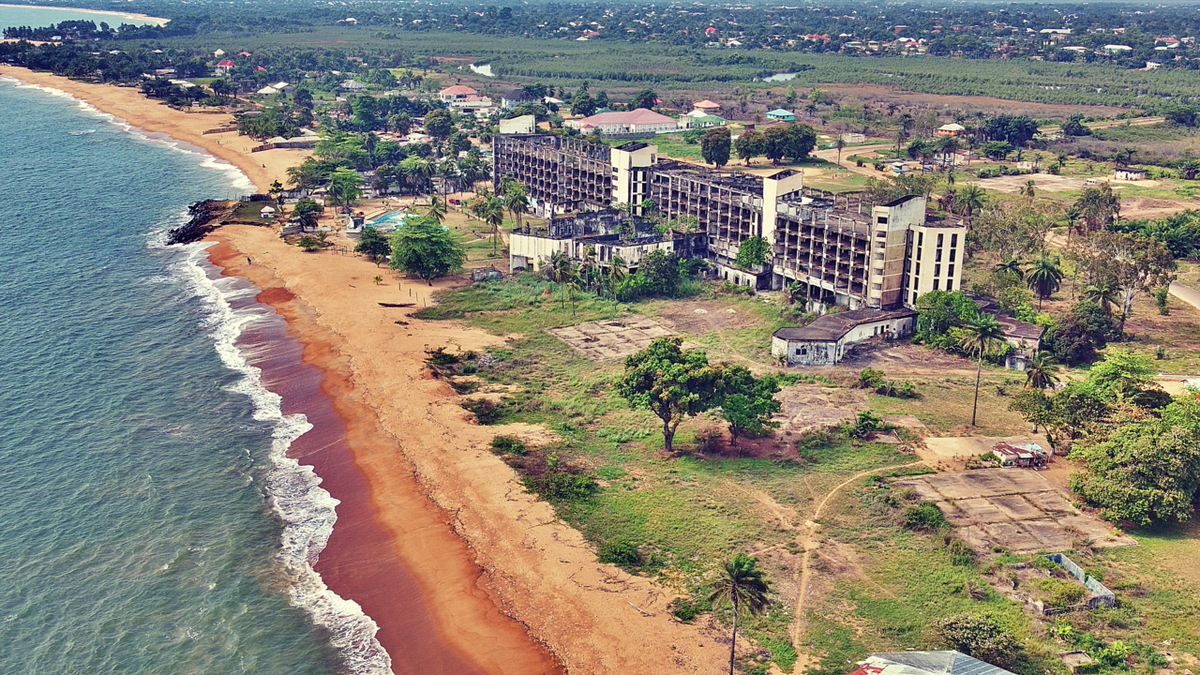
Liberia went through two devastating civil wars between 1989 and 2003 that killed an estimated 250,000 people and displaced much of the population [6]. The wars are recent enough that anyone over thirty in Liberia today remembers them. Monrovia still carries the architectural scars.
The recovery has been slow and uneven, but it has happened. In 2005, Liberia elected Ellen Johnson Sirleaf, the first elected female head of state in Africa, who later shared the Nobel Peace Prize for her work on women's rights [6]. The country has held peaceful elections since, including a presidential transition in 2018.
It would be wrong to write about Liberia without saying this part out loud. The same country that has the stars and the stripes and the constitution and the deep American backstory has also been through the kind of recent history that doesn't fit any of those symbols cleanly.
Frequently Asked Questions
Is Liberia an American country?
Liberia is an independent African nation, not part of the United States. It was founded in 1847 by formerly enslaved Black Americans who were repatriated from the US by the American Colonization Society. Despite strong cultural and historical ties to America, Liberia has been fully sovereign for more than 175 years.
Why does Liberia have a flag like the US flag?
Liberia's flag was designed in 1847 to reflect the country's founding by Black settlers from the United States. It uses eleven red and white stripes and a single white star on a blue field, echoing the US flag but symbolizing Liberian independence as the first African republic.
What language do they speak in Liberia?
The official language of Liberia is English, used in government, education, and business. Liberian English has its own distinct accent and vocabulary. More than 20 Indigenous languages are also spoken across the country, with Kpelle, Bassa, and Grebo among the most common.
Is Liberia safe to visit?
Liberia is generally considered safe for travelers who take standard precautions, especially in Monrovia and main tourist areas. Petty crime can occur, and infrastructure in rural areas is limited. The country has been stable politically since the end of the civil wars in 2003, and tourism is slowly developing.
What is the currency in Liberia?
Liberia uses the Liberian dollar (LRD), but the US dollar is widely accepted and used alongside it in daily transactions. Larger purchases, hotels, and international business are often priced in US dollars, while smaller everyday spending typically uses Liberian dollars.