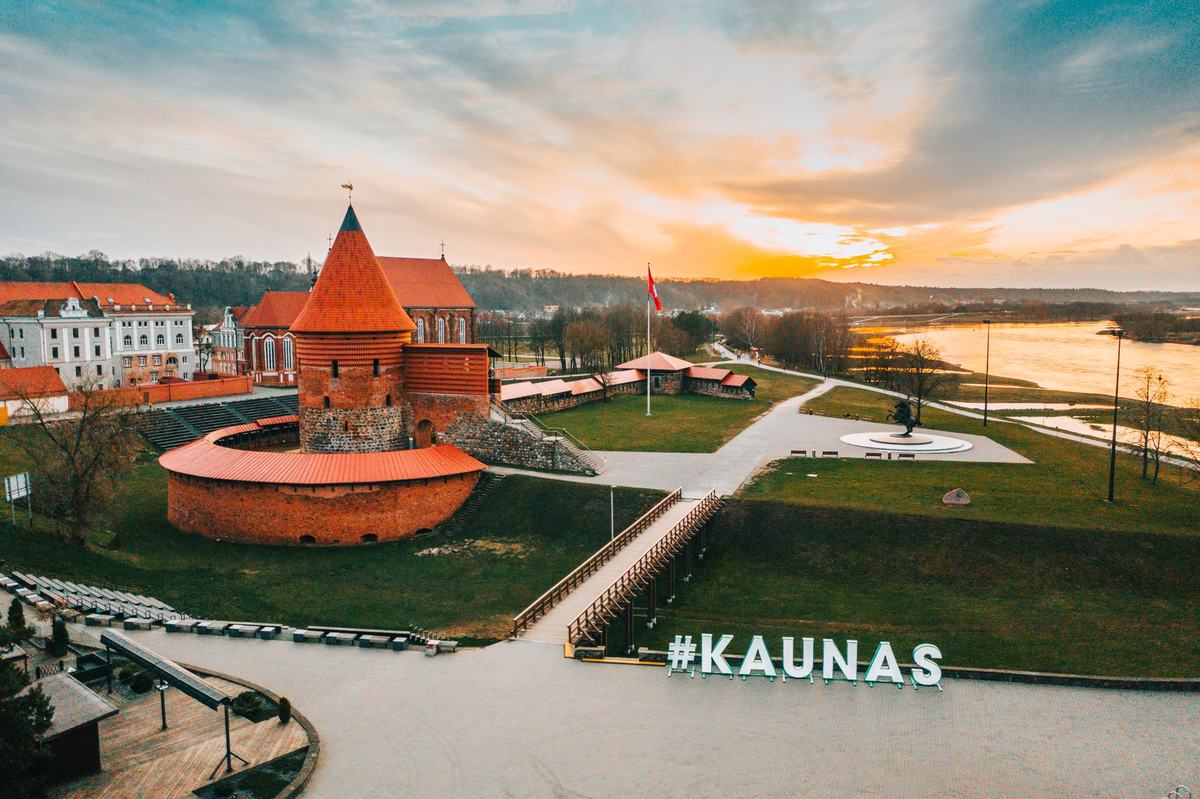
- Capital: Vilnius [1]
- Population: About 2.87 million [2]
- Area: 65,300 square kilometers (25,212 sq mi) [1]
- Official language: Lithuanian [1]
- Currency: Euro (since 2015) [3]
- Distinguishing claim: In the 15th century, the Grand Duchy of Lithuania was the largest state in Europe, stretching from the Baltic to the Black Sea [4]
I grew up thinking Lithuania was a small country that had always been a small country. Then I read about the Grand Duchy and had to sit down for a minute. For about two hundred years in the late Middle Ages, this little patch of pine forest on the Baltic ran a state that reached almost a thousand miles south to the shores of the Black Sea. That gap between what Lithuania is now and what it once was hangs over the whole country. You feel it in Vilnius, you feel it in the back roads, and you feel it in the way Lithuanians tell you their own history without ever quite raising their voice.
A Medieval Empire Nobody Remembers
The Grand Duchy of Lithuania was, for a long stretch of the 14th and 15th centuries, the largest state in Europe by area [4]. It absorbed huge chunks of what is now Belarus, Ukraine, and western Russia. It was also the last pagan state in Europe, holding on to its old gods of thunder and oak trees until 1387, long after the rest of the continent had converted to Christianity [5]. Then it merged with Poland through a royal marriage and the two countries spent the next four centuries as a single Commonwealth that, at its peak, was one of the major powers of Europe.
And then it vanished. Partitioned out of existence by Russia, Prussia, and Austria in the late 1700s. Lithuanians spent the next century and a half being told they were not really a separate people, that their language was a peasant dialect, that their alphabet should be Cyrillic. They did not agree. Turns out you can suppress a national identity on paper for a long time and still not actually erase it.
The Language Is Older Than You'd Guess
Lithuanian is one of the oldest living Indo-European languages still spoken today, and linguists treat it like a kind of living fossil. It has preserved grammatical features and word forms that most other Indo-European languages dropped thousands of years ago [6]. Some Lithuanian words are still recognizably close to Sanskrit. The word for "son" is sūnus, the word for "god" is dievas, the word for "smoke" is dūmas. Linguists who study Proto-Indo-European treat Lithuanian a little the way biologists treat the coelacanth.
There are only about three million speakers in the world, which makes it one of the smaller national languages in the European Union. But its weight in historical linguistics is wildly out of proportion to its size.
A Hill Covered in Crosses
About twelve kilometers north of the city of Šiauliai, there is a small hill that has been quietly accumulating crosses for the better part of two hundred years [7]. Nobody really planned the Hill of Crosses. People just kept bringing them. After a failed uprising against the Russian Empire in 1831, families started leaving crosses there for the dead they could not bury. By the time the Soviets took over a century later, the hill had thousands of them.
The Soviets bulldozed it. Three separate times. They burned the wooden ones, melted the metal ones, and tried to flood the site. Lithuanians kept coming back at night and putting up new ones. By the time the country regained independence in 1991, the hill had more crosses than ever. Today there are well over 100,000, planted into each other, leaning, draped with rosaries, ranging from massive carved oak crucifixes to tiny ones made of bent wire. Pope John Paul II visited in 1993, and that pretty much sealed its place as one of the strangest and most affecting religious sites in Europe.
Basketball Is the Second Religion
If you ask a Lithuanian what their national sport is, they will not say it is football. They will say it is basketball, and they will not be joking [8]. Lithuania has won three Olympic bronze medals, finished fourth at multiple FIBA World Cups, and consistently punches at the level of countries ten or twenty times its size. The national team's bronze medal at the 1992 Barcelona Olympics, just a year after independence, was famously partly funded by the Grateful Dead, who paid for the team's tie-dye uniforms. That is not a thing I made up.
Back home in Montana, basketball was a small-town high school thing, the gym packed on Friday nights and the rest of the week quiet. In Lithuania it is more like that, except the country is the town and the gym is everywhere.
Vilnius and a Tiny Self-Declared Republic
Vilnius is one of the great underrated capitals of Europe. Its old town is a UNESCO World Heritage Site, baroque churches stacked next to Gothic ones, narrow lanes that curve unexpectedly and open onto small squares [9]. It also contains, within its city limits, an artists' neighborhood called Užupis that declared itself an independent republic on April 1st, 1997. The Republic of Užupis has its own flag, its own president, its own twelve-line constitution carved onto a wall in dozens of languages. The constitution includes the lines "A dog has the right to be a dog" and "Everyone has the right to be happy". Customs officers stamp your passport at the bridge if you ask nicely. It is half joke and half real, and the locals will tell you the joke is the point.
The Curonian Spit and the Sand That Walks
Out on the Baltic coast, a long thin strip of sand called the Curonian Spit runs ninety-eight kilometers between the open sea and a wide brackish lagoon [10]. The dunes there are some of the largest moving sand dunes in northern Europe, and over the past few centuries they have buried entire villages. The Lithuanian half of the spit is a national park, the dunes are protected, and pine forests have been planted to stabilize them. It is one of those landscapes that looks like it cannot possibly be in the same country as the snowy forests inland. You stand on top of a dune and the wind moves sand around your boots and a few miles east there are moose in the pines.
Frequently Asked Questions
Is Lithuania part of the European Union?
Yes. Lithuania joined the European Union in 2004 and adopted the euro in 2015. It is also a member of NATO and the Schengen Area, so travel from most of Europe is passport-free. Vilnius is the largest city and the main international gateway.
What language do they speak in Lithuania?
Lithuanian is the official language and is spoken by most of the population. It is one of only two surviving Baltic languages, the other being Latvian, and it is considered one of the most archaic living Indo-European languages. Russian and English are also widely understood, especially among older and younger generations respectively.
Is Lithuania a safe country to visit?
Lithuania is generally considered safe for travelers, with low rates of violent crime. Vilnius and Kaunas are walkable and well-policed, though normal precautions against pickpocketing in tourist areas apply. Roads are good, public transport is reliable, and tap water is safe to drink.
What is Lithuania famous for?
Lithuania is best known for the medieval Grand Duchy that once stretched to the Black Sea, the Hill of Crosses, the baroque old town of Vilnius, its passion for basketball, and the moving sand dunes of the Curonian Spit. It was also the first Soviet republic to declare independence in 1990.
When is the best time to visit Lithuania?
Late May through September offers the warmest weather and long daylight hours, with peak conditions in July and August. Spring and early autumn are quieter and pleasant. Winter is cold, often well below freezing, but Vilnius's old town and Christmas markets have their own appeal.
Sources
- The World Factbook: Lithuania
- Official Statistics Portal of Lithuania: Population
- European Central Bank: Lithuania and the euro
- Encyclopaedia Britannica: Grand Duchy of Lithuania
- Encyclopaedia Britannica: Christianization of Lithuania
- Encyclopaedia Britannica: Lithuanian language
- UNESCO: Cross-crafting and its symbolism in Lithuania
- BBC: Lithuania, the small country with a giant basketball heart
- UNESCO World Heritage Centre: Vilnius Historic Centre
- UNESCO World Heritage Centre: Curonian Spit