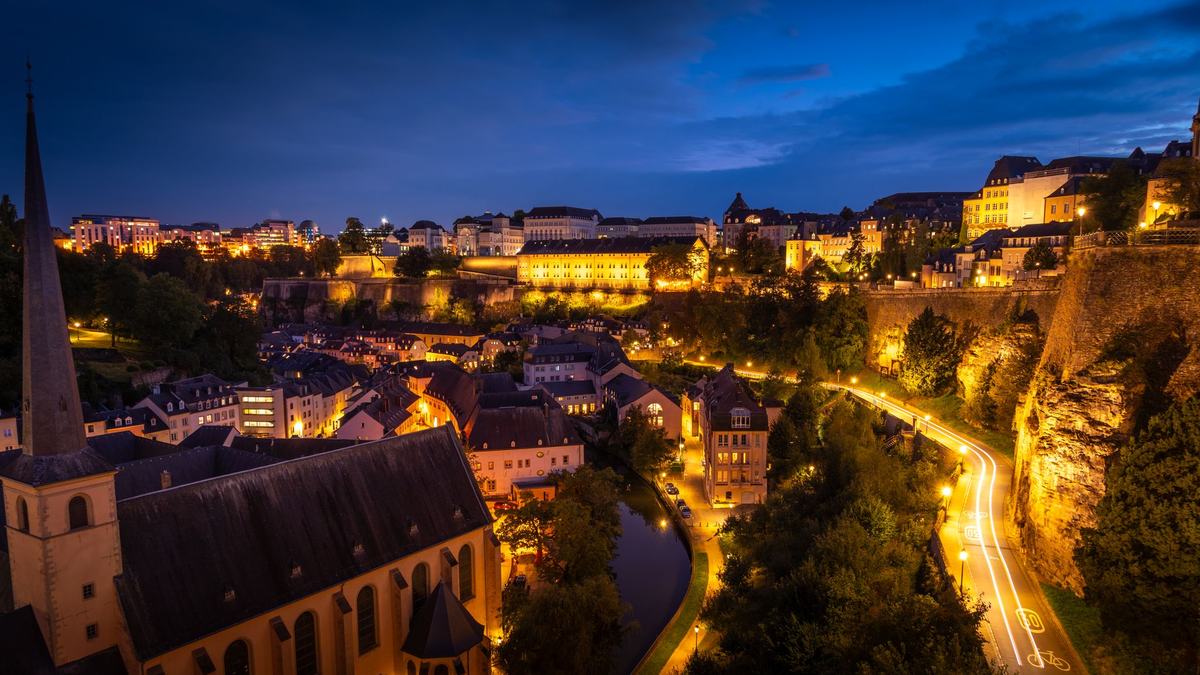
- Capital: Luxembourg City [1]
- Population: roughly 672,000 [2]
- Area: 2,586 square kilometers (998 square miles) [1]
- Official languages: Luxembourgish, French, German [3]
- Currency: Euro (EUR)
- The only sovereign grand duchy in the world [1]
Most people couldn't find Luxembourg on a map without squinting. Which is funny, because it's one of the wealthiest countries on Earth, the last grand duchy still standing, and the place that quietly helped invent the European Union. I had to look this up twice the first time I read it: a country smaller than Rhode Island has more banks per capita than almost anywhere on the planet, runs all its public transit for free, and produces a head of state called a Grand Duke. That gap between how small it is and how much it does is the whole story.
The Only Grand Duchy Left
There used to be a handful of grand duchies scattered across Europe. Tuscany, Baden, Hesse, a few others. They all got swallowed by wars or empires or quiet political mergers. Luxembourg is the only one still standing, and it's been independent since 1839 [1]. The current head of state is Grand Duke Henri, who took the throne in 2000. The title isn't ceremonial in some symbolic way. It's the actual constitutional designation of the country, and it makes Luxembourg unique on the entire planet.
Back home in Montana we had a saying about small towns: if it's small enough, nobody bothers to take it over. Luxembourg sort of pulled that off at the European scale. Wedged between Germany, France, and Belgium, it should have been absorbed by one of them a dozen times over. Instead, it negotiated, married into the right royal families, and stayed put.
Three Languages, One Country
This part still amazes me. Luxembourg has three official languages, and they all do different jobs [3]. Luxembourgish is what people speak at home and in the streets. French is the language of laws and government paperwork. German shows up in newspapers and church. Kids learn all three growing up, and most also pick up English and sometimes a fourth language at school.
Which, if you think about it, is wild for a country you can drive across in under an hour. Luxembourgish itself is a Germanic language with heavy French influence. For a long time it was considered a dialect of German, but in 1984 the country officially declared it a language of its own. There's a slow, ongoing push to standardize spelling and grammar, and the national broadcaster RTL produces shows in it. Linguists love the place. Luxembourgers just shrug and switch languages mid-sentence.
The Free Public Transit Experiment
In 2020, Luxembourg became the first country in the world to make all public transportation free for everyone [4]. Trains, buses, trams, all of it. Tourists, residents, commuters, doesn't matter. You just get on. The only catch is first-class train seats, which still cost money.
The idea was partly about traffic. Luxembourg City has one of the worst commuting situations in Europe per capita, because hundreds of thousands of workers cross the border every day from France, Belgium, and Germany. Making transit free was meant to coax people out of their cars. The results have been mixed, but the experiment itself is remarkable. A whole country decided that getting somewhere shouldn't cost you anything, and just did it.
The Fortress That Became a Capital
Luxembourg City sits on a dramatic outcrop of rock with deep gorges carved by two rivers, the Alzette and the Petrusse. For centuries this was one of the most heavily fortified spots in Europe, nicknamed the "Gibraltar of the North". The Spanish, the French, the Austrians, the Prussians, everybody who held it kept adding to the walls.
In 1867, after the Treaty of London, the great powers agreed Luxembourg would be neutral and the fortress would come down [1]. They dismantled the walls and most of the bastions over the next sixteen years. What's left is still impressive enough that UNESCO put the old city and its fortifications on the World Heritage list in 1994 [5]. You can walk through tunnels carved into the rock, called the Bock Casemates, that once held entire garrisons of soldiers. Twenty-three kilometers of them, dug into the cliffs.
The Wealth That Doesn't Quite Add Up
Luxembourg consistently ranks as the richest country in the world by GDP per capita [2]. The numbers are almost absurd. Over $130,000 per person in recent years, far ahead of the United States, Switzerland, or anywhere in Asia. The economy runs on banking, investment funds, and the European institutions headquartered there. Roughly half the workforce commutes in from neighboring countries every morning, which skews the per-capita math, but even so, Luxembourgers live very, very well.
Here's the thing though. The country is also a major hub for what's politely called tax optimization. A long string of multinational corporations route their European profits through Luxembourg subsidiaries to lower their tax bills. That's been controversial, and the EU has cracked down on some of the more aggressive arrangements. But the legal framework that makes Luxembourg attractive to global capital is also what funds the free buses and the high quality of life.
Steel, Then Satellites
For most of the twentieth century, Luxembourg's economy ran on steel. The country sits on rich iron ore deposits, and the steel industry was once so dominant that the company ArcelorMittal, headquartered in Luxembourg City, became the largest steelmaker in the world. As steel declined globally, Luxembourg had to pivot.
What it pivoted to is, of all things, space. SES, founded in 1985 and still based in the country, is one of the largest satellite operators on Earth. And in 2017, Luxembourg passed a law giving private companies the legal right to own resources they mine in space [1]. They're trying to position themselves as the Delaware of asteroid mining. Whether that pans out or not, the willingness to bet on something that strange is exactly the kind of move a tiny country has to make to stay relevant.
Frequently Asked Questions
What language do people speak in Luxembourg?
Luxembourg has three official languages: Luxembourgish, French, and German [3]. Luxembourgish is spoken in daily life, French is used for laws and government, and German appears in media. Most Luxembourgers speak all three plus English from school.
Is Luxembourg a country or a city?
Luxembourg is both. The Grand Duchy of Luxembourg is a sovereign country in Western Europe, and its capital is also called Luxembourg, often referred to as Luxembourg City [1]. The country covers about 2,586 square kilometers and borders Belgium, France, and Germany.
Why is Luxembourg so rich?
Luxembourg has the highest GDP per capita in the world due to its banking sector, investment fund industry, EU institutions, and favorable corporate tax regime [2]. About half its workforce commutes daily from France, Belgium, and Germany, supporting its small population of around 672,000.
Is public transport really free in Luxembourg?
Yes. Since March 2020, Luxembourg has been the first country in the world to offer free public transit nationwide [4]. Buses, trams, and second-class train travel are free for residents and visitors alike. Only first-class train seats still require a ticket.
What is Luxembourg famous for?
Luxembourg is famous for being the only grand duchy left in the world, its UNESCO-listed fortress capital, free public transportation, and its outsized role in European finance and politics [1] [5]. It's also one of the founding members of the EU and NATO.