- Capital: Kuala Lumpur (with Putrajaya as the administrative capital) [1]
- Population: About 34 million [2]
- Area: 330,803 square kilometers (127,724 sq mi) [1]
- Official language: Malay (Bahasa Malaysia) [1]
- Currency: Malaysian ringgit (MYR) [1]
- Distinguishing claim: Malaysia is one of only a handful of countries physically split by a sea, with its two halves separated by roughly 640 kilometers of the South China Sea [3]
I grew up looking at maps in the back of a Montana library and thinking countries came in tidy shapes. Then I noticed Malaysia. Half of it sits at the bottom of the Asian mainland, dangling off Thailand. The other half is on the island of Borneo, hundreds of miles east across open water. Same flag, same parliament, same prime minister, but you need a plane to get from one to the other. Here's the thing about Malaysia. The geography is just the start. The country has rainforests older than the dinosaurs went extinct, a capital city that once held the tallest building in the world, and a cave so big you could fit a stadium in it. I had to look this up twice.
A Country Cut in Two by the Sea
Malaysia is made up of Peninsular Malaysia, which shares a land border with Thailand and a causeway with Singapore, and East Malaysia, which occupies the northern third of Borneo and shares that island with Indonesia and the tiny sultanate of Brunei [3]. Between the two halves lies about 640 kilometers of the South China Sea. The peninsula holds most of the people, the capital, and the famous skyline. East Malaysia, made up of the states of Sabah and Sarawak, holds most of the wilderness, the indigenous communities, and the wildest landscapes.
The country wasn't really born this way. The Federation of Malaya, made up of the peninsular states, gained independence from Britain in 1957. Sabah and Sarawak joined six years later, in 1963, along with Singapore, to form Malaysia [4]. Singapore was kicked out two years after that and went its own way. What was left was the two-part country you see on the map now. It works, but it makes for a country with two very different personalities depending on which half you're standing in.
A Rainforest That Predates the Amazon
The rainforests of Borneo and the Malay Peninsula are some of the oldest on the planet. The forest in Taman Negara, a national park on the peninsula, is estimated to be around 130 million years old [5]. That means it was already mature when the dinosaurs were still walking around, and it kept going while the Amazon was still being built. The trees in there have had so much time to evolve that the biodiversity is staggering. Botanists routinely find new species, and a single hectare can contain more tree species than the entire United Kingdom.
In Sabah and Sarawak, those same forests are home to orangutans, pygmy elephants, proboscis monkeys, and clouded leopards [6]. Logging and palm oil have done real damage over the last fifty years, and conservation is a constant fight. But what's left is still one of the most biologically rich pieces of land on Earth, and Malaysia is one of only twelve countries the United Nations classifies as "megadiverse".
The Petronas Towers Held a World Record for Six Years
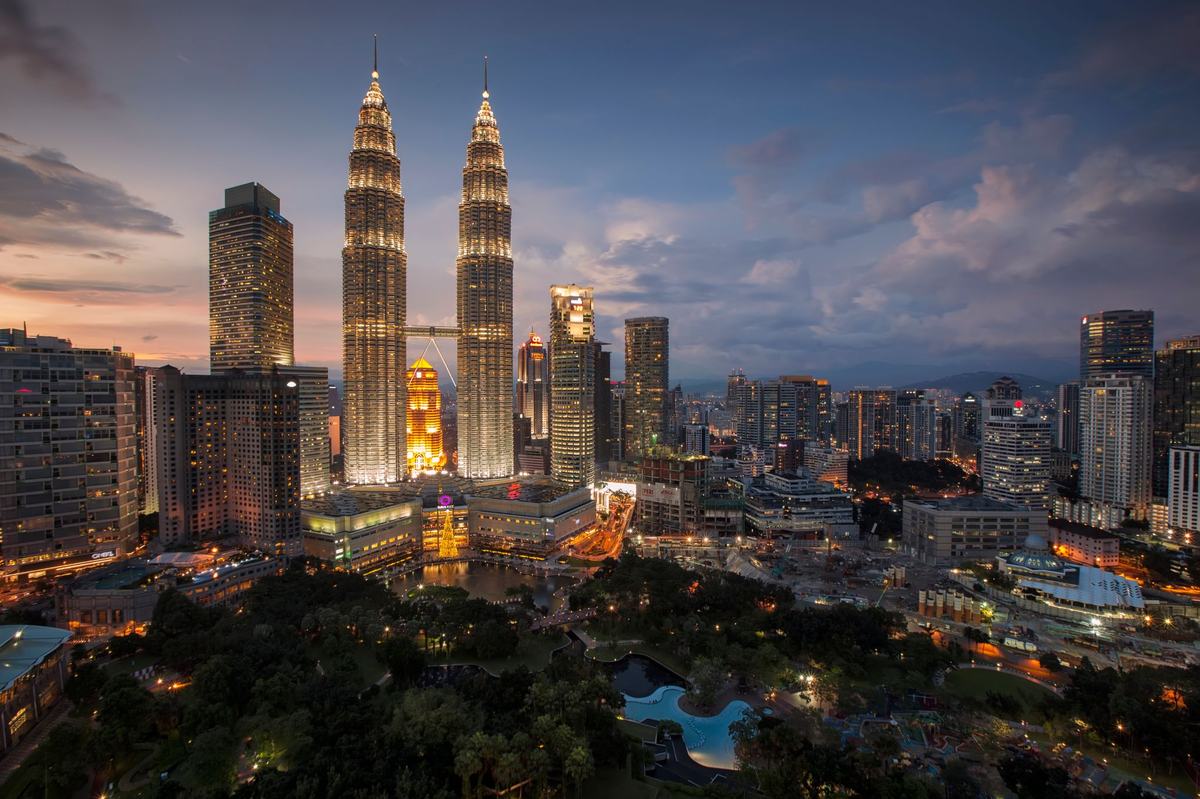
For a stretch between 1998 and 2004, the tallest building in the world wasn't in New York or Chicago or Dubai. It was in Kuala Lumpur. The Petronas Twin Towers rise 451.9 meters (1,483 feet) into the air, and they held the world record for tallest building from their completion until Taipei 101 finally edged them out [7]. They are still the tallest twin towers anywhere.
What I find more interesting than the height is the sky bridge. There's a double-decker walkway connecting the two towers between the 41st and 42nd floors, and the engineering on it is genuinely clever. It isn't bolted rigid. It slides slightly to absorb the swaying of the towers in the wind, so the buildings can sway independently without tearing the bridge apart. Standing up there, you're 170 meters above the ground on a piece of architecture that's deliberately a little bit loose.
Sarawak's Cave Big Enough to Park a Plane
Out in the rainforest of Sarawak, in a national park called Gunung Mulu, there's a chamber inside a mountain called the Sarawak Chamber. By volume, it is one of the largest underground chambers in the world by a clear margin [8]. The numbers are absurd. It is about 700 meters long, 400 meters wide, and 100 meters high. You could fit forty Boeing 747s inside it, parked nose to tail. There is no artificial light in there. Cavers reach it after a long underground river journey and stand in a void so big their flashlights cannot find the far wall.
The same park is home to Deer Cave, which has one of the largest cave passages of any cave on Earth and a nightly outflow of millions of bats that pour out at dusk in a black ribbon you can see from the entrance platform a kilometer away. The whole Mulu park is a UNESCO World Heritage Site, partly because of the caves and partly because of the limestone pinnacles that jut up out of the jungle like teeth.
A Country of Three Main Cultures, Sharing One Plate
Malaysia is one of the most multi-ethnic countries in Southeast Asia. The population is roughly 70 percent ethnic Malay and indigenous, around 22 percent ethnic Chinese, and about 7 percent ethnic Indian, with a small but vibrant mix of others [9]. That mix is the result of centuries of trade and a more recent century of British colonial labor migration, and it has produced one of the great food cultures on the planet.
Walk through a hawker center in Penang or Kuala Lumpur and you will see Malay nasi lemak being sold next to Chinese char kway teow next to Indian roti canai, and people of every background eating all of it. Nasi lemak, the national dish, is a plate of rice cooked in coconut milk with a few sides: a hard-boiled egg, fried anchovies, peanuts, cucumber, and a spicy sambal made from chilies [10]. It costs almost nothing on the street, and it is the breakfast that holds the country together. The food culture is the part of Malaysia that travelers usually fall hardest for, and you can see why.
Frequently Asked Questions
Where is Malaysia located?
Malaysia is in Southeast Asia, split into two parts. Peninsular Malaysia sits south of Thailand and north of Singapore, while East Malaysia occupies the northern part of the island of Borneo, sharing that island with Indonesia and Brunei. The two halves are separated by the South China Sea.
What language is spoken in Malaysia?
Malay, known locally as Bahasa Malaysia, is the official language. English is widely spoken, especially in business, education, and cities, due to the country's British colonial past. Many Malaysians also speak Mandarin, Tamil, or one of several indigenous languages, depending on their community.
Is Malaysia safe for tourists?
Malaysia is generally a safe destination for travelers, with low rates of violent crime against tourists. Petty theft and credit card fraud can occur in busy areas, so normal urban precautions apply. The country has good infrastructure, reliable healthcare in major cities, and a well-developed tourism industry.
What is Malaysia famous for?
Malaysia is known for the Petronas Twin Towers in Kuala Lumpur, some of the oldest rainforests on Earth in Borneo and the peninsula, the massive caves of Gunung Mulu, its multi-ethnic culture of Malay, Chinese, and Indian communities, and a street food tradition centered on dishes like nasi lemak and laksa.
What is the best time to visit Malaysia?
The dry season on the west coast of the peninsula runs roughly from December to February, while the east coast and Borneo are drier from March through October. Temperatures stay warm and humid year-round, hovering around 27 to 32 degrees Celsius. Avoid the worst monsoon rains for outdoor travel.
Sources
- The World Factbook: Malaysia
- Department of Statistics Malaysia: Current Population Estimates
- Encyclopaedia Britannica: Malaysia
- Encyclopaedia Britannica: Formation of Malaysia
- UNESCO: Taman Negara National Park
- WWF: Borneo and Sumatra Forests
- Council on Tall Buildings and Urban Habitat: Petronas Towers
- UNESCO World Heritage Centre: Gunung Mulu National Park
- Department of Statistics Malaysia: Demographic Statistics
- BBC Travel: Nasi lemak, Malaysia's national dish