- Capital: Malé, one of the most densely populated cities in the world [1]
- Population: Around 521,000 [2]
- Area: 298 square kilometers of land, scattered across roughly 90,000 square kilometers of ocean [1]
- Official language: Dhivehi [1]
- Currency: Maldivian rufiyaa (MVR) [1]
- Distinguishing claim: The flattest country on Earth, with an average ground level of only 1.5 meters above sea level [3]
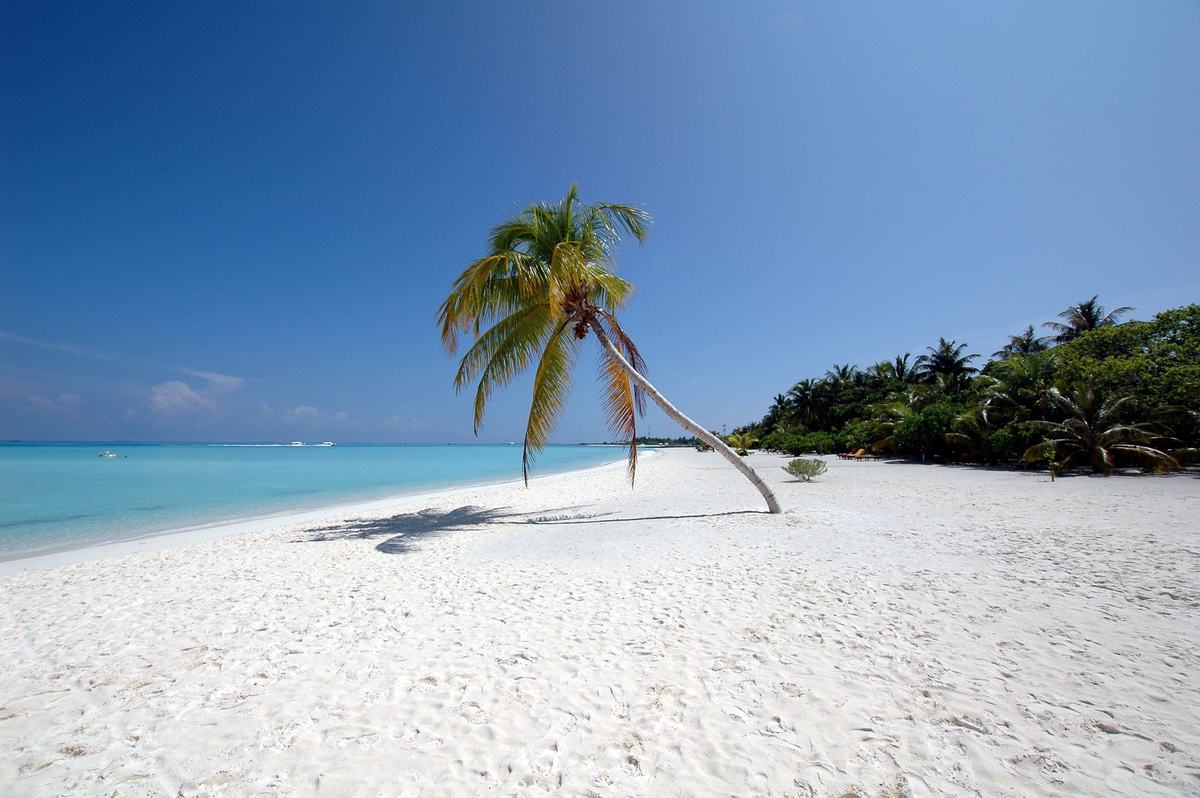
Here's the thing about the Maldives. It's a country, but most of it isn't land. You're looking at 1,192 coral islands strung out across roughly 90,000 square kilometers of the Indian Ocean, and the total dry surface adds up to less than the city of Indianapolis. The country is mostly water, the land that does exist is barely there, and the whole place sits on top of a chain of coral atolls that took something like 60 million years to grow into the shape they're in now.
I read the average elevation number a few times before it sank in. 1.5 meters above sea level. The highest natural point in the entire country is 5.1 meters. Back home in Montana, that's the height of a basketball hoop with a guy standing under it. And that's the tallest thing the Maldives has that isn't a building or a palm tree.
A Country Built on Coral, Sitting on a Submerged Mountain Range
The Maldives runs north to south for about 870 kilometers along the equator, but it's only about 130 kilometers wide at its broadest point. The islands are the tops of coral reefs that grew on top of the Chagos-Laccadive Ridge, an underwater volcanic mountain chain that's been sinking slowly for tens of millions of years. As the volcanoes subsided, the coral kept growing upward, racing the sea level. That's how you get atolls, ring-shaped reefs around lagoons where an island used to be.
The word "atoll" itself comes from Dhivehi, the Maldivian language. "Atholhu". It's one of the only Dhivehi words that made it into English [4]. The country has 26 natural atolls, organized administratively into 21 atoll groups, and the largest of them, Huvadhu, is one of the biggest coral atolls on Earth by surface area.
About 200 of the 1,192 islands are inhabited. Another 150 or so have been developed as one-resort-per-island tourist destinations, which is essentially the country's economic model. You fly into Malé, get on a seaplane or a speedboat, and end up on a sliver of sand that has exactly one hotel on it and no other neighbors.
Malé, the City That Covers Its Entire Island
The capital, Malé, is one of those places that doesn't quite compute until you see a satellite photo. The city covers nearly the entire island it sits on. Roughly 2.2 square kilometers of land, more than 200,000 people living on it. That works out to one of the highest population densities of any city in the world [1].
There are no traffic lanes that go anywhere, in the sense that you can't drive out of town. You can drive across town in about ten minutes. Bridges and reclamation projects have started to spill the city onto neighboring islands. Hulhumalé, an artificial island built next to the airport, is essentially a planned overflow city designed to take pressure off the capital and to sit a little higher above the waterline.
The Cabinet Meeting That Was Held Underwater
In October 2009, the Maldivian government held a cabinet meeting twenty feet underwater. The president and his ministers put on scuba gear, sat at a horseshoe-shaped table on the seabed, and signed a document calling for global action on carbon emissions [5]. The whole thing was photographed and beamed around the world, which was the point. The Maldives is one of the countries with the most to lose from rising seas, and the government wanted everyone to see exactly what was at stake.
The science isn't subtle. If sea level rises by a meter, a substantial part of the country goes underwater. The government has been buying land in other countries as a hedge, building artificial islands at higher elevations, and pouring money into seawalls and reef restoration. Some of the resort islands have actually shrunk noticeably within a single human lifetime.
Almost Entirely Sunni Muslim, With a Buddhist Past
Today the Maldives is officially a fully Sunni Muslim country. Islam was adopted in 1153 CE, and citizenship is legally tied to being Muslim. Friday is the holy day, and the architecture of the older mosques is unique in the Islamic world. The Old Friday Mosque in Malé, built in 1658, is carved entirely from coral stone and is on UNESCO's tentative list of World Heritage sites [6].
Before Islam, though, the islands were Buddhist for over a thousand years. Archaeologists have dug up stupas, vihara complexes, and stone Buddha heads on several of the islands, and the country still has the partial remains of pre-Islamic temples scattered across the atolls. The poet and historian Thor Heyerdahl spent a lot of time here in the 1980s trying to trace what he believed were even older sun-worshipping cultures predating the Buddhists.
A Language Written in a Script That Goes Right to Left
Dhivehi is an Indo-Aryan language, distantly related to Sinhala, the language of Sri Lanka. What's wild is the writing system. Thaana, the script used today, was invented in the 1700s and is written right to left, like Arabic. But the letters themselves are derived partly from Arabic numerals and partly from older indigenous scripts, which makes it one of the most unusual writing systems in the world by origin [4].
The country also has its own dialect chains. The southern atolls speak versions of Dhivehi different enough that they're sometimes treated as separate languages. People from Addu, the southernmost atoll group, can usually understand standard Dhivehi from Malé, but a person from Malé often can't follow Addu speech without effort.
Frequently Asked Questions
Where exactly are the Maldives?
The Maldives lies in the Indian Ocean, southwest of Sri Lanka and India, straddling the equator. The country stretches about 870 kilometers from north to south and is made up of 1,192 coral islands across 26 natural atolls.
How many islands are inhabited in the Maldives?
About 200 of the 1,192 islands have permanent local populations. Another 150 or so are developed as private resort islands, each typically hosting a single hotel. The rest are uninhabited sandbars, reefs, and small coral cays.
What is the highest point in the Maldives?
The highest natural point in the Maldives is roughly 5.1 meters above sea level. The country's average ground elevation is only about 1.5 meters, which makes it the flattest country in the world and one of the most vulnerable to sea level rise.
What language is spoken in the Maldives?
The official language is Dhivehi, an Indo-Aryan language related to Sinhala. It is written in Thaana, a unique right-to-left script invented in the 18th century. English is widely spoken in tourism and government, especially in Malé and on resort islands.
When did the Maldives gain independence?
The Maldives gained full independence from the United Kingdom on July 26, 1965, after 78 years as a British protectorate. The country became a republic in 1968 and has held that form of government since, with occasional periods of political turbulence.