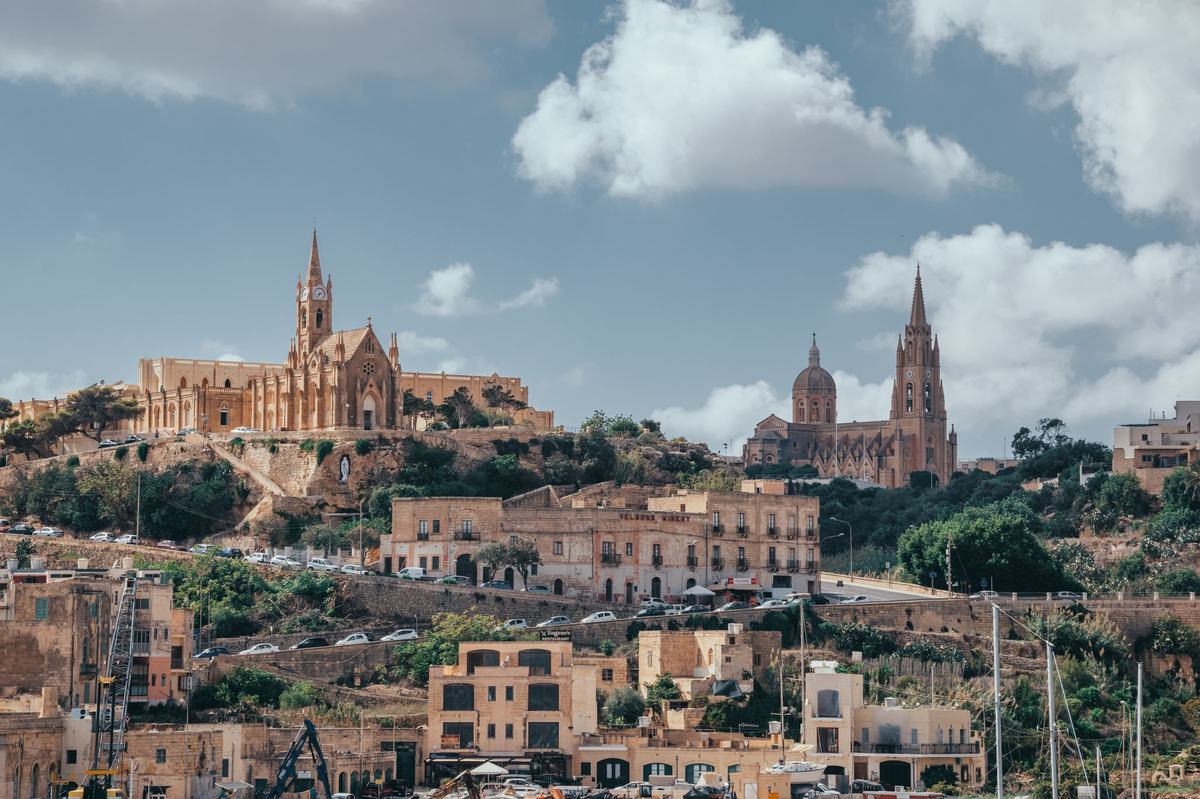
- Capital: Valletta [1]
- Population: roughly 553,000 [2]
- Area: 316 square kilometers (122 square miles) [1]
- Official languages: Maltese, English [1]
- Currency: Euro (EUR)
- Home to some of the oldest free-standing stone structures on Earth [3]
Here's something that'll ruin the next geography quiz you take: Malta has temples older than Stonehenge and older than the Egyptian pyramids. I had to look this up twice. A country you could drive across in under an hour somehow holds buildings that have been standing since people in most of Europe were still figuring out farming. That's the thing about Malta. It looks small on a map, almost too small to bother with, and then you start pulling on the threads and you realize this little cluster of rocks in the middle of the Mediterranean has been one of the busiest crossroads in human history for seven thousand years.
The Oldest Buildings on Earth
Around 3600 BC, somebody on Malta started piling massive limestone blocks into the shape of a temple. They kept doing it for the next thousand years. The result is a network of megalithic structures scattered across the islands - Ġgantija, Ħaġar Qim, Mnajdra, Tarxien - that predate the Great Pyramid of Giza by roughly a thousand years [3]. UNESCO has them all on the World Heritage list.
Nobody knows for sure who built them. The civilization that put them up vanished around 2500 BC, leaving no written language and only fragmentary remains. What's left are the temples themselves, some with stones weighing more than twenty tons, raised without metal tools, without the wheel, without any of the things we assume you need to move that kind of weight. Back home in Montana the oldest thing I ever saw growing up was a hundred-year-old barn. Standing inside Ġgantija on Gozo, looking at walls that were already ancient when Rome was a swamp, does something to your sense of time.
Two Official Languages, Both Strange
Malta has two official languages, and the first one is genuinely unusual. Maltese is the only Semitic language written in the Latin alphabet, and the only Semitic language that's an official EU language [1]. It's descended from Arabic - specifically the Arabic spoken in Sicily during the Middle Ages - but with heavy borrowings from Italian, Sicilian, French, and English layered on top.
The result sounds like nothing else in Europe. A Maltese speaker can sometimes follow a conversation in Tunisian Arabic, then turn around and slip into English without missing a beat. English is the second official language, a holdover from 164 years as a British colony, and almost everyone on the island speaks both fluently [1]. Road signs, government documents, court proceedings - all in both languages. If you grew up there, code-switching mid-sentence is just how conversation works.
A Capital Built by Knights
Valletta is one of the few capital cities in the world that was planned from scratch as a fortress [4]. After the Knights of St. John fought off an Ottoman siege in 1565, they decided to build a brand new city on a peninsula jutting into the Grand Harbour. The Pope sent his own military engineer to design it. Construction started in 1566, the grid was laid out with mathematical precision, and the whole place was named after the knight who led the defense, Jean Parisot de la Valette.
Walk through it today and the bones are still there. UNESCO calls it one of the most concentrated historic areas in the world, with 320 monuments packed into 0.55 square kilometers [4]. The St. John's Co-Cathedral, plain on the outside, opens into one of the most ornate baroque interiors anywhere - including two original Caravaggio paintings the artist made while hiding out on the island.
The Knights, the Siege, and a Strange Country
The story of how the Knights of St. John ended up running Malta is the kind of historical accident that shouldn't have happened. After being kicked out of Rhodes by the Ottomans in 1522, the knights wandered Europe looking for a home. In 1530, Emperor Charles V gave them Malta in exchange for an annual rent of one Maltese falcon, delivered to his viceroy in Sicily [1]. That's where the Dashiell Hammett novel got its title.
The knights ran Malta as a sovereign religious-military state for 268 years. They fought the Ottomans, built the fortifications, ran hospitals that were considered the most advanced in Europe, and accidentally turned the islands into one of the wealthiest spots in the Mediterranean. Napoleon ended the whole arrangement in 1798 when he stopped by on his way to Egypt and just took the place. The British took it from Napoleon two years later, and Malta didn't become fully independent until 1964.
A Country in the Middle of Everything
Look at Malta on a map and the geography explains the history. The islands sit almost exactly between Sicily and North Africa, on every trade route that ever mattered in the Mediterranean. Phoenicians showed up around 800 BC. Then Carthaginians, Romans, Byzantines, Arabs, Normans, Spanish, French, British. Everybody passed through, everybody left something. The Maltese flag carries the George Cross, awarded to the entire population by King George VI in 1942 for surviving one of the most brutal bombing campaigns of World War II [5]. Malta was the most bombed place on Earth during the war, taking more tonnage of bombs per square mile than London.
And nobody talks about this, but Malta is also one of the most densely populated countries in the world. Over 1,700 people per square kilometer, packed onto islands with limited fresh water and basically no rivers. They desalinate most of their drinking water now. Despite that, the country runs at full speed - it's an EU member, uses the euro, has one of the fastest-growing economies in Europe, and has somehow become a hub for online gaming companies, of all things.
Frequently Asked Questions
What language do people speak in Malta?
Malta has two official languages: Maltese and English [1]. Maltese is the only Semitic language written in the Latin script and is closely related to medieval Sicilian Arabic. English is widely spoken thanks to 164 years of British rule before independence in 1964.
How big is Malta?
Malta covers about 316 square kilometers, making it one of the smallest countries in the European Union [1]. The archipelago consists of three main inhabited islands - Malta, Gozo, and Comino - with a total population of roughly 553,000 people.
Why is Malta so famous?
Malta is famous for its prehistoric megalithic temples, the fortified capital Valletta, its role in the 1565 Great Siege under the Knights of St. John, and its strategic position in the Mediterranean [3] [4]. It holds three UNESCO World Heritage sites.
Is Malta part of Italy?
No, Malta is an independent country and a full member of the European Union [1]. It lies about 80 kilometers south of Sicily but became fully independent from Britain in 1964 and a republic in 1974. Maltese, not Italian, is the national language.
What currency does Malta use?
Malta uses the Euro [1]. It joined the EU in 2004 and adopted the euro in 2008, replacing the Maltese lira. English is widely accepted in shops and businesses, and card payments are common throughout the islands.