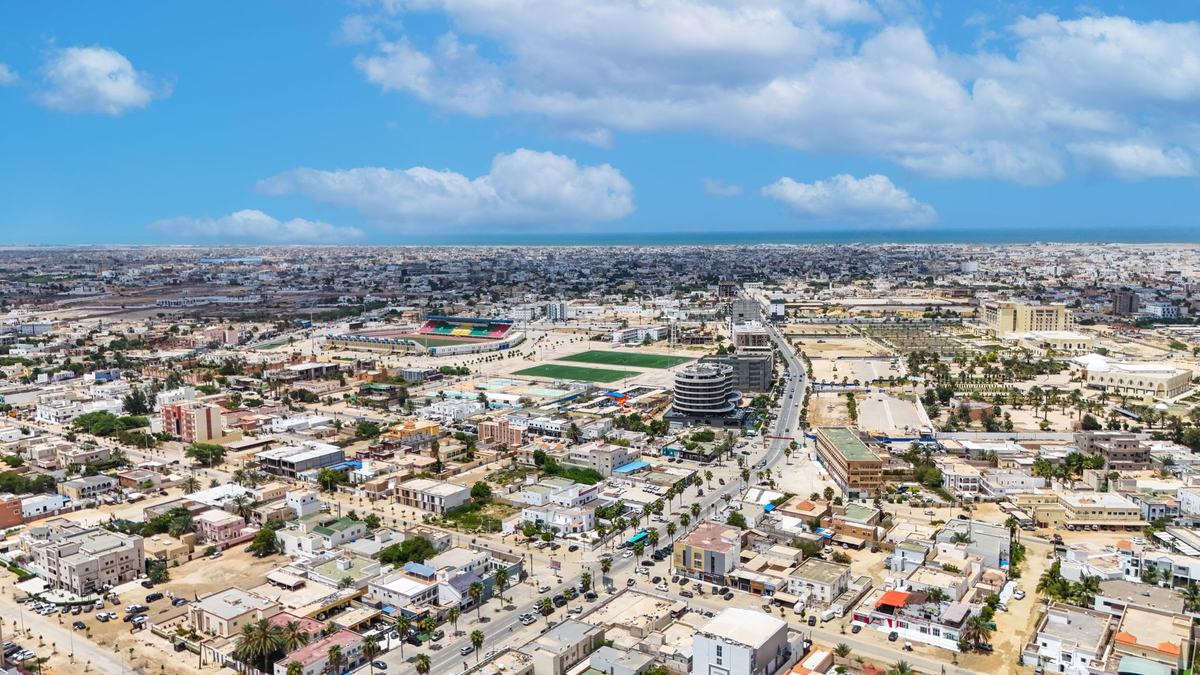
- Capital: Nouakchott [1]
- Population: roughly 4.9 million [2]
- Area: 1,030,700 square kilometers (about 398,000 square miles) [1]
- Official language: Arabic (Pulaar, Soninke, and Wolof are national languages) [1]
- Currency: Mauritanian ouguiya (MRU)
- About three quarters of the country is Sahara desert [3]
I grew up thinking the Sahara was just a place on a map, a yellow patch between greener countries. Then I started reading about Mauritania and had to sit with it for a while. Here is a country bigger than Texas and California combined, with fewer people than Los Angeles, where the dunes start in the east and roll west until they hit the Atlantic Ocean. Most of the population lives in a thin strip along the coast and the southern river, and the rest of the map is mostly sand. That is the first thing you have to know about Mauritania. It is a country defined by the desert, and by the very specific way people have learned to live with it.
Where the Sahara Meets the Sea
Mauritania sits on the northwest shoulder of Africa, with Morocco and Western Sahara to the north, Algeria to the northeast, Mali to the east and south, and Senegal along the Senegal River in the south. Its western edge is 754 kilometers of Atlantic coastline [1]. That coastline is one of the richest fishing grounds on Earth. Cold currents push nutrients up from the deep, the continental shelf is wide and shallow, and the result is a marine zone that produces enormous catches of octopus, hake, sardines, and shrimp. Fishing accounts for a major chunk of the national economy and a big share of the government's revenue [2].
Then you turn around and face inland, and the green vanishes within a few hundred kilometers. The Sahara takes over. Sand seas, rocky plateaus, the occasional oasis. The contrast is the country in a sentence.
A Train You Can Actually Ride on Top Of
This is the part that stops people. Mauritania operates one of the longest trains in the world. It runs from the iron ore mines at Zouerate, deep in the interior, to the port at Nouadhibou on the coast. The train is typically 2.5 to 3 kilometers long, made up of around 200 to 220 cars, hauling roughly 84 wagons of iron ore at a time [4]. It crosses 704 kilometers of desert on a single track, with almost nothing in between.
Here is the thing nobody mentions until you go looking. There is a free passenger car, but plenty of travelers and locals ride on top of the open iron ore cars, sitting on the cargo itself, wrapped in scarves to keep out the dust. It is one of those journeys that ends up on every "world's wildest train rides" list, and it is also just how some people get home. Iron ore is one of the country's biggest exports, and the train is the artery that keeps the whole industry running.
Cities Made of Books
Out in the desert, on the old trans-Saharan trade routes, there are towns that used to be major stops for caravans moving salt, gold, and books between North Africa and the empires further south. Four of them, Ouadane, Chinguetti, Tichitt, and Oualata, are listed together as a UNESCO World Heritage Site [5]. Chinguetti was once considered the seventh holiest city in Islam, and during the Middle Ages it became a center for Islamic scholarship.
The remarkable part is what survived. Several family-run libraries in Chinguetti still hold manuscripts that date back to the 13th century, hand-copied texts on theology, astronomy, mathematics, law, and poetry. The dry desert air preserved them. The buildings are made of dry stone, the streets are narrow and sand-blown, and inside these small libraries are pages older than the printing press. Back home in Montana the oldest book I ever held was a hundred years old. Standing in a library where the manuscripts predate Columbus is a different kind of quiet.
A Land of Many Peoples
Mauritania sits on a cultural fault line where Arab-Berber North Africa meets sub-Saharan West Africa, and the population reflects that. The Bidan, or "white Moors", and the Haratin, who share the same Hassaniya Arabic language and culture, make up the majority. There are also large populations of Pulaar, Soninke, and Wolof speakers, mostly in the south near the Senegal River [1]. Arabic is the official language, but you hear several others daily, and the national languages are protected by the constitution.
The cuisine carries the geography in it. Thieboudienne, a fish and rice dish shared with Senegal, shows up on the coast. Mechoui, slow-roasted lamb, comes from the desert tradition. Green tea is poured from a height into small glasses, three rounds, each one sweeter than the last, and refusing a glass is genuinely impolite.
Frequently Asked Questions
What language do they speak in Mauritania?
The official language is Arabic, specifically the local dialect known as Hassaniya. Pulaar, Soninke, and Wolof are recognized as national languages and spoken widely in the south [1]. French is still used in business and some government settings, a legacy of the colonial era.
Is Mauritania a safe country to visit?
Mauritania is generally calm in its main cities and along the coast, but several governments advise against travel to border areas with Mali and parts of the eastern desert due to security risks. Travelers usually visit Nouakchott, Nouadhibou, and the heritage cities with guides.
What is Mauritania famous for?
Mauritania is best known for its vast Sahara landscapes, the iron ore train running from Zouerate to Nouadhibou, and the ancient caravan cities of Chinguetti, Ouadane, Tichitt, and Oualata, which are together a UNESCO World Heritage Site [5]. Its Atlantic coastline is also one of the world's richest fisheries.
What is the capital of Mauritania?
The capital is Nouakchott, located on the Atlantic coast. It was a small fishing village before becoming the capital at independence in 1960 and has since grown into the country's largest city, home to roughly a quarter of the national population [1].