- Capital: Port Louis [1]
- Population: about 1.26 million [1]
- Area: 2,040 square kilometers (about 790 square miles) [1]
- Official language: English, with French, Mauritian Creole, and Bhojpuri widely spoken [2]
- Currency: Mauritian rupee (MUR) [1]
- Distinguishing claim: the only country where the extinct dodo bird ever lived [3]
Most people couldn't point to Mauritius on a map. It's a speck in the Indian Ocean, about 1,200 miles off the southeast coast of Africa, smaller than Rhode Island, and somehow it's home to one of the most multicultural societies on the planet. I had to look this up twice when I first read it. A country that's about 790 square miles has four working languages, three major religions, and a national dish that traces back to indentured laborers from a different continent. That's the thing about islands. They concentrate everything.
A Country Sitting on an Extinct Volcano
Mauritius isn't a continental scrap that broke off something bigger. It's a volcano. The whole island pushed up from the ocean floor about eight to ten million years ago, and the last eruption was somewhere around 25,000 years ago, which in geological time is basically yesterday [4]. The center of the island is a high plateau, ringed by mountain ridges that are actually the worn-down remnants of the original crater walls. Standing on the rim of Trou aux Cerfs in Curepipe, you're looking down into the throat of an extinct volcano with a forested lake at the bottom.
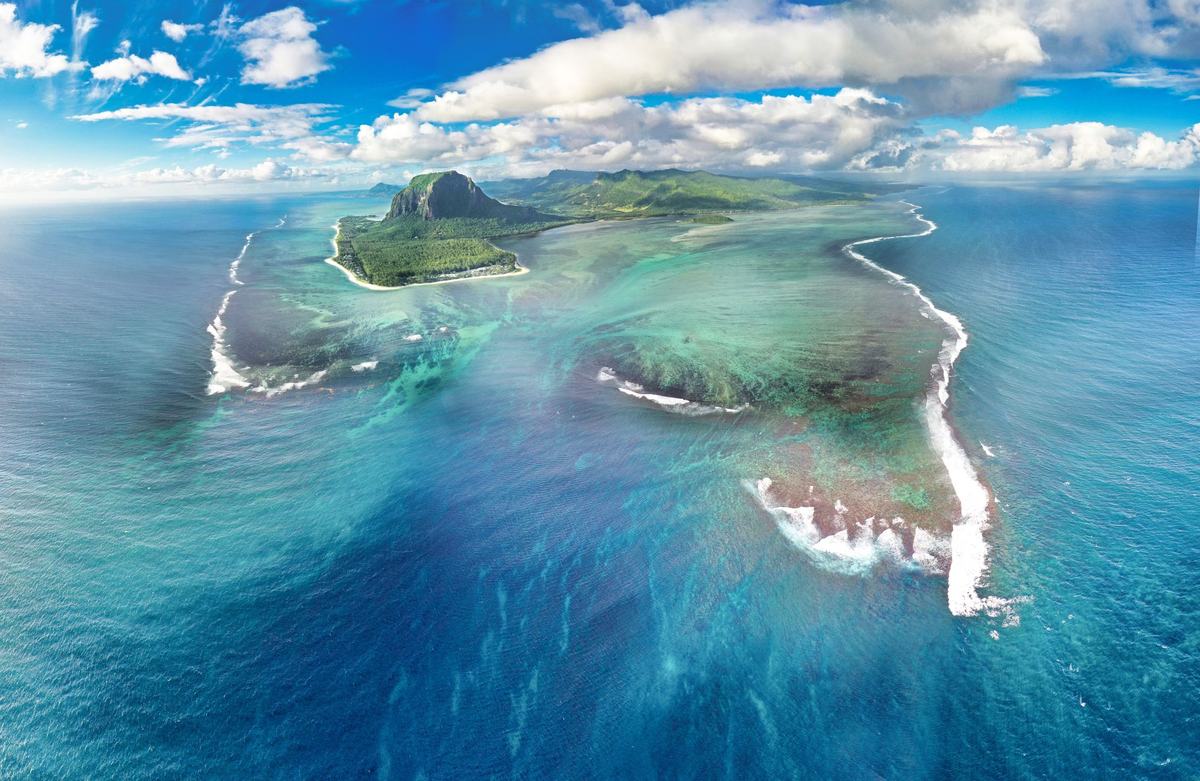
The reefs around the island are nearly as remarkable as the island itself. A nearly continuous coral reef surrounds most of Mauritius, creating a calm lagoon between the shore and the open ocean. The water inside the reef is so clear and so shallow in spots that from the air it looks fake. There's even a stretch off the southwest coast called Le Morne Brabant where an underwater illusion makes it look like a waterfall is flowing off the ocean floor. It's just sand and silt being pushed by currents, but the effect is uncanny.
The Dodo Was a Real Bird That Lived Here
Here's the thing about the dodo. It wasn't a cartoon. It was a flightless bird, about three feet tall, related to pigeons, and it lived only on Mauritius. When Portuguese and then Dutch sailors arrived in the 1500s and 1600s, the dodo had no reason to fear them, because nothing on the island had ever hunted it. Within about a hundred years of human contact, the dodo was gone, wiped out by a combination of hunting, introduced pigs and rats eating the eggs, and habitat destruction [3]. The last confirmed sighting was around 1662.
The dodo is on the Mauritian coat of arms, which I find quietly heartbreaking. A country put the bird it accidentally exterminated on its national symbol. There's a museum in Port Louis that has a partial skeleton, and Mauritian schoolchildren grow up learning about the dodo the way American kids learn about the passenger pigeon, except the dodo has become a kind of global shorthand for extinction itself. "Dead as a dodo" is a phrase you hear in English everywhere. The bird itself only existed in one place.
Four Languages and Nobody Agrees Which Comes First
If you walk through Port Louis, you'll hear at least four languages in a single block. English is the official language of government and the courts, a leftover from British colonial rule. French dominates the media, business, and most of the books in any given store. Mauritian Creole, a French-based language with African, Indian, and Malagasy influences, is what almost everyone actually speaks at home. And Bhojpuri, brought by indentured workers from northern India, is still spoken by a significant chunk of the population, especially in rural areas [2].
What's interesting is that none of these languages is "winning". Most Mauritians switch between them mid-conversation depending on who they're talking to. Parliament is conducted in English, but speeches are often peppered with French and Creole. Schools teach in English and French, but the playground is pure Creole. Back home in Montana, you'd be lucky to find a town where two languages get equal airtime. Here, four of them coexist without much fuss.
Sugar, Curry, and a Cuisine from Everywhere
For most of the 19th and 20th centuries, Mauritius ran on sugar. Sugarcane fields still cover huge stretches of the central plateau, and even though tourism and finance have overtaken agriculture as economic drivers, sugar shaped everything about modern Mauritian society. After slavery was abolished in 1835, the British brought in hundreds of thousands of indentured laborers from India to work the cane fields [5]. Their descendants now make up roughly 68 percent of the population, which is why Hinduism is the largest religion on the island.
The food reflects all of it. A typical Mauritian meal might pair a Tamil curry with French bread, served alongside a Chinese-style stir-fry, finished with a Creole rougaille of tomatoes and chilies. Street food sellers in Port Louis sell dholl puri, a thin flatbread filled with split peas, that's a direct descendant of Bihari cooking but evolved into something specifically Mauritian. Turns out, when you put a bunch of cuisines on a small island for two hundred years, they don't compete. They braid.
A Tiny Country with an Outsized Economy
Mauritius is one of the few African nations classified as a high-income economy by the World Bank, with a GDP per capita that consistently outperforms most of its mainland neighbors [5]. The economy used to be 90 percent sugar. Now it's a mix of tourism, textiles, financial services, and a growing tech sector. The country has invested heavily in education and infrastructure, and the literacy rate sits above 92 percent.
What I find quietly impressive is that Mauritius has managed all this without becoming a tax haven cliche or a tourism monoculture. It still grows its own sugar. It still teaches four languages. It still puts a long-dead bird on its money. Small countries can punch above their weight when they take their own history seriously.
Frequently Asked Questions
Where is Mauritius located?
Mauritius is an island country in the Indian Ocean, about 1,200 miles off the southeast coast of Africa, east of Madagascar. It sits roughly at the same latitude as the southern tip of Mozambique. The country also includes the smaller islands of Rodrigues, Agalega, and Saint Brandon.
What language do they speak in Mauritius?
English is the official language, but most Mauritians speak Mauritian Creole at home. French dominates media and business, and Bhojpuri is widely spoken in rural areas. It's common for one person to use all four languages in a single day.
Is Mauritius part of Africa?
Yes, Mauritius is officially part of Africa and a member of the African Union, even though it sits well out in the Indian Ocean. Geographically it's closer to Madagascar than to the African mainland, but politically and culturally it has strong African, Indian, and European ties.
Did the dodo really live in Mauritius?
Yes. The dodo was a flightless bird native only to Mauritius, and it went extinct in the late 17th century after Dutch sailors arrived. Hunting and introduced animals like pigs and rats destroyed the population within roughly a hundred years of human contact.
What is the currency of Mauritius?
The official currency is the Mauritian rupee, abbreviated MUR. It's divided into 100 cents and is issued by the Bank of Mauritius. The currency is relatively stable, and major hotels and businesses also accept euros and US dollars in tourist areas.