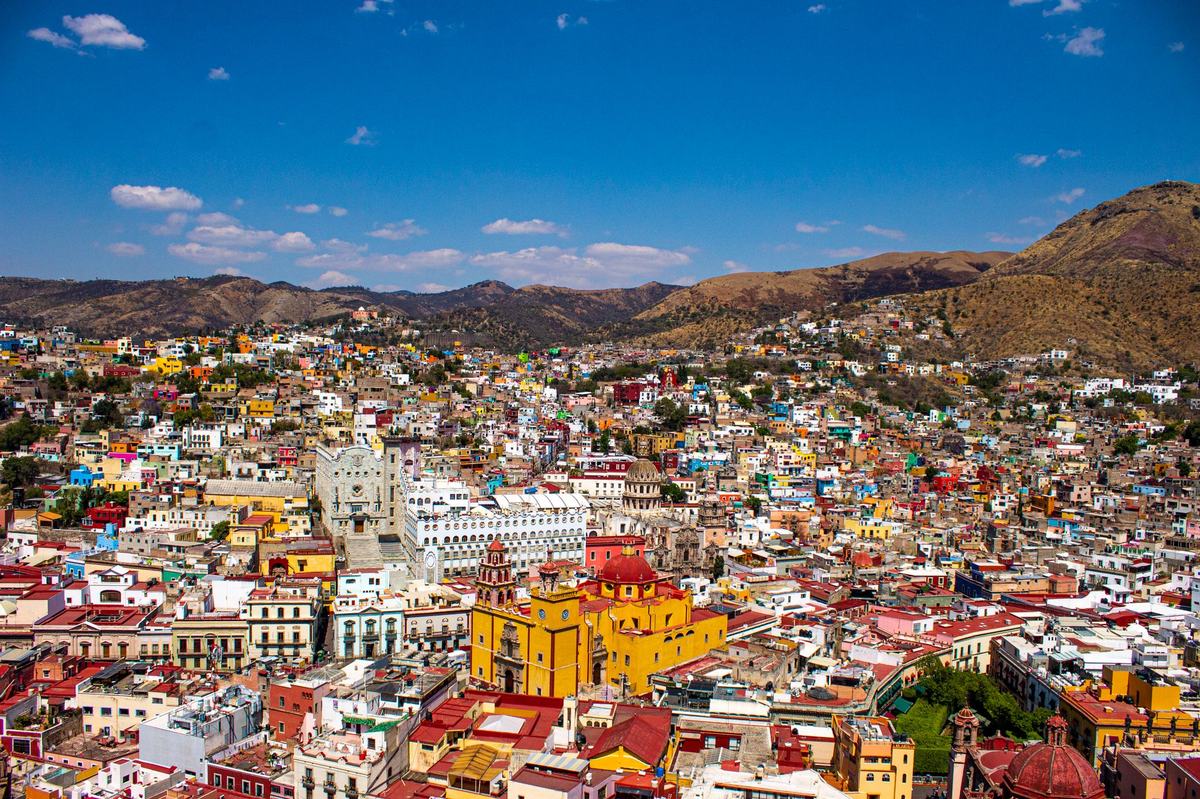
- Capital: Mexico City (one of the largest metro areas on Earth, with about 22 million people in the greater region) [1]
- Population: Roughly 130 million, making Mexico the 10th most populous country in the world [2]
- Area: 1,964,375 square kilometers (758,449 square miles), about three times the size of Texas [1]
- Official languages: Spanish plus 68 recognized Indigenous languages, all considered "national languages" by law [3]
- Currency: Mexican peso (MXN)
- Distinguishing claim: Mexico has 35 UNESCO World Heritage Sites, the most of any country in the Americas [4]
Most Americans think they know Mexico. Beaches, tequila, mariachi, maybe a vacation in Cancun. I thought the same thing growing up in Montana, where the only Mexican food I knew came from a yellow box that promised "authentic taste". Then I started reading, and the country kept getting bigger. Not just geographically, although it's bigger than people realize. Deeper. Older. Stranger in the best possible way.
Here's the thing about Mexico: it has more pyramids than Egypt, more UNESCO sites than any other country in the Americas, and a capital city that is literally sinking into a drained lakebed at about 50 centimeters a year in some neighborhoods. None of that fits on a margarita coaster.
A Country That Speaks 68 Languages, Officially
This is the fact I had to look up twice. Mexico does not have a single official language at the federal level. Spanish is the de facto national language, sure, but in 2003 the General Law of Linguistic Rights of Indigenous Peoples recognized 68 Indigenous languages as "national languages" with the same legal status as Spanish [3]. That covers everything from Nahuatl, the language of the Aztecs, which still has around 1.7 million speakers, to Mayan languages spoken across the Yucatán, to Zapotec, Mixtec, Otomi, and dozens more.
Within those 68 languages, linguists count something like 364 distinct variants, because what gets grouped as one language often contains dialects so different that speakers from neighboring valleys can't fully understand each other. Imagine if every state in the U.S. had its own legally protected language, and most of them predated English by several centuries. That's a rough analog.
The Mexican government prints official documents in many of these languages. Schools in Indigenous regions are supposed to teach in the local language alongside Spanish. The reality of that policy is uneven, but the legal architecture is more progressive than most countries with multiple living Indigenous languages.
The Capital Is Built on a Lake. Sort Of.
When the Spanish arrived in 1519, they found Tenochtitlan, the Aztec capital, sitting on an island in the middle of Lake Texcoco. Hernán Cortés described it as more beautiful than any city in Europe. There were causeways, floating gardens, aqueducts carrying fresh water, and a population that may have rivaled or exceeded Paris at the time.
The Spanish destroyed it, then built Mexico City on top of the ruins. And kept building. And kept draining the lake to make room. Five centuries later, Mexico City sits on what used to be a lakebed, and the soft clay underneath is compacting under the weight of the city above. Parts of the historic center have sunk more than 12 meters since the colonial period, and certain neighborhoods are still sinking by 30 to 50 centimeters every year [5].
You can see it in the buildings. The Metropolitan Cathedral, finished in 1813, has had to be structurally stabilized because one side of it sank faster than the other. The Palacio de Bellas Artes, the gorgeous white marble opera house, has settled about 4 meters into the ground since it opened in 1934. Walk around the old colonial blocks and you'll notice doorways that tilt and floors that pitch like the deck of a ship. The city is literally swallowing itself, slowly, and the engineers are running out of clever fixes.
More Pyramids Than Egypt
Egypt has somewhere between 100 and 140 known pyramids, depending on which scholar you ask. Mexico has thousands. Most of them are buried under jungle or hidden inside hills that look natural until you start digging. The largest pyramid in the world by volume is not Giza. It's the Great Pyramid of Cholula in central Mexico, a structure so big and so overgrown that the Spanish built a church on top of it without realizing what they were standing on [6].
The base of Cholula covers about 16 hectares, roughly four times the footprint of the Great Pyramid of Giza, though it's shorter in height. Locals had known about the mound for centuries, but its true scale wasn't confirmed until the 1930s when archaeologists started tunneling in. You can walk through those tunnels today. The pyramid is hollow from a century of excavation, and the church on top is still active.
Teotihuacan, just outside Mexico City, has the Pyramid of the Sun and the Pyramid of the Moon, both built before the Aztecs even arrived in the valley. Chichen Itza in the Yucatán is so geometrically precise that on the spring and fall equinoxes, the setting sun creates the illusion of a serpent slithering down the side of the main pyramid. That wasn't an accident. The Maya astronomers who designed it understood the equinoxes better than most Europeans of the same era.
The Year Mexico Had No Head of State
In 1858, after a bitter civil war over the country's new liberal constitution, Mexico ended up with two simultaneous presidents. Conservatives recognized one, liberals recognized another, and neither side could agree on anything for about a year. The official position of head of state was, depending on how you count, vacant or doubled. It took the eventual victory of Benito Juárez and the liberals to settle it, and even then the country plunged immediately into the French Intervention and the strange three-year reign of an Austrian archduke installed as Emperor Maximilian I.
Mexican history runs like this. Layers stacked on top of layers, with periods of chaos that look impossible on paper but somehow produced a stable, modern country. Juárez himself was a Zapotec man from rural Oaxaca who learned Spanish as a teenager and became one of the most consequential presidents in Mexican history. There's no real American analog for that.
Geography That Doesn't Quit
Mexico is enormous and stranger than its map suggests. It contains two of the longest mountain ranges in North America, the Sierra Madre Occidental and the Sierra Madre Oriental, which run roughly parallel down either side of the country. Between them sits a high central plateau where most of the population lives, including Mexico City at 2,240 meters above sea level - higher than Denver.
The country has tropical rainforest in the south (Chiapas, Tabasco), high desert in the north (Sonora, Chihuahua), pine forests in the central mountains, and one of the most biodiverse coral reef systems in the Western Hemisphere along the Yucatán coast. It is one of only 17 "megadiverse" countries identified by the UN Environment Programme, which collectively hold about 70 percent of the planet's biodiversity [7].
There's a volcano in Michoacán called Cuexcomate that's sometimes called the smallest volcano in the world. It's 13 meters tall. You can walk to the top in about a minute. Whether it counts as a true volcano or a geyser cone is debated among geologists, but the locals are pretty firm about which side they're on.
Food, And Why Yours Is Probably Wrong
UNESCO added traditional Mexican cuisine to its Intangible Cultural Heritage list in 2010, the first national cuisine ever recognized that way [4]. The reason wasn't the tacos. It was the whole system - corn nixtamalization, the Mesoamerican triad of corn-beans-squash, the use of native chiles, the regional traditions that vary so much between Oaxaca and Sinaloa and Yucatán that calling it all "Mexican food" is like calling everything from Maine to Louisiana "American food".
Mole alone can have 30 or more ingredients in some recipes. Pozole is a soup with roots in pre-Columbian rituals (the original version had a much darker ingredient list that the Spanish put a stop to). Tacos al pastor were invented in the 20th century by Lebanese immigrants who adapted their shawarma technique to Mexican ingredients. Nothing about this country's food is what an American chain restaurant suggests.
Frequently Asked Questions
What is the capital of Mexico?
The capital is Mexico City, known in Spanish as Ciudad de México (CDMX). It sits at 2,240 meters above sea level on a high central plateau and has a metropolitan population of roughly 22 million, making it one of the largest urban areas in the world [1].
What languages are spoken in Mexico?
Spanish is the de facto national language, but Mexico legally recognizes 68 Indigenous languages as "national languages" with equal status. These include Nahuatl, Yucatec Maya, Zapotec, Mixtec, and dozens of others spoken by around 7 million Indigenous-language speakers nationwide [3].
How many UNESCO sites does Mexico have?
Mexico has 35 UNESCO World Heritage Sites as of the most recent updates, more than any other country in the Americas and among the top ten globally. These include archaeological sites, colonial cities, and natural areas like Sian Ka'an and the El Vizcaíno whale sanctuary [4].
Is Mexico City really sinking?
Yes. Mexico City was built on a drained lakebed, and the soft clay underneath is compressing under the city's weight. Parts of the historic center have sunk more than 12 meters since the colonial era. Some neighborhoods still sink 30 to 50 centimeters annually [5].
What is the largest pyramid in Mexico?
The Great Pyramid of Cholula in Puebla is the largest pyramid in the world by total volume, with a base covering about 16 hectares. A Spanish colonial church sits on top because the Spanish didn't realize the overgrown mound was a pyramid when they built it [6].
Sources
- Mexico Country Profile - World Bank
- Mexico Population - United Nations
- General Law of Linguistic Rights of Indigenous Peoples - Government of Mexico
- UNESCO World Heritage List - Mexico
- Mexico City Subsidence Research - NASA Earth Observatory
- Great Pyramid of Cholula - National Institute of Anthropology and History (INAH)
- Megadiverse Countries - UN Environment Programme