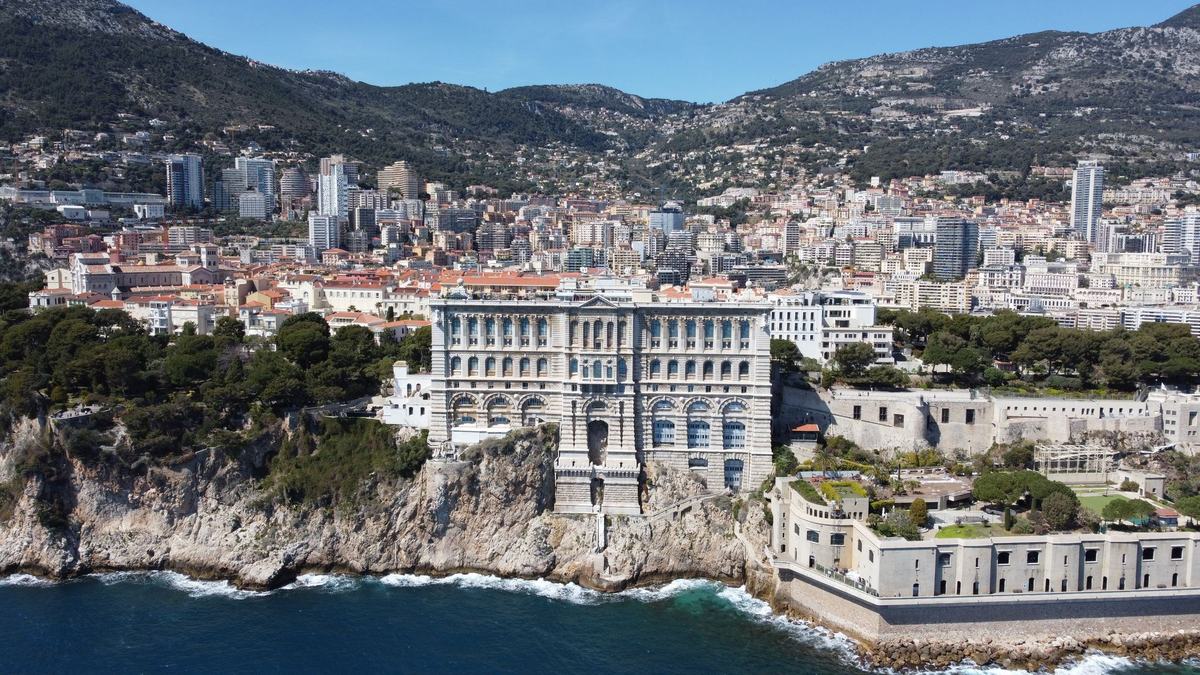
- Capital: Monaco (the city-state itself) [1]
- Population: roughly 39,000 [2]
- Area: about 2.08 square kilometers (0.81 square miles) [1]
- Official language: French [1]
- Currency: Euro (EUR)
- Ruled by the House of Grimaldi since 1297, one of the oldest reigning dynasties in Europe [3]
Here's something that'll ruin the next geography quiz you take: Monaco is smaller than Central Park in New York. The entire sovereign country. You could walk its longest dimension in about half an hour at a slow pace, and you'd never run out of breath doing it. I had to look this up twice. A real United Nations member state, with its own prince and its own laws and its own national soccer team, packed into a strip of coastline shorter than a marathon. And somehow it has been quietly outliving empires for over seven hundred years.
A Country You Can Walk Across
Monaco covers 2.08 square kilometers, which is roughly 500 acres [1]. That's it. The whole nation is squeezed onto a steep slope between the Mediterranean and the French Alps, and it's gotten that small partly because there isn't room to grow. France wraps around it on three sides and the sea cuts off the fourth. Over the years, Monaco has actually been expanding by reclaiming land from the ocean. The Fontvieille district was built on landfill in the 1970s, and a newer extension called Mareterra opened in 2024, adding about six hectares of brand new country.
That last detail still gets me. Most nations expand through wars or treaties. Monaco expands by pouring concrete into the sea. Back home in Montana you could fit Monaco into a single rancher's pasture and still have room left over for the cattle.
The Grimaldi Family Has Held On for Over 700 Years
In 1297, a man named Francois Grimaldi disguised himself as a Franciscan friar, knocked on the gates of the Rock of Monaco, and once inside, drew a sword hidden under his robe and seized the fortress for his family [3]. That's the founding story, and it's painted on Monaco's coat of arms to this day. The Grimaldis have ruled the place, with a few interruptions, for more than seven centuries.
The current head of state is Prince Albert II, who took over from his father Prince Rainier III in 2005. Rainier is probably better known to Americans because in 1956 he married the actress Grace Kelly in a wedding that was watched by an estimated 30 million people on early television. She became Princess Grace of Monaco and died in a car accident on the steep cliff roads above the city in 1982. The Grimaldis are one of the longest continuously reigning royal houses on Earth, older than the current British line by several centuries.
More Millionaires per Square Mile Than Anywhere
Roughly one in three residents of Monaco is a millionaire in US dollar terms, which makes it the densest concentration of wealth on the planet [4]. The reason is simple enough. Monaco does not charge personal income tax on individuals who live there, a policy that's been in place since 1869. That means if you can afford to buy or rent property in Monaco, and you actually live there for at least six months and a day each year, you keep everything you earn outside the country.
The catch is that property is among the most expensive in the world. Apartments routinely sell for more than 50,000 euros per square meter, and in the most desirable buildings, much more. Which, if you think about it, means the tax break is essentially a luxury good. The country collects its revenue mostly through VAT, corporate taxes on certain businesses, and the famous Monte Carlo casino.
The Casino That Saved a Country
By the mid 1800s, Monaco was almost broke. It had just lost two of its three towns, Menton and Roquebrune, to France, and was down to a tiny coastal strip with no real economy. Prince Charles III had an idea. He'd open a casino and lure rich European gamblers to a place where their habit was perfectly legal. The Casino de Monte Carlo opened in 1863, and within a decade it had paid off the national debt and made the country wealthy [5].
Charles III then abolished income taxes for residents, since the casino was generating so much revenue the government didn't need them. The neighborhood that grew up around the casino was named Monte Carlo, after him. Today, ironically, citizens of Monaco are not allowed to gamble there. Only foreigners and non-citizen residents can step inside the gaming rooms. It's a small detail, but it tells you exactly how Monaco thinks of itself: a country that sells a service to outsiders and protects its own.
More Police Officers per Person Than Almost Anywhere
Monaco has one police officer for roughly every 60 residents, which is one of the highest ratios in the world [1]. The country also has hundreds of CCTV cameras covering nearly every street, alley, and entrance. Crime rates are correspondingly tiny. You can leave your phone on a cafe table and walk away, and there's a good chance it'll still be there when you get back. For a place that holds this much wealth in this small a space, that level of security is the whole point.
The country has no army of its own. Defense is handled by France under a longstanding treaty. What Monaco does have is the Compagnie des Carabiniers du Prince, a small ceremonial guard for the palace, and a couple of public security forces that handle policing. The whole national security apparatus could probably fit on one football field.
The Grand Prix That Runs Through the Streets
Once a year, Monaco closes off its city streets and hosts one of the most famous auto races in the world: the Monaco Grand Prix, run since 1929 [6]. The course winds through the actual streets of Monte Carlo and La Condamine, past the harbor, through a tunnel, and up the steep hill toward the palace. There are no run-off areas. A small mistake at 180 miles per hour and you're into a wall or a metal barrier.
Most modern Formula One circuits are purpose-built tracks with safety zones and wide pavement. Monaco is a holdover from an older era, when racing happened on whatever roads were available. Drivers love it and hate it. It rewards precision and punishes everything else. The harbor fills up with superyachts for race week, and the whole country basically turns into one giant party for three days.
Frequently Asked Questions
How big is Monaco?
Monaco covers about 2.08 square kilometers, or 0.81 square miles, making it the second smallest country in the world after Vatican City [1]. You can walk across the entire country in roughly 30 minutes. Its population is around 39,000 residents.
Why is Monaco so rich?
Monaco has no personal income tax for residents, which attracts wealthy individuals from around the world [4]. Combined with revenue from the Monte Carlo casino, tourism, VAT, and corporate taxes on certain businesses, this has made Monaco one of the wealthiest countries per capita on Earth.
Is Monaco part of France?
No. Monaco is a sovereign country and a member of the United Nations [1]. France handles its defense under a longstanding treaty, and Monaco uses the euro, but it has its own government, prince, laws, and constitution. The Grimaldi family has ruled since 1297.
Can you live in Monaco without being rich?
Technically yes, but practically it's very hard. Property prices in Monaco are among the highest in the world, often above 50,000 euros per square meter. To gain residency, applicants generally need to show significant funds or income and secure a place to live in the country.
What language do they speak in Monaco?
The official language of Monaco is French [1]. Monegasque, a traditional local language related to the Ligurian dialect of northern Italy, is also spoken by a small portion of the population and taught in schools. Italian and English are widely understood as well.