- Capital: Ulaanbaatar [1]
- Population: approximately 3.5 million [1]
- Area: 1,564,116 square kilometers (sixth-largest landlocked country, 18th-largest country overall) [1]
- Official language: Mongolian (written in Cyrillic, with Traditional Mongolian script returning to official use) [2]
- Currency: Mongolian tögrög (MNT) [1]
- Population density: roughly 2 people per square kilometer, the lowest of any sovereign nation [3]
I grew up in Montana thinking I understood empty country. Big sky, long roads, towns where the gas station closes at six. Then I started reading about Mongolia and realized I'd been playing in the kiddie pool. Montana has about seven people per square mile. Mongolia has about five. Across an area three times the size of Texas. Turns out the word "empty" has more than one meaning.
A Country Built on Sky and Steppe
Mongolians call their country "the land of the eternal blue sky", and once you look at the numbers it stops sounding like tourism copy. Ulaanbaatar gets around 250 sunny days a year, and the country averages more than 260 [4]. That clear, cold continental air is what defines the landscape - vast rolling steppe, mountains pushing up in the west, the Gobi sprawling south into China. The Gobi itself is a cold desert. People hear "desert" and picture Saharan dunes, but the Gobi gets snow. Temperatures swing from minus 40 in January to over 100 degrees Fahrenheit in summer [5]. Back home in Montana we brag about thirty-degree temperature swings in a day. Mongolia laughs at that.
Here's the thing about being landlocked and huge at the same time. Mongolia sits squeezed between Russia and China, the only two neighbors it has, and there's no third option. No coastline. No sea route. The nearest ocean is over a thousand miles away. That single fact has shaped Mongolian history, trade, language, and politics for centuries. Every road in or out goes through one of two countries.
Ulaanbaatar: Half a Nation in One City
About 1.6 million of Mongolia's roughly 3.5 million people live in the capital [1]. That's nearly half the country in one city. The rest of the population is spread so thin across the steppe that you can drive for hours without seeing a building. Ulaanbaatar sits at around 4,300 feet elevation, which makes it one of the coldest capital cities on Earth. Average January temperatures hover around minus 13 degrees Fahrenheit [4]. Reykjavik is a tropical resort by comparison.
The city has grown fast, and a lot of that growth is informal. Ger districts, named after the traditional round felt tents, ring the city core. Families who used to be herders moved in, brought their gers with them, and built up neighborhoods of mixed gers and small houses. Roughly 60 percent of the city's residents live in these districts [6]. They're a window into how Mongolia is still figuring out the relationship between its nomadic past and its urban present.
The Last Great Nomadic Culture
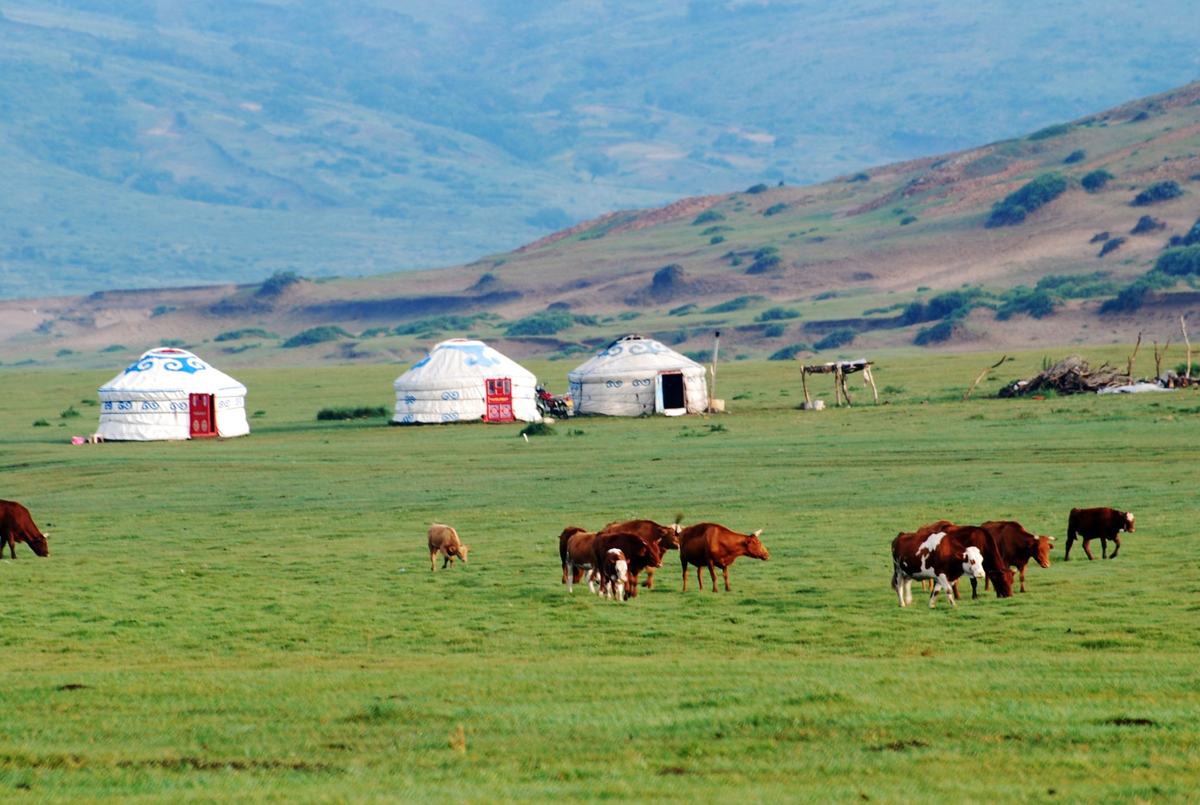
Around a third of Mongolians still live as semi-nomadic herders, moving their gers and livestock with the seasons [7]. That's not a museum exhibit. That's the actual living arrangement of roughly a million people right now. The five traditional animals - horses, sheep, goats, cattle, and camels - are still the foundation of rural life. Mongolia has more horses than people, and kids learn to ride before they can really walk. I had to look this up twice, but the figure I kept finding was around 3 to 4 million horses across the country.
The Naadam festival, held every July, is the cultural backbone of all this. Three sports: wrestling, archery, and horse racing. The horse racing isn't a track event - it's a cross-country sprint of up to 30 kilometers, and the jockeys are children, usually between five and thirteen, because the lighter the rider the better the horse runs [8]. UNESCO inscribed Naadam on its list of Intangible Cultural Heritage in 2010. Watching footage of the opening ceremonies, with thousands of horses and riders moving across open ground, makes you realize how much of human history happened on horseback, and how much of it Mongolia still remembers.
Genghis Khan and the Empire That Reshaped a Continent
You can't write about Mongolia without writing about him. Genghis Khan unified the Mongol tribes in 1206 and his descendants built the largest contiguous land empire in history, stretching from Korea to Hungary at its peak [9]. That's roughly 9 million square miles. For comparison, the British Empire was bigger overall, but it was scattered across oceans. The Mongol Empire was one continuous block of land, ruled from horseback.
What gets lost in the Hollywood version is everything else. The Mongols ran a working postal relay system called the Yam, with stations every 20 to 40 miles, where messengers could change horses and keep going. Marco Polo wrote about it. They practiced religious tolerance at a time when most of Europe was burning people over communion bread. They standardized weights and measures across the empire and gave merchants safe passage across the Silk Road - the period historians call the Pax Mongolica.
Modern Mongolians revere him in a way that catches outsiders off guard. The international airport in Ulaanbaatar is named after him. So is the currency, the beer, the vodka. There's a 130-foot stainless steel statue of him on horseback an hour outside the capital, and you can climb up through the horse's mane to a viewing platform on its head [10]. It's the largest equestrian statue in the world.
Throat Singing, Eagle Hunting, and Other Things You Won't Find Elsewhere
Mongolian khoomei - throat singing - is the kind of thing you have to hear to believe. A single singer produces two distinct pitches at the same time, a low droning fundamental and a high whistling overtone, by shaping the throat and mouth in ways most voice teachers would tell you are impossible. UNESCO listed it as Intangible Cultural Heritage in 2009 [8]. There are several styles, each tied to specific landscapes - the sound of a river, the wind in a mountain pass.
Out in western Mongolia, in the Bayan-Ölgii region, Kazakh families still hunt with golden eagles. Not falcons. Eagles. A trained female golden eagle can weigh fifteen pounds with a seven-foot wingspan, and hunters carry them on a forked wooden support strapped to the saddle because the birds are too heavy to hold on a glove for long. The tradition goes back centuries and is celebrated every fall at the Golden Eagle Festival in Ölgii. There are fewer than a hundred active eagle hunters left, and most of them are over fifty.
Frequently Asked Questions
What language do they speak in Mongolia?
The official language is Mongolian, spoken by roughly 95 percent of the population. It's written in Cyrillic script, adopted during the Soviet era, though the Traditional Mongolian script is being reintroduced for official use by 2025. Kazakh is a recognized minority language in the western Bayan-Ölgii Province.
Is Mongolia part of China or Russia?
Mongolia is an independent sovereign country, not part of either neighbor. It became independent from China in 1921 and was a Soviet satellite state until 1990, when it transitioned to a democratic parliamentary republic. Inner Mongolia, a separate region inside China, is often confused with the country of Mongolia.
How cold does Mongolia get in winter?
Winters are extreme. Ulaanbaatar, the capital, regularly sees January temperatures around minus 13 degrees Fahrenheit, and rural areas can drop to minus 40. Mongolia's combination of high elevation, continental climate, and lack of nearby ocean makes its winters among the harshest of any inhabited country on Earth.
Do people in Mongolia still live in tents?
Yes, roughly a third of Mongolians still live in gers, the traditional round felt tent, either full-time as herders or seasonally. Even in Ulaanbaatar, large ger districts surround the city center. The ger is portable, well-insulated, and has been the standard Mongolian dwelling for thousands of years.
What is Mongolia famous for?
Mongolia is best known as the homeland of Genghis Khan and the Mongol Empire, the largest contiguous land empire in history. It's also famous for its nomadic herding culture, the vast Gobi Desert, throat singing, the Naadam festival, and being the most sparsely populated sovereign country in the world.
Sources
- Mongolia - The World Factbook (CIA)
- Mongolia to restore Traditional Mongolian script by 2025 - UNESCO
- Population density (people per sq. km) - World Bank Data
- Climate of Mongolia - Mongolian National Agency for Meteorology and Environmental Monitoring
- Gobi Desert - Encyclopaedia Britannica
- Ulaanbaatar Statistical Yearbook - National Statistics Office of Mongolia
- Mongolia Country Overview - World Bank
- Mongolian Naadam and Khoomei on the UNESCO Intangible Heritage List
- The Mongol Empire - Encyclopaedia Britannica
- Genghis Khan Equestrian Statue - Smithsonian Magazine