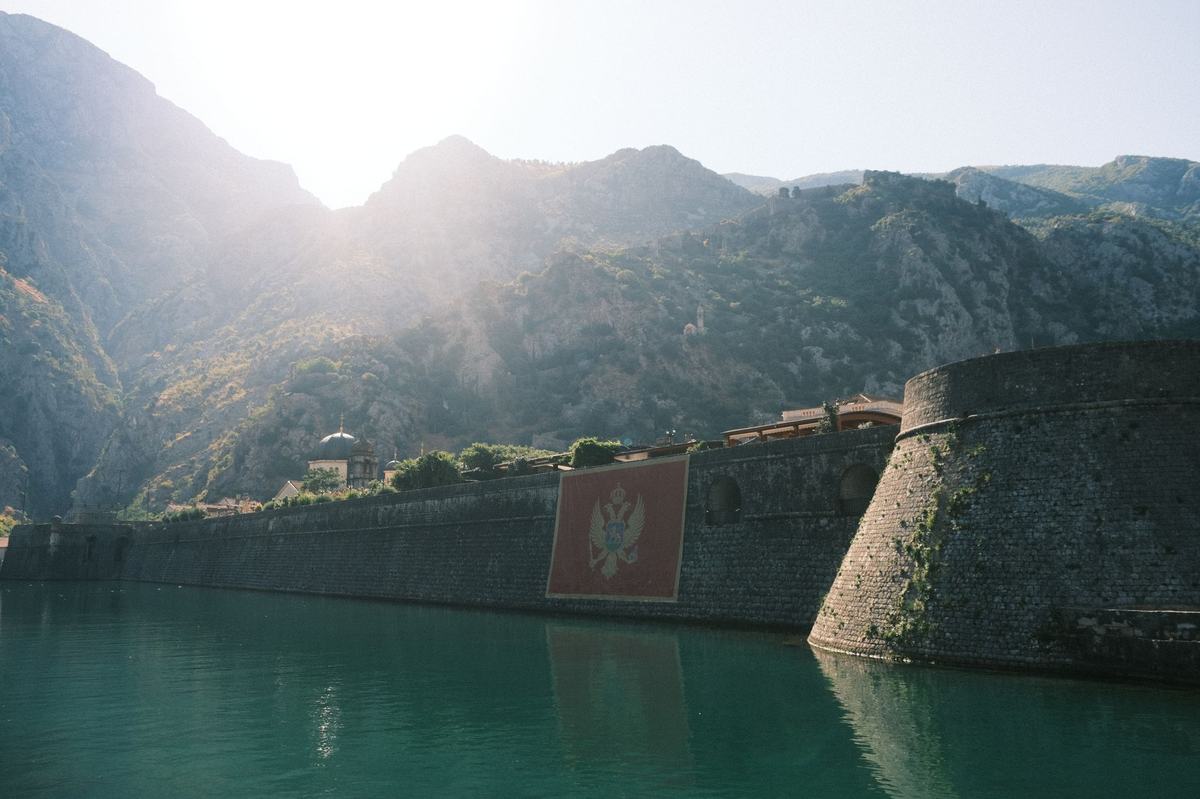
- Capital: Podgorica [1]
- Population: roughly 617,000 [2]
- Area: 13,812 square kilometers (5,333 square miles) [1]
- Official language: Montenegrin [1]
- Currency: Euro (EUR), used unilaterally without being in the eurozone [1]
- Home to Europe's deepest canyon and one of its oldest national parks [3]
I grew up thinking the Balkans were one blurry zone of conflict and old maps. Then I started reading about Montenegro and had to sit down for a minute. Here's a country smaller than Connecticut, sitting on the Adriatic, with a name that literally means "black mountain", and it packs in a fjord, a canyon nearly as deep as the Grand Canyon, glacial lakes, Venetian fortified towns, and Orthodox monasteries carved into cliffs. The whole place is about the size of a decent national park back home. And yet you could spend a month here and barely scratch it. That's what gets me about Montenegro. It looks like a footnote between Croatia and Albania, and the second you look closer the footnote turns into a whole library.
The Black Mountain Behind the Name
The country is named after Mount Lovćen, the dark, brooding peak that rises right behind the old royal capital of Cetinje [1]. Venetian sailors coming up the Adriatic saw the mountain from the sea, covered in dense black pine forest, and called it Monte Negro - black mountain. The local Slavic translation, Crna Gora, means the same thing. The English version came straight from the Venetians.
Lovćen isn't just a name source. It's the symbolic heart of the country. At the summit, 1,657 meters up, sits the mausoleum of Petar II Petrović-Njegoš, Montenegro's most beloved poet-prince-bishop, who basically invented modern Montenegrin literature in the 1840s while also running the country. To visit you climb 461 stone steps cut into the rock. The view from up there takes in the whole country on a clear day, from the Adriatic to Albania.
A Fjord in the Mediterranean
The Bay of Kotor is the kind of place that makes you question what you know about geography. It's a long, winding inlet that cuts thirty kilometers into the mountains, with sheer cliffs dropping straight into deep, dark water. Most travel writers call it Europe's southernmost fjord, though geologists will tell you it's technically a submerged river canyon rather than a glacial fjord [4]. Either way it looks like somebody dropped a piece of Norway into the Mediterranean.
The town of Kotor sits at the deepest point, a UNESCO World Heritage city wrapped in stone walls that climb 1,200 meters up the mountainside behind it [4]. Walk through the gate and you're in a medieval Venetian town that looks almost exactly like it did in 1500, narrow alleys, white limestone squares, cats everywhere - Kotor has so many stray cats that there's a cat museum. The walls themselves are one of the longer fortified perimeters in Europe, and climbing them in summer heat is a small act of penance with a very good payoff.
The Canyon That Almost Beats the Grand Canyon
The Tara River cuts through northern Montenegro in a canyon 1,300 meters deep at its lowest point, making it the deepest canyon in Europe and the second deepest in the world after the Grand Canyon [3]. The river itself is so clean you can drink from it, which is becoming a rarer thing in Europe by the year. UNESCO protects the whole basin as part of the Durmitor biosphere reserve.
Durmitor National Park, which surrounds the canyon, is one of the oldest protected areas in the Balkans, established in 1952 [3]. It holds eighteen glacial lakes - locals call them "mountain eyes" - and the country's highest peak, Bobotov Kuk at 2,523 meters. The park covers about 390 square kilometers of karst plateau, beech forest, and exposed limestone, the kind of high country that reminds me of the eastern slope of the Rockies, except older and somehow lonelier.
A Republic That Voted Itself Into Existence
Montenegro is one of the youngest countries in Europe, having peacefully separated from Serbia in a 2006 independence referendum that passed by less than a single percentage point [1]. Which, if you think about it, is wild. A country broke apart over a margin smaller than the polling error, and nobody fired a shot. The vote crossed the EU-mandated threshold of 55 percent by just over two thousand ballots.
The Montenegrin state itself is much older than that, though. The Principality of Montenegro existed in various forms from the late medieval period onward, ruled for centuries by prince-bishops from the Petrović-Njegoš dynasty operating out of Cetinje. The country was recognized as fully independent at the Congress of Berlin in 1878, then absorbed into Yugoslavia after World War I, then folded into the Kingdom of Serbs, Croats and Slovenes, then into Tito's Yugoslavia, then briefly federated with Serbia after the wars of the 1990s. The 2006 vote ended all of that.
A Currency That Isn't Officially Theirs
Here's a small fact that surprised me. Montenegro uses the euro as its currency, but it isn't actually a member of the eurozone, and it isn't even in the European Union [1]. The country adopted the German mark in 1999 to escape hyperinflation in the Yugoslav dinar, then switched to the euro in 2002 when Germany did, simply by deciding to. The European Central Bank doesn't love this arrangement, but it tolerates it. Montenegro has been an EU candidate since 2010 and is currently considered one of the front-runners for membership.
The country joined NATO in 2017, which made it the 29th member of the alliance. For a country of 617,000 people with a defense force you could fit inside a college football stadium, that's a significant geopolitical move. Russia was not pleased.
Frequently Asked Questions
What is Montenegro known for?
Montenegro is known for the Bay of Kotor, the Tara River Canyon, Durmitor National Park, and Mount Lovćen [3] [4]. It holds four UNESCO World Heritage listings and is famous for combining Adriatic coastline with high mountain terrain in a country smaller than Connecticut.
What language do people speak in Montenegro?
The official language is Montenegrin, which is mutually intelligible with Serbian, Croatian, and Bosnian [1]. About 43 percent of the population identifies Montenegrin as their first language and roughly 37 percent identifies Serbian, but speakers of all four can understand one another without difficulty.
Is Montenegro part of Serbia?
No, Montenegro has been an independent country since June 2006, when it left the State Union of Serbia and Montenegro after a referendum [1]. It is a sovereign republic, a member of NATO since 2017, and an active candidate for EU membership.
What currency does Montenegro use?
Montenegro uses the euro, though it is not a member of the European Union or the eurozone [1]. It adopted the euro unilaterally in 2002, after previously using the German mark. Card payments are common in tourist areas, and ATMs are widely available.
Is Montenegro safe to visit?
Yes, Montenegro is generally considered one of the safer countries in Europe for travelers, with low rates of violent crime [5]. Standard precautions against petty theft apply in busy coastal areas during summer, but most visitors travel the country without any trouble.