- Capital: Rabat (population around 580,000) [1]
- Population: about 37 million [2]
- Area: 446,550 square kilometers (not counting Western Sahara) [1]
- Official languages: Arabic and Amazigh (Berber) [3]
- Currency: Moroccan dirham (MAD)
- Home to the world's oldest continuously operating university, founded in 859 CE [4]
I grew up thinking Africa was one shade of brown on the map. Then I learned Morocco has snow-capped mountains, Atlantic surf towns, Roman ruins, and the Sahara, all within a day's drive of each other. I had to look this up twice because it didn't sound real. One country, four climates, three coastlines if you count the Strait of Gibraltar. The geography alone makes Montana feel like a small idea.
A Country with Four Imperial Cities
Most countries get one historic capital and move on. Morocco kept four. Fez, Marrakech, Meknes, and Rabat each took a turn as the seat of power across different dynasties, and each one left its bones behind. Walk into the old medina in Fez and you're walking into a labyrinth that hasn't really changed since the 9th century. No cars. No grid. Just nine thousand alleys, mules hauling propane tanks, and the occasional Wi-Fi router taped to a stone wall that's older than most countries.
Marrakech runs hotter and louder, with the famous Jemaa el-Fna square that turns from juice stalls and snake charmers in the afternoon to open-air food stadium at night. Rabat is the quiet one, the current capital, where the king lives and the embassies cluster along tree-lined boulevards. Meknes is the underdog, a 17th-century capital built by a sultan who apparently wanted his own Versailles and got most of the way there before running out of time.
The Oldest University Is in Fez
Here's something that'll ruin the next geography quiz you take. The University of al-Qarawiyyin in Fez has been operating since 859 CE. UNESCO and Guinness both call it the oldest continuously operating university in the world [4]. A woman founded it. Her name was Fatima al-Fihri, and she used her inheritance to build a mosque that grew into a school that grew into the institution where scholars like Ibn Khaldun once taught. The library still has manuscripts from the 9th century, including a Quran written on camel skin.
Which, if you think about it, reframes the whole story we tell ourselves about who invented higher education. Oxford opened in 1096. Bologna in 1088. Al-Qarawiyyin had been running for over two hundred years by then.
The Blue Town in the Rif Mountains
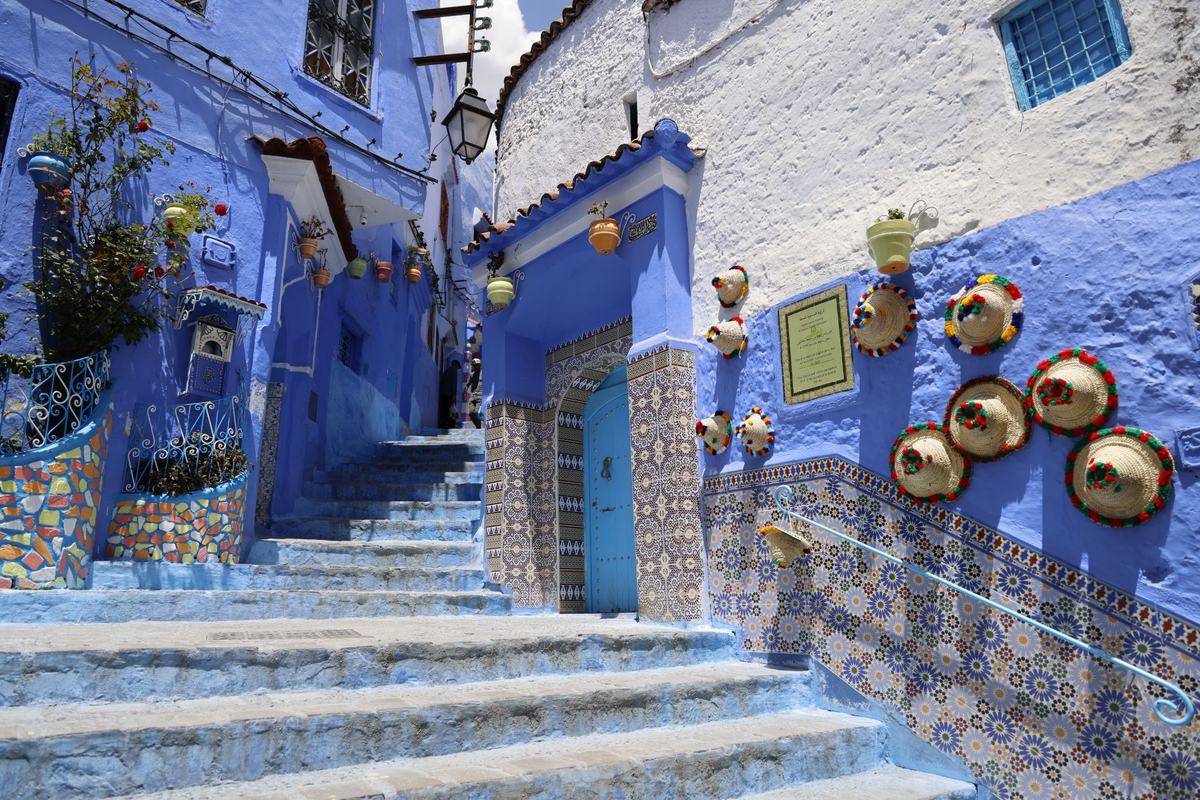
Chefchaouen sits high in the Rif Mountains in the north, and almost everything in the old town is painted blue. Walls, doors, stairs, planters, sometimes the cats. Nobody fully agrees on why. One story says Jewish refugees who arrived in the 1930s brought the tradition with them as a symbol of the sky and divinity. Another says it keeps mosquitoes away. A third says the locals just liked how it looked and the tourism worked out. The town leans into all three and sells postcards either way.
What surprised me reading about Chefchaouen is how recently it became famous. Foreigners were forbidden from entering until 1920. The place was essentially sealed off, holding onto Andalusian Spanish, Berber traditions, and a dialect of Arabic that drifted in its own direction for centuries. Now it's one of the most photographed small towns on the planet.
A Geography That Refuses to Pick a Lane
Morocco has the Atlas Mountains running diagonally across its middle, with peaks over 4,000 meters. Toubkal, the highest, hits 4,167 and gets real snow in winter [1]. People ski there. There's a resort called Oukaïmeden, and it's an hour from Marrakech. You can wake up in the desert, eat lunch in a souk, and be on a chairlift by dinner.
South of the mountains, the land falls away into the Sahara. Erg Chebbi, near Merzouga, is the dunescape most travelers picture when they think of Morocco. Some of those dunes hit 150 meters tall, and the sand goes orange at sunrise in a way photographs can't quite capture. North and west, you get 1,800 kilometers of Atlantic coastline plus a chunk of Mediterranean shore. Surf towns like Taghazout have become a quiet hub for Europeans escaping winter. And nobody talks about this, but Morocco has its own version of Provence: lavender, olive groves, and argan trees, the gnarled ones where goats sometimes climb up to eat the fruit. Yes, that's real. Yes, there are photographs.
Mint Tea, Tagines, and a Spice Trade That Never Ended
Moroccan food is one of those cuisines that hides its complexity in unfussy presentation. A tagine, the cone-shaped clay pot, is also the name of what cooks inside it: slow-braised lamb, chicken with preserved lemon and olives, kefta with eggs cracked on top at the last minute. The trick is that nothing is rushed. The pot's shape recirculates moisture so the meat goes tender on almost no liquid.
Then there's the tea. Atay, sweet green tea with fresh mint, poured from a long-spouted pot held high so it foams in the glass. The pour is half the ritual. You will be offered tea everywhere - by rug sellers, by the guy fixing your scooter, by strangers who invite you into their courtyard because you looked at the door too long. Refusing is rude. Drinking three glasses is the rule. The first glass is said to be bitter as life, the second strong as love, the third gentle as death. Which sounds heavy until you've sat on a cushion in a Berber tent in the desert and watched someone do the pour for the fifth time that day.
The country sits at one end of the old spice trade and it shows. Saffron from the Taliouine region. Cumin, paprika, ginger, cinnamon, turmeric stacked in pyramids in every souk. Ras el hanout, the famous spice blend, can have over thirty ingredients depending on the vendor, and every family has its own version.
Frequently Asked Questions
What is Morocco best known for?
Morocco is best known for its imperial cities, Sahara desert landscapes, vibrant souks, and tagine cuisine. The country is also famous for the blue town of Chefchaouen, the Atlas Mountains, mint tea culture, and the medieval medinas of Fez and Marrakech, which are UNESCO World Heritage Sites.
Is Morocco in Africa or Europe?
Morocco is in North Africa. The country sits at the northwest tip of the African continent, separated from Spain by the 14-kilometer Strait of Gibraltar. Despite its African location, Morocco has deep historical ties to Europe and the Arab world, reflected in its languages, architecture, and cuisine.
What languages do Moroccans speak?
Moroccans speak Arabic and Amazigh (Berber), the two official languages. French is widely used in business, government, and education as a legacy of the colonial period. Spanish appears in the north, and English is becoming more common among younger Moroccans, especially in tourist areas and major cities.
What is the best time to visit Morocco?
The best times to visit Morocco are spring (March to May) and fall (September to November), when temperatures are mild across the country. Summer can be brutal in inland cities like Marrakech and Fez, while the Sahara is hostile in July and August. Winter is ideal for desert travel.