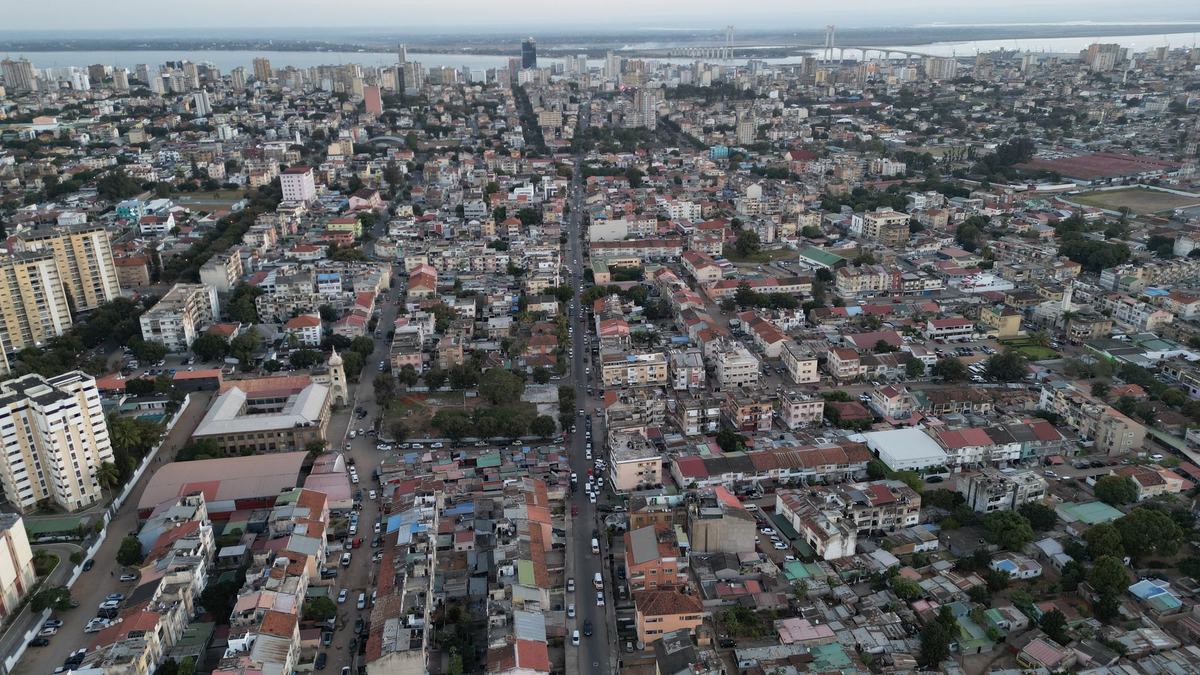
- Capital: Maputo, in the far south of the country [1]
- Population: about 33.9 million people (2023 estimate) [2]
- Area: 801,590 square kilometers, roughly twice the size of California [1]
- Official language: Portuguese, with dozens of Bantu languages spoken at home [1]
- Currency: Mozambican metical (MZN)
- Coastline: roughly 2,470 kilometers along the Indian Ocean, one of the longest in Africa [1]
I used to think of "Portuguese-speaking countries" and stop at Portugal and Brazil. Then a librarian back in Montana handed me a battered copy of a Mia Couto novel, told me I was reading a writer from Mozambique, and I had to look this up twice. A whole country on the Indian Ocean, the size of two Californias, speaking Portuguese in southern Africa. I'd somehow gone twenty-something years without putting it on the map in my head.
Mozambique is one of those places that feels improbable the first time you really look at it. It sits on Africa's southeast coast, hugging the Indian Ocean from Tanzania all the way down to South Africa. It got its name from a single small island off the northern coast, the Island of Mozambique, which was a major Swahili-Arab trading post long before Vasco da Gama showed up in 1498 and pinned it onto European maps [3]. The whole country eventually took the name of that one tiny island. There's something I love about that. The smallest dot ends up labeling the entire territory.
A Coastline That Goes On Forever
The coast is the first thing anyone who's been there talks about. About 2,470 kilometers of Indian Ocean shoreline, which is a long, slow drive even on paper [1]. White sand. Dhows. Coral reefs that haven't been loved to death yet. Bazaruto and Quirimbas, two archipelagos that show up on diving magazine covers a few times a year. The water in places is shockingly clear, the kind of color that doesn't really photograph right, no matter how good your phone is.
The catch is that this coast also makes Mozambique a magnet for cyclones spinning off the Indian Ocean. Cyclone Idai hit central Mozambique in March 2019 and was one of the deadliest storms ever recorded in the southern hemisphere [4]. The city of Beira, second largest in the country, took the brunt of it. When you read about climate vulnerability as an abstraction in the news, this is the kind of place the abstraction is talking about.
Portuguese in Southern Africa
Mozambique speaks Portuguese because it was a Portuguese colony for almost five centuries, from 1505 until independence in 1975 [3]. That's a long time. Long enough that Portuguese became the official language and the working tongue of the cities, even though most Mozambicans grow up speaking a Bantu language at home, Emakhuwa being the most widely used [1]. Walk through Maputo and you'll hear Portuguese sentences laced with Changana words, the way Spanglish drifts in and out in parts of the US Southwest.
Mozambique is one of nine official Portuguese-speaking countries in the world. It's the only one in mainland southern Africa. It joined the Commonwealth of Nations in 1995 despite never having been British, mostly because all its neighbors are English-speaking and it made trade easier [5]. That's a rare move. The Commonwealth almost always means a former British colony. Mozambique was the first exception.
A Flag with a Rifle on It
Here's the thing I tell everyone who hasn't heard it. Mozambique's flag has an AK-47 on it. A literal Kalashnikov, crossed with a hoe and an open book, all stacked on a yellow star [3]. It's the only national flag in the world with a modern assault rifle on it.
The symbolism is straightforward once you know the history. The rifle stands for defense and the long armed struggle that won independence in 1975. The hoe is agriculture, the open book is education, the star is socialism and internationalism. The country has held referendums about whether to change the flag, and people have voted to keep it. Most Mozambicans see it as a piece of national history, not a glorification of violence.
The first time I saw it printed on a postage stamp, I genuinely stopped what I was doing. You don't expect that on a flag.
Music, Food, and a Word Worth Knowing
Mozambican food is what you get when Portuguese sailors, African staples, Indian spice routes, and the Arab Swahili coast all sit at the same table for five hundred years. Peri-peri sauce, the fiery chili condiment that South Africans and the rest of the world have semi-stolen, traces its modern lineage right through Mozambique [6]. The country is where Portuguese settlers met the African bird's eye chili and started bottling the result. Matapa, a dish of cassava leaves cooked with peanuts and coconut milk, is closer to the everyday national food than anything spicy.
The music is its own story. Marrabenta is the signature genre, born in the suburbs of what's now Maputo in the 1930s and 1940s, an upbeat fusion of Portuguese folk and local rhythms [7]. The name comes from "rebentar", Portuguese for "to break", because the cheap guitar strings the early players used kept snapping.
And the word worth knowing: machamba. It means a small farm or family plot of land, the kind that produces most of Mozambique's food. Roughly three out of four Mozambicans live off agriculture in some form. The machamba is the country's economic engine, even if it doesn't show up in GDP charts.
Frequently Asked Questions
What language do they speak in Mozambique?
Portuguese is the official language and the one used in schools, government, and media. At home most people speak a Bantu language, with Emakhuwa, Changana, and Sena being the most common. About half of Mozambicans speak Portuguese as a second language rather than a first.
Is Mozambique safe to visit?
Mozambique is broadly safe for tourists in the south, including Maputo, Inhambane, and the Bazaruto Archipelago. The far north, especially Cabo Delgado province, has had an active insurgency since 2017 and most governments advise against travel there. Always check current advisories before booking.
What is Mozambique known for?
Mozambique is best known for its long Indian Ocean coastline, its Portuguese-language heritage in southern Africa, peri-peri chili sauce, marrabenta music, and being the only country with a modern assault rifle on its national flag. It's also a major exporter of natural gas and aluminum.
When did Mozambique gain independence?
Mozambique gained independence from Portugal on June 25, 1975, after a ten-year armed struggle led by the liberation movement FRELIMO. A civil war followed almost immediately and lasted until 1992. The country has been at peace, with a few regional exceptions, since then.