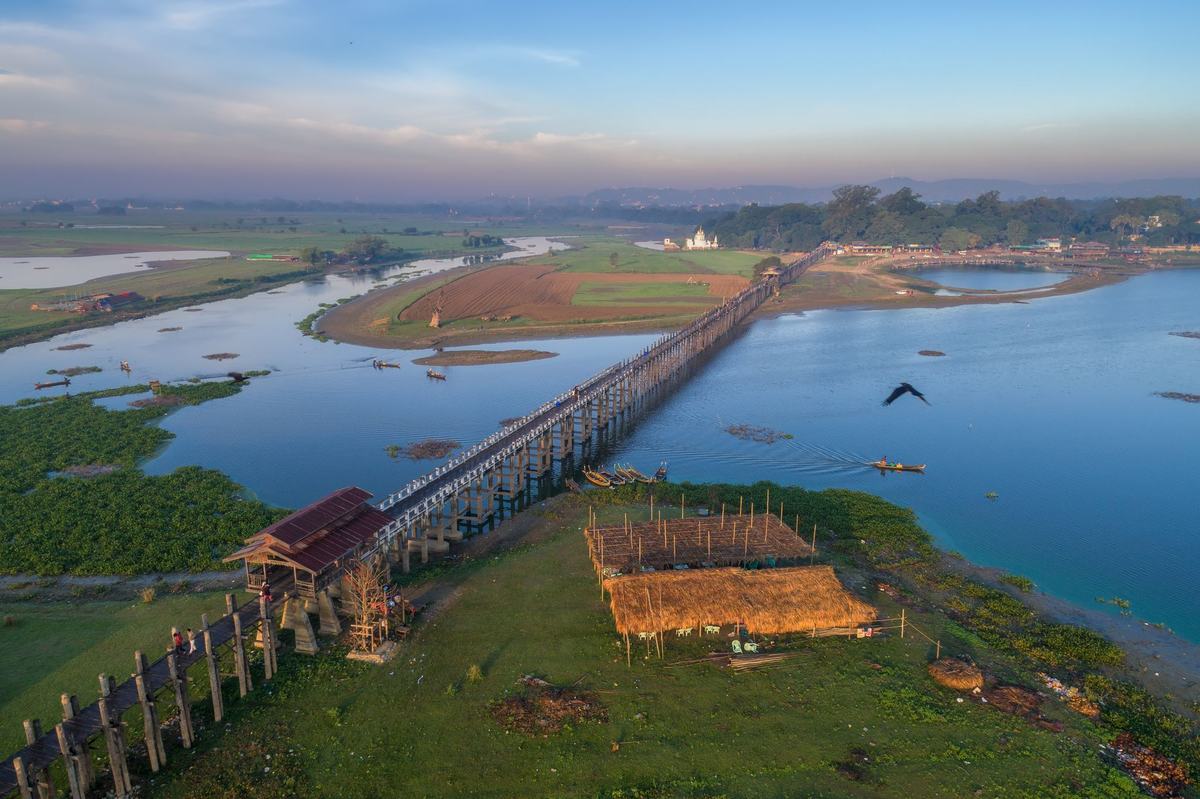
- Capital: Naypyidaw, a planned city opened in 2005 [1]
- Population: about 54.5 million people (2023 estimate) [2]
- Area: 676,578 square kilometers, slightly larger than Texas [1]
- Official language: Burmese, with over 100 other languages spoken across ethnic groups [1]
- Currency: Myanmar kyat (MMK)
- Distinction: home to the Shwedagon Pagoda, said to enshrine relics of the historical Buddha [3]
I grew up thinking of Southeast Asia as a tidy cluster of beach destinations on a map. Then I read a travel essay about a city in Myanmar with more than two thousand temples on a single dusty plain, and I had to look this up twice. Bagan is real. The temples are real. There are eleventh-century brick stupas you can still walk inside, and most travelers have never heard of any of them.
Myanmar sits between Bangladesh, India, China, Laos, and Thailand, which is one of the busier neighborhoods on the planet. The country runs north to south along the Bay of Bengal and the Andaman Sea, and it spends a lot of its geography being mountainous, riverine, and densely forested. It also has two names, two clocks, and a road system that does something nowhere else in the world does. None of that is exaggeration.
Two Names for the Same Country
Most countries get one official name. Myanmar has two, and which one you use says something about your politics. The country was called Burma for most of its modern history. In 1989 the military government renamed it Myanmar, arguing the new name was more inclusive of the country's many ethnic groups beyond the Bamar majority [4]. The United Nations adopted the new name. The United States and the United Kingdom held out for years, mostly as a quiet protest against the military regime that imposed the change.
These days you'll see both names in English-language press, sometimes in the same paragraph. The Burmese word for the country, in formal speech, is essentially "Myanmar". In casual speech, it's closer to "Bama". So in a sense both names have always existed in the language. The English-language argument is partly about which one outsiders should use.
A Million Pagodas, More or Less
Myanmar is one of the most devoutly Buddhist countries in the world. About 88 percent of the population is Theravada Buddhist, and you can feel it everywhere. Every town has stupas. Every hill has a stupa. Every taxi has a small offering tucked into the dashboard.
The Shwedagon Pagoda in Yangon is the heart of it. The main stupa is gilded with several tons of gold leaf and is said to contain eight hairs of the historical Buddha [3]. People come at sunrise and sunset and sit on the marble platform and just stay there. Locals call it the soul of the country, and after an hour on the platform you start to understand why.
Bagan is the other place that defies easy description. From the ninth to the thirteenth centuries, the kings of Bagan built more than ten thousand Buddhist temples on a single plain along the Irrawaddy River. Earthquakes, time, and looting have taken a toll, but more than 2,200 of them are still standing [5]. You can rent an e-bike, ride for an hour in any direction, and find yourself alone inside a brick temple older than most European cathedrals.
A Clock Half an Hour Off the Rest of Us
Myanmar runs on a time zone that's six and a half hours ahead of Greenwich [1]. Not six. Not seven. Half an hour off. India does this too, and so does Nepal at fifteen minutes past the hour, but it always catches new travelers off guard. Land at Yangon airport and you'll set your watch to a time most of the world doesn't use.
The traditional Burmese calendar adds another layer. It's a lunisolar calendar with twelve months, plus an extra "intercalary" month inserted every few years to keep things aligned with the seasons. Most people use the Gregorian calendar for daily business, but festivals, monastic dates, and traditional birthdays still run on the old system. Two calendars, side by side, and almost nobody finds it confusing.
The Road Rule Nobody Else Has
Here's the thing about driving in Myanmar. The country drives on the right, like the United States. But most of the cars on the road have the steering wheel on the right, like the United Kingdom or Japan [6]. That combination, right-side traffic with right-side steering, doesn't exist anywhere else.
It happened by accident, more or less. Until 1970 Myanmar drove on the left, a holdover from British colonial rule. The military government switched the country to right-hand traffic overnight. Most cars on the road at the time were left-hand drive, but in the decades since, most imports have come used from Japan, where the steering wheel is on the right. The result is a country where the driver sits on the curb side and has to lean way out to pass anyone. It is, as a friend who lived in Yangon put it, "a permanent slow-motion improvisation".
Food, Tea Shops, and a Salad Made of Leaves
Burmese food doesn't get the global press that Thai or Vietnamese food gets, which is its own kind of shame. The signature dish is mohinga, a fish-based noodle soup that most people eat for breakfast. The other one to know is lahpet thoke, a salad made from fermented tea leaves, served with peanuts, garlic, dried shrimp, and a splash of lime [7]. Tea, but as food. I had to look this up twice when I first read about it.
The tea shop, in Myanmar, is closer to what a diner is in the rural United States. People sit for hours. Plastic stools, sweet tea with condensed milk, samosas, and Burmese-style fritters. Politics gets argued. Marriages get arranged. Everyone seems to know everyone else's grandmother. Back home in Montana the closest thing was the one cafe in town where the ranchers ate breakfast at five in the morning. The architecture is different. The function is the same.
Frequently Asked Questions
What is Myanmar known for?
Myanmar is known for its devout Theravada Buddhist culture, the gilded Shwedagon Pagoda in Yangon, and the ancient temple plain of Bagan with more than 2,200 surviving stupas. It is also the only country with right-hand-drive cars on right-hand-side roads.
Is Myanmar the same as Burma?
Yes, Myanmar and Burma refer to the same country. The military government changed the official English name from Burma to Myanmar in 1989. The United Nations and most countries now use Myanmar, though some media and individuals still prefer Burma.
What language is spoken in Myanmar?
Burmese is the official language and the most widely spoken, used in government, schools, and media. More than a hundred other languages are spoken across the country's many ethnic groups, including Shan, Karen, Rakhine, and Mon. English is also used in business.
When is the best time to visit Myanmar?
The cool, dry season from November to February is the most pleasant time to visit. Temperatures are mild, rainfall is low, and most major sites including Bagan and Inle Lake are easy to travel between. The monsoon runs roughly May to October.