- Capital: Windhoek [1]
- Population: Approximately 2.6 million (2023) [2]
- Area: 825,615 km² (about twice the size of California) [1]
- Official language: English (with Oshiwambo, Afrikaans, German, and others widely spoken) [1]
- Currency: Namibian dollar (NAD), pegged 1:1 to the South African rand [3]
- Distinguishing claim: Home to the Namib, the oldest desert on Earth, estimated at 55 to 80 million years old [4]
I grew up thinking deserts were just hot sand. Then I read about Namibia and had to sit down for a minute. Picture a country bigger than Texas and California combined, with fewer people in it than the city of Houston. Now picture sand dunes the color of rust climbing 1,000 feet into the sky, and a coastline so brutal that sailors called it the Skeleton Coast because so many ships and whales washed up dead. That's Namibia. It's the kind of place that makes you wonder how empty the planet actually is, once you get away from the parts of it we crowded into.
A Country with Almost Nobody in It
Here's the thing about Namibia: it's one of the least densely populated countries on Earth. About 3 people per square kilometer, depending on which year you check [2]. For comparison, my home state of Montana feels empty at around 3 people per square kilometer too, and we joke about it constantly. But Montana has interstates, gas stations every fifty miles, and Costco. Namibia has stretches where the next human settlement is hours of dirt road away, and the only thing you'll see is oryx standing on a ridge like they own the place.
Most of the country sits on a high plateau, with the Namib Desert running along the entire Atlantic coast and the Kalahari sweeping in from the east. The middle is dry, rocky savanna where ranchers run cattle on parcels the size of small American counties. You can drive for an entire day on a Namibian gravel road and pass maybe four other vehicles. The country is what it is partly because of the climate - rain is scarce, the soil is thin, and water is the thing every conversation eventually circles back to.
The Oldest Desert on Earth
The Namib has been a desert for somewhere between 55 and 80 million years [4]. Long enough that the plants and animals there evolved specifically to live in it, which is not something you can say about most deserts. The Sahara, by comparison, has only been a desert for around 2 to 3 million years. The Namib was already old when Tyrannosaurus rex was a going concern.
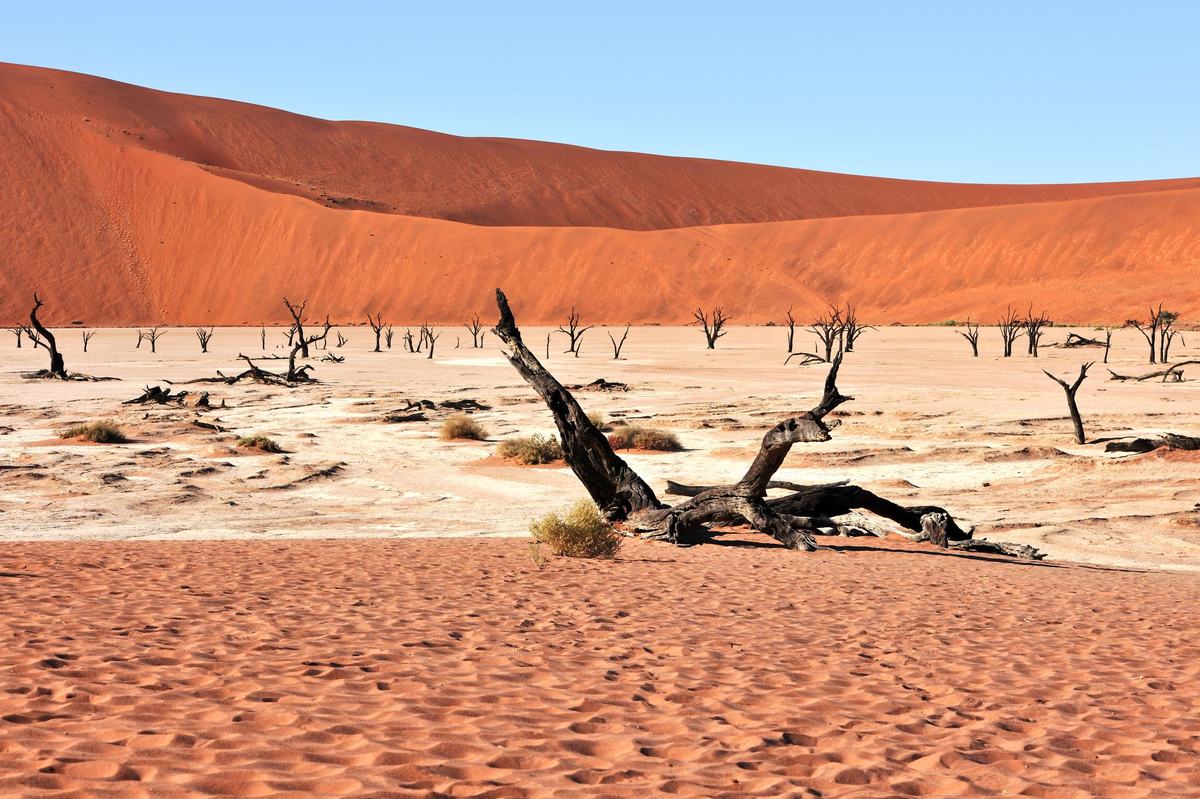
The most famous patch is Sossusvlei, where the dunes turn a deep red because of iron oxide in the sand, and they're tall - the biggest, called "Big Daddy", is over 325 meters [5]. Climbing it is the kind of thing you don't forget. The sand is cool just under the surface even at midday, and from the top you can see white salt pans cracked like dried paint, with the skeletons of ancient camelthorn trees standing dead in the middle. Photographers come from everywhere for this. I have not been, yet, but it sits near the top of the list.
The Skeleton Coast
The Atlantic coast of Namibia got its name honestly. Cold Benguela Current air collides with the hot desert air and produces a near-constant fog that, for centuries, killed sailors. Ships ran aground in the fog and the desert took everything. You can still walk the coast and find rusting hulls half-buried in sand, sometimes miles inland because the dunes moved over them. The Bushmen who lived nearby called it "the land God made in anger". The Portuguese called it "the gates of hell" [6].
Which, if you think about it, is one of the more honest place names ever given. Whales used to wash up on the beach in large numbers, and their bones bleached white in the sun, and that's where the "skeleton" part came from. Today most of the coastline is a protected national park, and access is restricted - you need a permit to even drive parts of it.
Wildlife That Knows How to Survive
Namibia was the first country in the world to put environmental protection into its constitution [7]. That happened at independence in 1990, and the result is a wildlife conservation system that's become a global model. About 44% of the country's land is under some form of conservation management, including community-run conservancies where local people benefit directly from tourism and game [7].
The wildlife adapted to a country with very little water. Desert elephants in the northwest can go days without drinking and walk huge distances between water holes. Black rhinos hide in rocky terrain that would chew up most off-road vehicles. The country has the world's largest population of free-roaming cheetahs, around a third of all the cheetahs left on Earth [8]. And the oryx, a big antelope with vertical horns, can raise its body temperature to handle desert heat without sweating, which is the kind of evolutionary trick that makes you respect what natural selection can do with enough time.
A Cultural Mix Shaped by History
Namibia was a German colony from 1884 until World War I, and then under South African administration until independence in 1990 [1]. You can still see the German part everywhere - towns like Swakopmund have bakeries that sell proper apfelstrudel, street signs in German, and architecture that looks like a Bavarian village dropped onto the edge of the desert. It's strange and a little jarring at first.
The country has about a dozen distinct ethnic groups. The Ovambo are the largest, the Herero are known for their elaborate Victorian-style dresses (a complicated legacy of German colonial influence), and the Himba in the northwest still live much as they have for centuries, with women covering their skin in a red ochre and butterfat paste called otjize. Namibia's official language is English, but most people grow up speaking two or three languages at home. The German colonial past included a brutal genocide of the Herero and Nama people between 1904 and 1908, which Germany formally recognized only in 2021 - a piece of history that took more than a century to get an honest accounting.
Frequently Asked Questions
What is Namibia best known for?
Namibia is best known for the Namib Desert, the oldest desert on Earth, and for being one of the least densely populated countries in the world. It's also famous for its wildlife conservation, towering red sand dunes at Sossusvlei, and the eerie Skeleton Coast where shipwrecks dot the Atlantic shore.
What language do they speak in Namibia?
English is the official language of Namibia, but most Namibians grow up multilingual. Oshiwambo is the most widely spoken first language, followed by Afrikaans, which serves as a common second language. German and various indigenous languages including Herero, Damara, and Nama are also spoken regularly.
Is Namibia safe to visit?
Namibia is generally considered one of the safer countries in Africa for travelers, with low rates of violent crime in tourist areas. Standard precautions apply in cities like Windhoek, particularly at night. The main risks for visitors are usually road conditions and wildlife encounters on self-drive safaris.
When is the best time to visit Namibia?
The best time to visit Namibia is during the dry season from May to October, when wildlife congregates around water sources and the weather is cool and clear. November to April brings hotter temperatures and occasional rain, which can make some gravel roads difficult but turns the desert briefly green.
Sources
- Namibia Country Profile - BBC News
- World Bank Data: Namibia
- Bank of Namibia: Currency
- Namib Sand Sea - UNESCO World Heritage
- Namib-Naukluft National Park - Namibia Tourism Board
- Skeleton Coast National Park - Encyclopedia Britannica
- Community Conservation in Namibia - World Wildlife Fund
- Cheetah Conservation Fund - Namibia