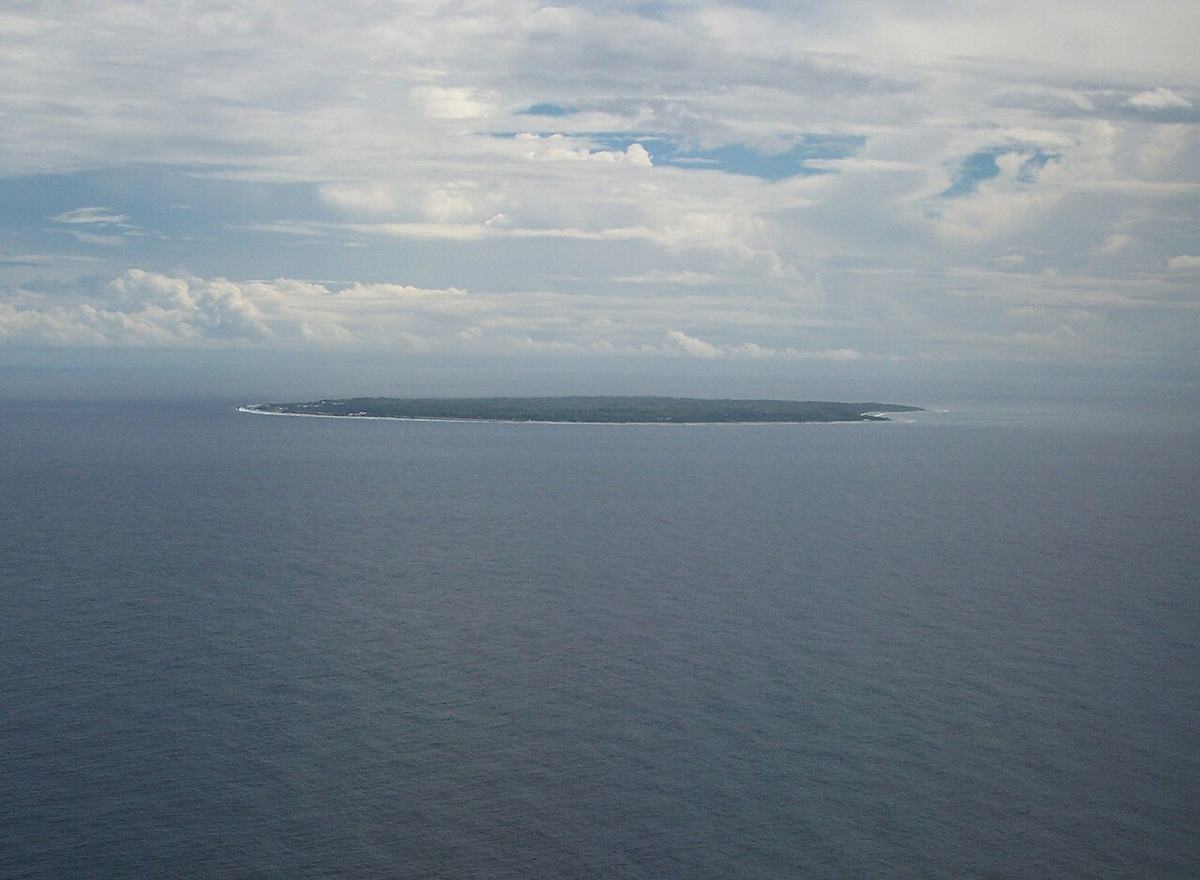
- Capital: no official capital; government offices sit in the Yaren District [1]
- Population: about 12,500 (2024 estimate) [2]
- Area: 21 square kilometers, roughly a third the size of Manhattan [1]
- Official languages: Nauruan and English [1]
- Currency: Australian dollar (AUD) [1]
- The third smallest country in the world by both area and population [3]
Here's something that'll ruin the next geography quiz you take: Nauru is the third smallest country on Earth, but for a brief stretch in the 1970s it had the highest per capita income on the planet. Higher than the United States. Higher than Saudi Arabia. Higher than Switzerland. The whole thing rested on bird droppings, which sounds like a joke until you read the full story. Then it stops being funny.
Nauru sits alone in the central Pacific, about 1,500 miles northeast of Australia. The nearest neighbor is Banaba, a single island in Kiribati, more than 180 miles away. You can walk the entire coast of Nauru in about four hours. The country has no rivers, no real harbor, and a single road that loops around the perimeter.
A Speck of Land with a Strange Inheritance
Nauru was formed by an ancient coral reef that got pushed up out of the ocean, then sat there for millions of years collecting seabird guano. Layer upon layer of it. Over time, the guano reacted with the coral and turned into phosphate rock, one of the most valuable fertilizers in the world. By the early 1900s, German and then British prospectors realized the entire interior of the island was essentially a giant phosphate mine.
For most of the 20th century, foreign companies dug up Nauru and shipped it overseas. When the country gained independence in 1968, the new government took over the mines and the money started flowing in. By the mid-1970s, Nauru was raking in tens of millions of dollars a year, and there were only around 7,000 people to share it. Citizens paid no income tax. Healthcare and education were free. The government built a national airline, Air Nauru, that at one point had a fleet larger than the country's population would seem to justify.
What Happens When You Mine Your Own Country
The trouble was simple. They were literally digging up the island and selling it. The interior of Nauru is now a moonscape of jagged limestone pinnacles where the phosphate was stripped out. About 80 percent of the island has been mined, leaving most of the country uninhabitable [4]. The population is squeezed onto a thin coastal strip, which is also where the airstrip, the school, the hospital, and pretty much everything else has to fit.
By the late 1990s, the phosphate was running out and the trust fund the government had set up to manage the money had been raided by bad investments. There was a chain of bankrupt hotels in Hawaii. A failed London musical about Leonardo da Vinci. A tower in Melbourne that became a kind of national punchline. The country went, in about two decades, from richest per capita to nearly broke.
Back home in Montana we had towns built around copper and lumber that emptied out when the resource was gone. Nauru is the same story compressed into one island and one generation.
The World's Smallest Capital City Situation
Nauru is the only country in the world with no official capital. The government sits in Yaren, on the southwestern coast, but Yaren isn't a city. It's a district. The constitution simply doesn't name a capital, which makes Nauru a favorite trick question for pub quizzes.
The country is divided into 14 districts, and the parliament has 19 members, one of the smallest legislatures of any sovereign state. Cabinet meetings sometimes feel less like government and more like a community council, because in a country this small everyone knows everyone.
Sport, Sumo, and Australian Rules
For a population this tiny, Nauru is unusually obsessed with sport. Weightlifting is the closest thing to a national passion, and the country has produced multiple Commonwealth Games medalists. Australian Rules football is the most popular team sport, a legacy of decades of close ties with Australia.
Nauru has also sent more than a few wrestlers to Japan to train as professional sumo. Most Pacific Island sumo champions come from Nauru, Tonga, or Samoa, and the Nauruan ones have a reputation for being almost impossibly strong. The combination of a high protein diet, big frames, and a culture that respects physical power produces athletes who would dominate at home in Helena and not look out of place anywhere.
A Country Still Figuring Out the Next Chapter
Today Nauru survives partly on foreign aid, partly on fishing license revenue, and partly on hosting an offshore processing center for asylum seekers under contract with Australia, which is controversial both inside the country and out. Climate change is the next concern. The coastal strip where everyone lives is barely above sea level, and the interior, scarred as it is, is hot and dry.
There's a slow rehabilitation effort to make the mined-out land livable again. Replanting trees. Filling pits. It's the kind of project that will take longer than the original mining did. Which, if you think about it, is how most environmental cleanups go.
Frequently Asked Questions
Where is Nauru located?
Nauru is a small island country in the central Pacific Ocean, just south of the equator. It lies about 1,500 miles northeast of Australia and 180 miles from its nearest neighbor, Banaba Island. It is one of the most isolated countries in the world.
How big is Nauru?
Nauru is 21 square kilometers, making it the third smallest country in the world by area, behind Vatican City and Monaco. The population is about 12,500. The entire coastline can be walked in roughly four hours along a single ring road.
Does Nauru have a capital city?
Nauru has no official capital. Government offices are located in the Yaren District on the southwest coast, which is often listed as the de facto capital in atlases. The constitution does not designate one, making Nauru unique among sovereign states.
Why was Nauru once so wealthy?
Nauru sits on rich phosphate deposits formed from millions of years of seabird droppings. After independence in 1968, the country exported phosphate aggressively and had the world's highest per capita income in the mid-1970s. The wealth collapsed when reserves ran out and trust fund investments failed.
Can tourists visit Nauru?
Yes, but visitors are rare. There is one international airport served mostly by Nauru Airlines, with flights connecting to Brisbane and a few Pacific cities. There are only a handful of hotels, no formal beaches developed for tourism, and most of the interior is mined-out limestone.