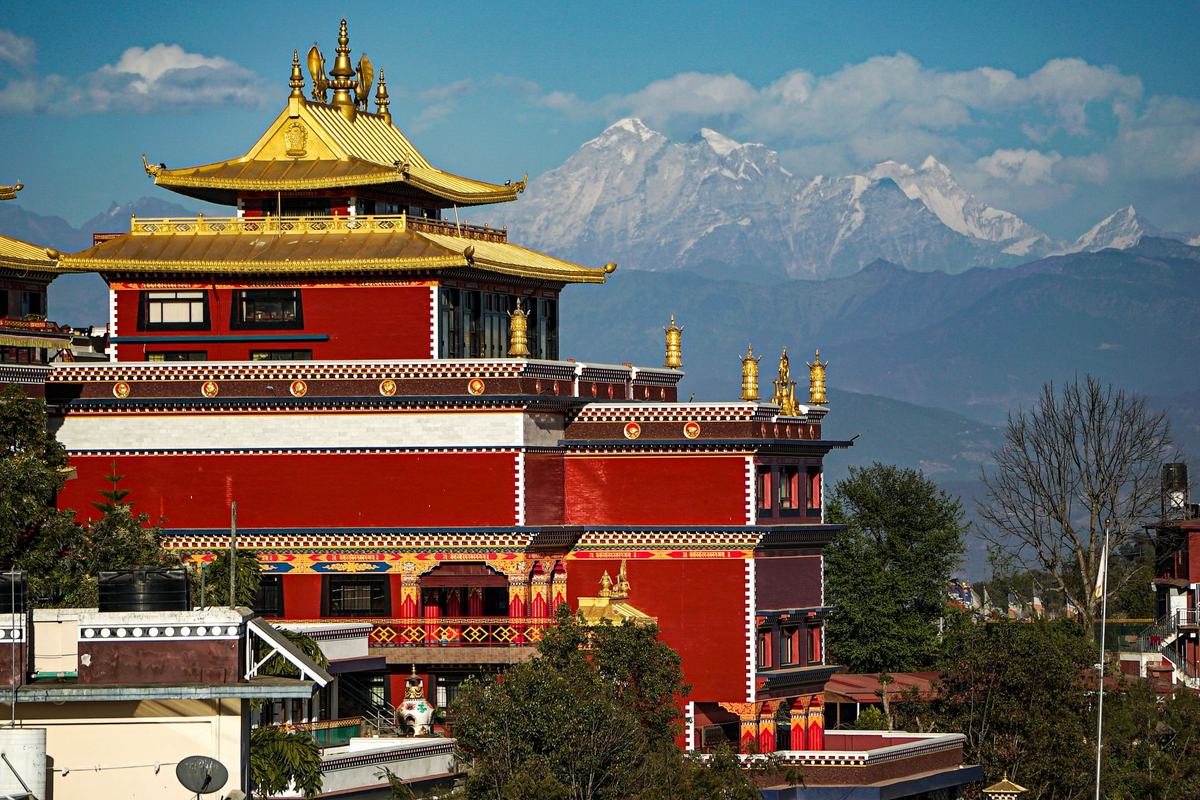
- Capital: Kathmandu [1]
- Population: about 30.9 million (2024 estimate) [2]
- Area: 147,516 square kilometers, roughly the size of Iowa [1]
- Official language: Nepali, with 123 other languages spoken across the country [3]
- Currency: Nepalese rupee (NPR) [1]
- Home to eight of the world's fourteen mountains above 8,000 meters, including Mount Everest [4]
I grew up thinking mountains were what you saw out the kitchen window in Montana. Then I read a book about Nepal in middle school and learned that the Rockies, the ones I'd been bragging about all my life, wouldn't even rank as foothills in the Himalayas. Nepal has eight of the fourteen tallest mountains on Earth. Eight. The other six are split between Pakistan, India, and China, and Nepal shares some of them anyway. The country fits between China and India like a slightly bent rectangle, and inside that small frame is the entire vertical history of our planet.
Nepal is about the size of Iowa, but its elevation runs from 60 meters above sea level in the southern plains to 8,849 meters at the summit of Everest. That's the steepest geographic gradient of any country in the world. You can start your morning in jungle thick enough to hide a tiger and end it looking at a glacier. The country contains tropical lowland, terraced hill country, alpine valleys, and high-altitude desert. All of it stacked into a strip you could drive across in a long afternoon, if the roads cooperated.
A Country Stacked Vertically
The Himalayas were pushed up when the Indian tectonic plate slammed into Asia about 50 million years ago, and they are still rising about 4 millimeters a year. Mount Everest is taller this year than it was the year I was born. Nepal sits on top of the most geologically violent border on Earth, which is also why the country sees regular earthquakes, including the 2015 disaster that killed nearly 9,000 people and damaged temples and homes across the Kathmandu Valley [5].
The southern strip of Nepal, called the Terai, is flat, hot, and humid. It's where most of the population actually lives and most of the rice gets grown. Travelers tend to picture monasteries and prayer flags, but a lot of Nepal looks like northern India: water buffalo, mango trees, and women in saris walking along irrigation canals. The famous Himalayan landscape is the northern third of the country. Most Nepalis have never seen Everest in person.
The Birthplace of the Buddha
Here's the thing about Nepal that surprises people. The Buddha was Nepali. Siddhartha Gautama, who became the Buddha, was born around 563 BCE in Lumbini, a small town in the southern Terai. There's an inscribed pillar from 249 BCE, put there by the Indian emperor Ashoka, that marks the exact spot [6]. Lumbini is a UNESCO World Heritage site today and one of the four main pilgrimage destinations in Buddhism, alongside three sites in India.
The interesting wrinkle is that Nepal is mostly a Hindu country. About 81 percent of Nepalis are Hindu and around 9 percent are Buddhist, though in practice the two religions overlap in ways that would confuse a strict theologian. Many temples honor both Hindu deities and the Buddha. Festivals mix freely. Until 2008, Nepal was the world's only officially Hindu kingdom. When the monarchy was abolished, the country became a secular republic, but the religious culture continued without much disruption.
A Flag Like Nowhere Else
Nepal is the only country in the world whose flag isn't a rectangle. It's two stacked triangular pennants, one on top of the other, with a moon in the upper triangle and a sun in the lower one. The flag dates back centuries in its general form, and the current version is described in the constitution with actual geometric construction instructions, including the angles and curves. It's a flag you could build with a compass and a straightedge if you had to.
The shape is said to represent the Himalayan peaks, and the sun and moon represent the hope that Nepal will last as long as those two heavenly bodies do. Which, if you think about it, is one of the more poetic reasons a country has ever put forward for its national symbol.
The Gurkhas and a Strange Military Tradition
Few small countries have a military reputation bigger than their actual military. Nepal is one of them. The Gurkhas, soldiers recruited from the Nepali hills, have been serving in the British Army since 1815, when the British East India Company fought a war against Nepal and came away so impressed with the Nepali troops that they started hiring them. Today there are still Gurkha regiments in both the British and Indian armies, and competition to join is brutal. Tens of thousands of young Nepali men apply each year for a few hundred spots [7].
The famous kukri knife, with its forward-curved blade, is the traditional weapon and now a ceremonial part of Gurkha uniform. Back home in Montana I knew a guy who collected military knives, and the kukri was his prize. He'd talk about it the way some people talk about classic cars.
Kathmandu and the Living Temples
The Kathmandu Valley is one of the densest concentrations of UNESCO World Heritage architecture anywhere. Seven separate monument zones are listed, including the old royal cities of Kathmandu, Bhaktapur, and Patan, plus the Hindu shrines at Pashupatinath and the Buddhist stupas at Boudhanath and Swayambhunath [8]. The valley was three independent kingdoms until the 18th century, and each one tried to outdo the others with palaces and temples.
Many of these temples are still living religious sites. People show up to make offerings before work. Cows wander through the squares. The 2015 earthquake collapsed parts of several historic structures, and the restoration work has been slow, partly because the traditional building methods - carved wood, hand-fired brick, no steel - take a long time and a small number of trained craftsmen to recreate.
Festivals That Stop the Country
Nepali festivals are not subtle. Dashain, the biggest one, lasts 15 days and effectively shuts down the country every fall. Families travel home. Animals get sacrificed. Goats and chickens are blessed and then slaughtered for the feast. Tika, a mixture of rice and red powder, gets pressed onto foreheads as a blessing from elders.
Tihar, also called the festival of lights, follows about two weeks later and is gentler, with five days of honoring different beings: crows, dogs, cows, and finally siblings. The dog day, Kukur Tihar, has become beloved online, with photos of strays getting garlands and red tika placed on their heads. The country also celebrates Holi, the Indian festival of colored powder, and several distinctly Nepali festivals that don't exist anywhere else.
A Republic Still Figuring Itself Out
Nepal was a monarchy until 2008. The royal family was the longest-ruling Hindu dynasty in the world, and the country had no real democratic government for most of its history. In 2001, almost the entire royal family was killed in a massacre at the palace, allegedly by the crown prince. The country was already in a civil war at the time, between the monarchy and a Maoist insurgency, and the killings accelerated the collapse of the old order.
Today Nepal is a federal democratic republic with a complicated multi-party system and frequent changes of government. Tourism, remittances from Nepalis working abroad, and Chinese and Indian aid keep the economy moving. Roads are improving. Hydropower projects are coming online. The country is still poor by global measures but the trajectory is different from what it was a generation ago.
Frequently Asked Questions
Where is Nepal located?
Nepal is a landlocked country in South Asia, sandwiched between India to the south, east, and west, and China to the north. It sits along the southern slope of the Himalayan mountain range. The capital, Kathmandu, is in a central valley about 1,400 meters above sea level.
Is Mount Everest entirely in Nepal?
Mount Everest sits on the border between Nepal and China, with the summit shared by both countries. The most popular climbing route, the South Col approach, starts from the Nepali side at the Khumbu region. Nepal handles the majority of commercial expeditions each year.
What language do Nepalis speak?
Nepali is the official language and is spoken or understood by most of the population. The country also recognizes 123 living languages, including Maithili, Bhojpuri, Tharu, Tamang, and Newar. English is widely used in business, tourism, and higher education.
Is Nepal a Hindu or Buddhist country?
Nepal is majority Hindu, with about 81 percent of the population identifying as Hindu and 9 percent as Buddhist. The two religions blend in everyday practice, and many temples are sacred to both traditions. Nepal is also the birthplace of the Buddha, in Lumbini.
Is Nepal safe for tourists?
Yes, Nepal is generally considered safe for tourists, with low rates of violent crime against visitors. The main risks are altitude sickness on trekking routes, road accidents on mountain highways, and occasional natural hazards like earthquakes and landslides. Standard travel precautions apply.
Sources
- The World Factbook: Nepal
- United Nations Population Division: Nepal
- National Statistics Office of Nepal: Census 2021
- UNESCO: Sagarmatha National Park
- United Nations Office for Disaster Risk Reduction: Nepal 2015 Earthquake
- UNESCO: Lumbini, the Birthplace of the Lord Buddha
- British Army: Brigade of Gurkhas
- UNESCO: Kathmandu Valley