- Capital: Amsterdam (official); The Hague is the seat of government [1]
- Population: about 17.9 million [2]
- Area: 41,850 square kilometers (16,160 square miles) [1]
- Official languages: Dutch, with Frisian as a second official language in Friesland [1]
- Currency: Euro (EUR)
- Distinguishing claim: roughly a third of the country sits below sea level, and another sliver of it didn't exist a hundred years ago [3]
Here's something that'll ruin the next geography quiz you take: the Netherlands has more bikes than people, and it isn't even close. About 23 million bikes for 17.9 million people, which works out to more than one for every man, woman, and infant. I had to look this up twice. Growing up in Montana, where the nearest bike path was a cracked shoulder on a state highway and the wind would push a kid sideways into a ditch, the idea of an entire country wired around two wheels felt like a fairy tale. The Dutch made it real, and they made it ordinary.
That's the thing about facts about Netherlands culture - the most surprising stuff is the stuff they treat as obvious. Land reclaimed from the sea. Ministers biking to work. A dinner table set at six on the dot. A flat horizon stitched together by canals and pumping stations that have been running, in one form or another, for centuries.
A Country Pulled Out of the Water
The name "Netherlands" literally means "low countries", and they meant it. About 26 percent of the country sits below sea level, and another 29 percent is less than a meter above it [3]. Without the dikes, dunes, and storm surge barriers, a serious chunk of the country would be ocean by lunch.
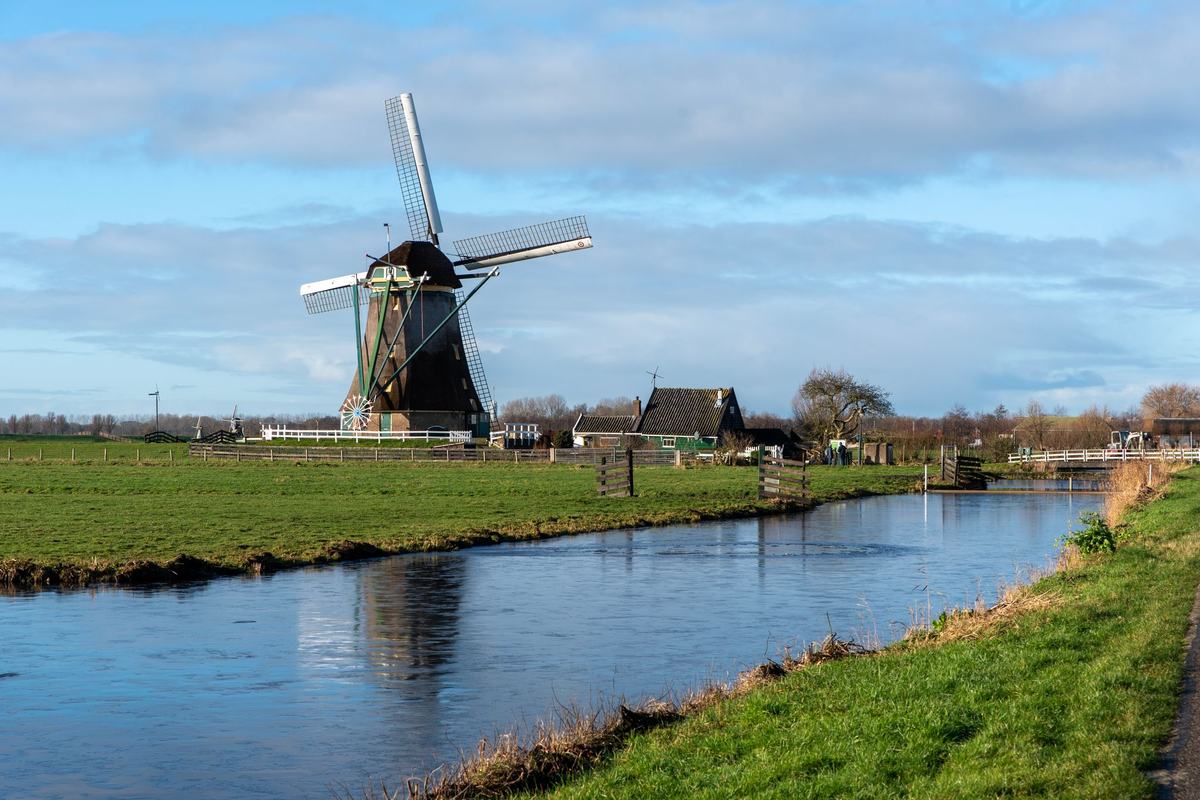
The Dutch have been pushing back the water for nearly a thousand years. They started with simple earth dikes around villages, then windmills to pump the polders dry, then steam, then diesel, then the kind of engineering that makes other countries fly in delegations to take notes. The Delta Works, built after the catastrophic 1953 North Sea flood, is a chain of dams, sluices, locks, and storm surge barriers that the American Society of Civil Engineers named one of the Seven Wonders of the Modern World.
And the country didn't just stop the sea, it took land back. Flevoland, an entire province on the central east side of the country, was the floor of an inland sea until the Dutch drained it in the 1950s and 1960s. Almost 970 square kilometers of new ground, parceled out into farms and towns and one fairly large city, Almere, founded in 1976 [3]. Drive across Flevoland today and you'd never guess it was lake bottom inside living memory. There are people in their seventies who remember when the place was water.
The Bike Capital of the World
Back to those bikes. Roughly 27 percent of all trips in the Netherlands are made by bicycle, and in cities like Amsterdam and Utrecht the share is closer to 40 percent [4]. That isn't a hobby, it's the transportation system.
The Dutch didn't always live this way. In the 1950s and 60s the country was paving over its old streets for cars, just like everyone else. Traffic deaths climbed, and in 1971 more than 400 children were killed by cars in a single year. A protest movement called Stop de Kindermoord, which translates roughly to "Stop the Child Murder", pushed the government to redesign streets around bicycles instead of vehicles. The country rebuilt itself, intersection by intersection, over the next fifty years.
Which, if you think about it, is the part nobody tells you. The Dutch bike culture wasn't a tradition handed down from grandfathers. It was a policy choice. Other countries could do this. Most won't.
Tulips, Windmills, and the World's First Stock Market Bubble
You can't write about facts Netherlands without the tulips. Tulips aren't even native, they were imported from the Ottoman Empire in the 16th century. The Dutch fell so hard for them that by 1637 a single bulb of the prized Semper Augustus variety could sell for the price of an Amsterdam canal house. Then the market collapsed in a few weeks, and historians have been arguing about Tulip Mania ever since as the first speculative bubble in recorded history.
The windmills are real but most of them aren't running anymore. At the peak, around 1850, the country had more than 10,000 working windmills, used for milling grain, sawing lumber, and most importantly, pumping water out of the polders. About 1,000 are still standing, and a few hundred still turn, kept alive by volunteer millers who train for years to earn the official license [5]. The village of Kinderdijk, a UNESCO World Heritage site, has nineteen of them lined up along a canal like an old photograph someone forgot to develop.
Stroopwafels, Bitterballen, and Dinner at Six
Dutch food doesn't get the press that French or Italian food does, and the Dutch themselves will half-jokingly tell you their cuisine is "potatoes, meat, and vegetables, in that order". But there are real treasures in there.
Stroopwafels - two thin waffle wafers glued together with caramel syrup - were invented in Gouda in the late 1700s, and the tradition is to set one on top of a hot cup of coffee until the steam softens the caramel. Bitterballen, deep-fried meat-ragout balls, are the national bar snack, the thing you order without thinking after the second beer. Herring is eaten raw from a stand on the street, head tilted back, the fish held by the tail and lowered straight into the mouth. The first time I saw this on a video I thought it was a joke. Turns out, it's a Tuesday.
And then there's the famous Dutch dinner schedule. Six p.m., on the dot, the country sits down to eat. Try to schedule a meeting at 5:30 and people will look at you the way a Montana rancher looks at a tourist asking to milk a cow. Dinner is not negotiable. Dinner is the wall the day stops at.
A Small Country with a Long Shadow
The Netherlands has fewer people than Florida and less land than West Virginia, and yet for stretches of history it has punched far above its weight. The Dutch Golden Age in the 17th century gave the world Rembrandt, Vermeer, the first multinational corporation (the Dutch East India Company), the first stock exchange, and a tradition of religious tolerance that pulled in thinkers from across Europe.
Today the country is the second-largest agricultural exporter in the world by value, after the United States, despite being roughly the size of a small American state [6]. The trick is greenhouses - vast climate-controlled glass cities outside Rotterdam and in the Westland region, growing tomatoes and peppers with a fraction of the water and land of conventional farming. The Dutch have been quietly rewriting what's possible on a square meter of dirt.
The Hague hosts the International Court of Justice and the International Criminal Court, making this flat little country the legal capital of the planet. Amsterdam handles the money, Rotterdam handles the cargo (it's the largest port in Europe), and The Hague handles the law. They split the workload the way a good Midwestern family splits Thanksgiving.
A Few Loose Threads Worth Knowing
The Dutch are the tallest people in the world on average, with men at about 1.84 meters (6 feet 0.5 inches) and women not far behind. Scientists are still arguing about why - genetics, dairy, public health - but the trend is real and well documented.
Orange is the national color even though the flag is red, white, and blue. It comes from the House of Orange-Nassau, the royal family. King's Day, every April 27, turns the entire country into a flea market in orange clothing.
Coffee shops are not cafés. Cafés sell coffee. Coffee shops sell cannabis under a tolerance policy that the Dutch call gedogen - technically illegal, deliberately not prosecuted. The system is older than I am and shows no sign of changing.
And the Dutch language has a sound, the guttural "g", that no foreigner reproduces correctly on the first try, which is why every Dutch person you meet will ask you to say "Scheveningen". It's a beach town. It's a test. Pass it and you'll get a small respectful nod.
Frequently Asked Questions
Is Amsterdam the capital of the Netherlands?
Yes, Amsterdam is the official capital of the Netherlands. The seat of government, parliament, and the royal residence, however, are in The Hague. This split dates back to the early 19th century and reflects how the Dutch separate political functions from ceremonial ones.
How much of the Netherlands is below sea level?
About 26 percent of the country lies below sea level, and another 29 percent sits less than a meter above it. The Dutch maintain a national system of dikes, dunes, pumping stations, and storm surge barriers, including the Delta Works, to keep the sea out and the land dry.
What language do they speak in the Netherlands?
Dutch is the official language across the country. Frisian, a related Germanic language, is co-official in the northern province of Friesland. English is widely spoken, with the Netherlands consistently ranking at or near the top of global English proficiency tables for non-native speakers.
Why are there so many bikes in the Netherlands?
The Dutch redesigned their streets around bicycles starting in the 1970s, in response to a protest movement after a sharp rise in traffic deaths, especially among children. Decades of consistent infrastructure spending made cycling the safest and fastest way to get around in most cities.
Is the Netherlands the same as Holland?
No, but the names get used interchangeably. "Holland" refers strictly to two provinces, North Holland and South Holland, on the western coast. The country itself is the Netherlands, made up of twelve provinces. The Dutch government formally asked people to stop using "Holland" as a shorthand in 2020.