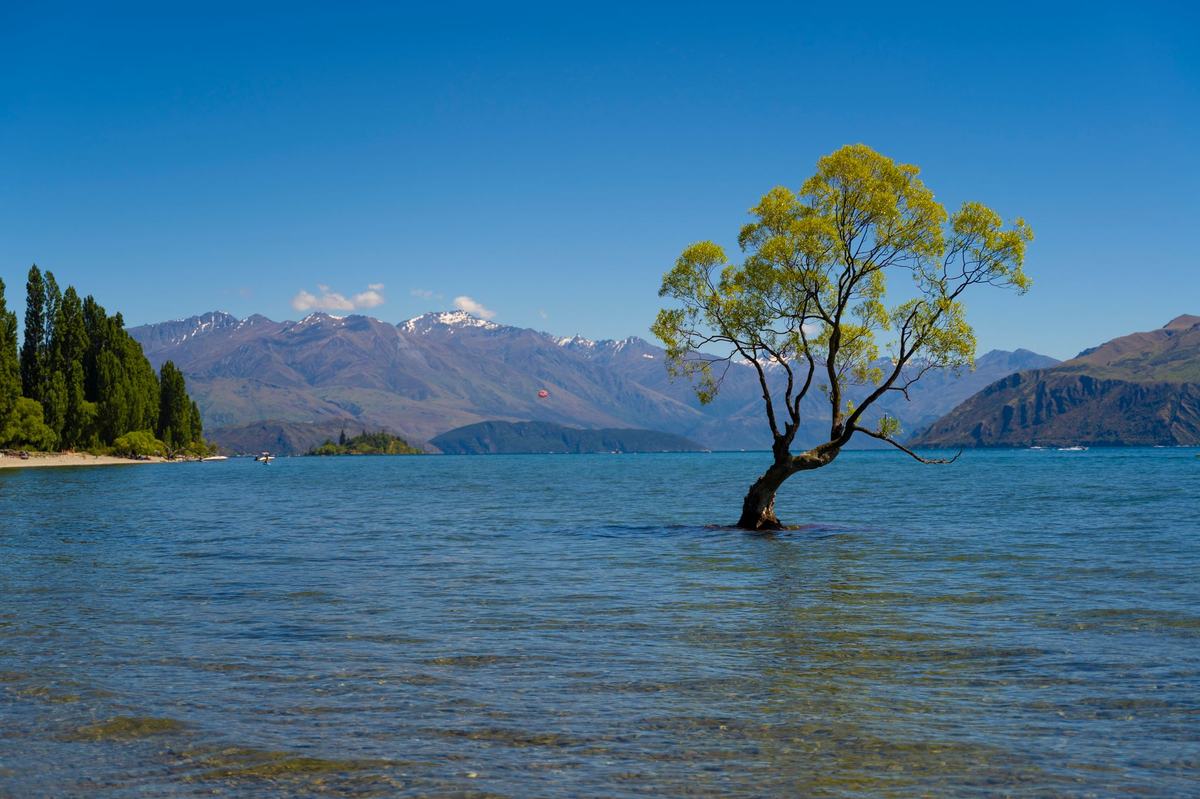
- Capital: Wellington [1]
- Population: about 5.2 million [2]
- Area: 268,021 square kilometers (103,483 square miles) [1]
- Official languages: English, Maori, and New Zealand Sign Language [3]
- Currency: New Zealand dollar (NZD)
- Distinguishing claim: the only sizable landmass on Earth that had no native land mammals before humans arrived, just bats and birds [4]
I grew up thinking islands were just smaller versions of continents. Then I read about New Zealand and had to sit down for a minute. For about 80 million years, this place drifted alone in the South Pacific, far enough from anywhere else that no land mammal ever found its way over. No deer, no rodents, no foxes, no cats. Just birds, bats, frogs, and a few reptiles that figured out how to do everything the mammals would have done somewhere else. The kiwi forages on the forest floor like a badger. The kakapo, a fat green parrot that can't fly, lumbers around eating fruit like a possum. The moa, the largest of which stood twelve feet tall, played the role of the deer until people showed up about 700 years ago and ate them all.
Back home in Montana, you can't walk twenty feet into the woods without seeing tracks from something with four legs and fur. The idea of a country where the wildlife evolved entirely without that pressure feels like science fiction. New Zealand is the closest the real world gets.
Two Islands, Three Languages, One Long Coastline
The country sits about 1,500 kilometers east of Australia, far enough that the trip across the Tasman Sea is a full three-hour flight. It's split into two main islands, called, in the dry New Zealand way, the North Island and the South Island. Between them and the offshore territories, the country has more than 15,000 kilometers of coastline, which is more than the United States has on its Atlantic and Pacific shores combined [1].
English is the language you'll hear most, but Maori, the language of the indigenous Polynesian people who arrived in the 13th century, has been an official language since 1987. New Zealand Sign Language joined the list in 2006, making New Zealand one of the very few countries on Earth to give sign language full official status [3]. Parliament debates are signed live. Election ads run with a signing interpreter in the corner. It sounds small until you realize how few governments treat their deaf citizens as full participants in the conversation.
You'll also notice the country has two names. New Zealand, given by the Dutch in 1642 after a province back in the Netherlands, and Aotearoa, the Maori name, often translated as "land of the long white cloud". Both names appear on the passport. The country has been slowly, deliberately moving toward the dual form in everyday use, and you'll see it on government websites, news broadcasts, and increasingly on the money.
More Sheep Than People
Here's the fact everyone trots out at parties: New Zealand has more sheep than people. That's been true since the 1850s, when the first big flocks arrived from Australia. At the peak in 1982, the country had more than 70 million sheep against barely 3 million humans, a ratio of about 22 to 1. The numbers have dropped a lot since then as dairy cows have taken over a lot of the pastureland, but even today there are about 25 million sheep against 5.2 million people, roughly five to one [5].
That sounds like a punchline until you drive through the South Island and actually see it. The Canterbury Plains and the rolling country of Otago are covered in white dots from horizon to horizon. Lamb and wool aren't quaint cultural trivia, they're a foundational pillar of the economy. Even the merino sweater on your back is statistically likely to be New Zealand grown.
A Country of Volcanoes, Glaciers, and Fjords
New Zealand sits on the Pacific Ring of Fire, where the Pacific and Australian tectonic plates grind against each other. The North Island is dotted with active volcanoes, including the perfectly conical Mount Ngauruhoe, which played the role of Mount Doom in The Lord of the Rings, and Lake Taupo, a deceptively peaceful body of water that is actually the crater of a supervolcano whose last major eruption around 1,800 years ago darkened skies as far as China and Rome.
The South Island is a different planet. The Southern Alps run down its spine, with peaks over 3,700 meters and glaciers that flow almost to sea level. The Franz Josef and Fox glaciers are two of the only glaciers in the world that descend into temperate rainforest, with ice creeping past tree ferns and moss. Down in the southwest corner, Fiordland National Park holds Milford Sound, which Rudyard Kipling called the eighth wonder of the world and which gets more than 6 meters of rain a year, turning the cliff walls into a hundred new waterfalls every time it pours.
The whole country is mountainous enough that no point of land is more than about 130 kilometers from the sea. Which, if you think about it, is a different way of being on Earth. You can ski in the morning and surf in the afternoon, and people actually do.
The Maori Story
Polynesian voyagers reached Aotearoa sometime around the year 1300, in great ocean-going canoes called waka that crossed thousands of kilometers of open water using the stars, the swells, and the flight paths of migrating birds. The civilization they built was tight-knit, tribal, and deeply tied to ancestry. The haka, the rhythmic posture dance that the All Blacks rugby team performs before every match, comes from that culture and is older than most European nations.
The Treaty of Waitangi, signed in 1840 between the British Crown and over 500 Maori chiefs, is the founding document of modern New Zealand. It's also the source of an honest and ongoing reckoning. The English and Maori versions of the treaty say slightly different things about sovereignty, and that gap has driven nearly two centuries of court cases, settlements, and political debate. The country hasn't pretended its way past the problem. It has built tribunals and committees and processes to keep working on it, generation after generation.
Today about 17 percent of New Zealanders identify as Maori [2]. Maori words are woven into everyday speech, kapa haka groups perform at schools, and the country's national anthem is sung first in Maori and then in English at every major event.
Wildlife That Exists Nowhere Else
Without mammals to compete with, the birds of New Zealand evolved into shapes you can't see anywhere else. The kiwi, the national bird, is the size of a chicken and lays an egg that is about 20 percent of its body weight. The kakapo is the world's only flightless parrot, and at one point in the 1990s the entire global population was down to 51 birds. Today, after one of the most painstaking conservation programs in history, it's back over 250 [6].
The tuatara is a reptile that looks like a lizard but is the last surviving member of an order that branched off from the dinosaurs about 250 million years ago. It can live more than 100 years, has a third eye on top of its head (covered by scales as it ages), and shows almost no genetic change from fossils of its relatives that died with the dinosaurs.
The price of evolving without mammals was paid the moment humans showed up with rats, dogs, cats, possums, and stoats. About a third of the country's native bird species went extinct in the last 700 years, including all nine species of moa. The remaining native birds survive mostly in fenced-off sanctuaries and on offshore islands kept predator-free by intense and unrelenting work.
A Few Loose Threads Worth Knowing
New Zealand was the first self-governing country in the world to give women the vote, in 1893. That's more than a quarter century before the United States. The campaign was led by Kate Sheppard, whose face is on the ten-dollar bill.
The country has no snakes, native or introduced. Not one. Customs officials at Auckland Airport will inspect your hiking boots for soil because the biosecurity rules are some of the strictest on Earth, and the country intends to keep its zero-snake record indefinitely.
The Hobbiton movie set on the Alexander family farm near Matamata is still standing, with all 44 hobbit holes maintained as a permanent attraction. Tourism around the Lord of the Rings and Hobbit films has been worth billions to the economy and is the closest thing the country has to a national myth invented in living memory.
And then there's the pavlova, a meringue dessert with a crisp shell and a marshmallow middle, topped with cream and fruit. Both New Zealand and Australia claim to have invented it, and the argument has been going since the 1920s. The food historians lean slightly toward New Zealand, but nobody on either side of the Tasman is conceding.
Frequently Asked Questions
What is the capital of New Zealand?
Wellington is the capital of New Zealand, located at the southern tip of the North Island. It hosts the parliament, the Beehive (the executive wing), and most national government offices. Auckland is larger by population, but Wellington has held the capital role since 1865.
How many people live in New Zealand?
New Zealand has a population of about 5.2 million people. The country is one of the least densely populated in the developed world, with roughly 19 people per square kilometer compared to about 37 in the United States and over 270 in the United Kingdom.
Is New Zealand part of Australia?
No, New Zealand is an independent country, separated from Australia by about 1,500 kilometers of the Tasman Sea. The two countries share close cultural and economic ties, but New Zealand has its own government, currency, and a distinct national identity rooted in both British and Maori traditions.
What languages are spoken in New Zealand?
New Zealand has three official languages: English, Maori, and New Zealand Sign Language. English is the most widely used in daily life, while Maori is taught in schools and used in official ceremonies. New Zealand Sign Language gained official status in 2006.
Are there really no snakes in New Zealand?
Yes, New Zealand has no native or wild snakes. The country's strict biosecurity laws keep snakes out, and even private ownership is banned. Occasional sea snakes have been spotted in northern waters, but no land snake population has ever established itself.