- Capital: Managua [1]
- Population: about 6.9 million [2]
- Area: 130,375 square kilometers (50,338 square miles), the largest country in Central America [1]
- Official language: Spanish, with English and indigenous languages recognized on the Caribbean coast [1]
- Currency: Nicaraguan córdoba (NIO)
- Distinguishing claim: home to Lake Nicaragua, the only freshwater lake in the world with a known population of sharks that swim in from the sea [3]
Here's something that'll ruin the next geography quiz you take: there are bull sharks living in a freshwater lake in the middle of Central America, and they got there by swimming up a river. I had to look this up twice. Lake Nicaragua, the second largest lake in Latin America, sits about thirty miles from the Caribbean coast, and bull sharks have been muscling their way up the San Juan River for centuries, leaping the rapids the same way salmon do back in the Pacific Northwest. The locals around the lake have known about them forever. Scientists figured it out properly only in the 1960s, when a team tagged a shark in the lake and caught it again in the open ocean a few months later.
That's the kind of place Nicaragua is. The headlines you've seen about it, if you've seen any, tend to be about revolutions and politics, but the country itself is mostly geography doing strange and beautiful things. Volcanoes that erupt every few years. An island in the middle of a lake that's actually two volcanoes joined at the hip. A Caribbean coast where people speak English Creole and the rhythm sounds more like Jamaica than Mexico. And a stretch of empty Pacific beaches that surfers have been quietly hoarding for thirty years.
A Lake the Size of an Inland Sea
Lake Nicaragua, or Cocibolca as the indigenous Nahua called it, covers roughly 8,264 square kilometers. That's bigger than every Great Lake except Superior, Huron, Michigan, and Erie. From the western shore on a hazy day you can't see the other side, and the surface gets choppy enough that small boats sometimes wait out the wind for hours.
In the middle of the lake sits Ometepe, an island formed by two volcanoes, Concepción and Maderas, joined by a low isthmus of lava and ash. Concepción is still active and looks the way a child draws a volcano, a perfect cone with a wisp of smoke at the top. Maderas is older and quieter, its crater filled with a cloud forest and a small lagoon. People have lived on Ometepe for at least 4,000 years, and the island is dotted with petroglyphs carved by pre-Columbian cultures whose names we no longer know.
The lake also holds the Solentiname Archipelago, a cluster of 36 small islands that became famous in the 1960s for an unlikely reason. A priest named Ernesto Cardenal moved there, taught the fishermen to paint, and the resulting school of brightly colored primitive art is now in galleries around the world.
The Land of Volcanoes
Nicaragua has 19 volcanoes along the Pacific side of the country, and at least seven of them are considered active. The chain is part of the Central American Volcanic Arc, where the Cocos plate is shoving itself under the Caribbean plate at about 70 millimeters a year. You can feel the consequences. Small earthquakes are common. Larger ones reshape cities.
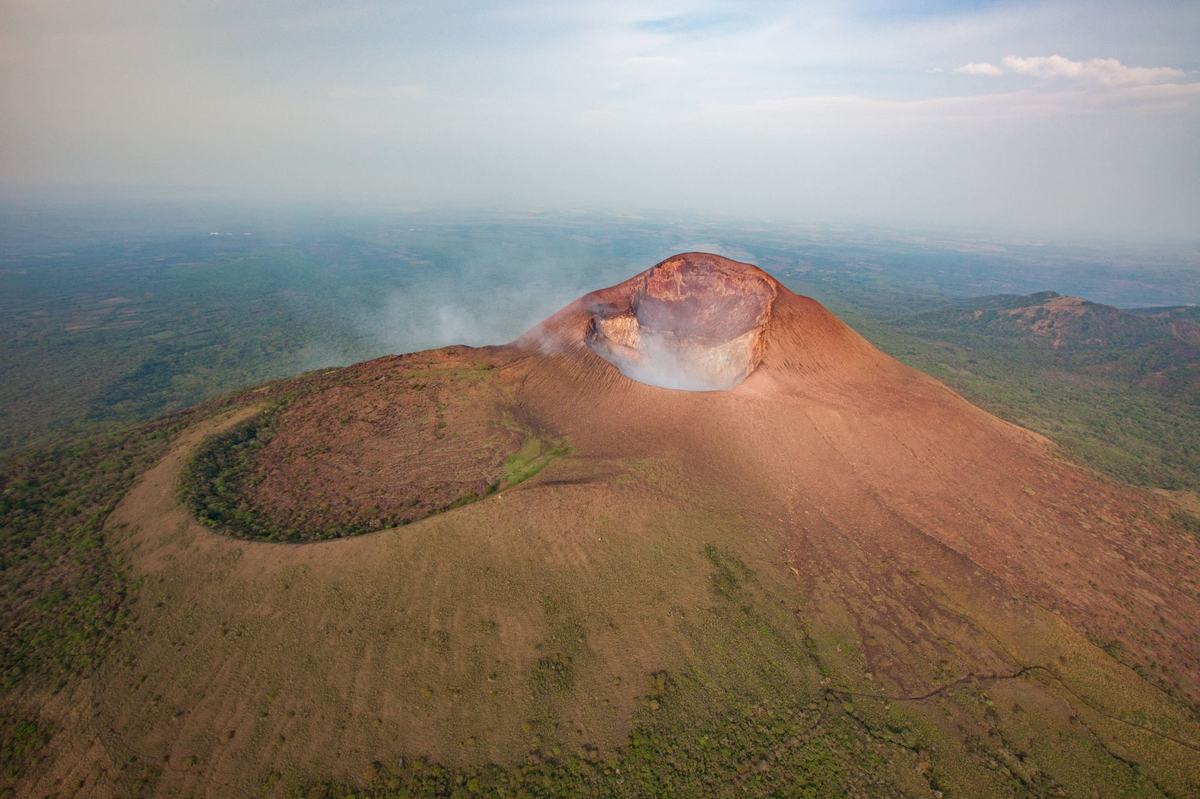
Cerro Negro, near the colonial city of León, is one of the youngest volcanoes in the Americas, only born in 1850 when it pushed up out of a farmer's cornfield. It's also the most popular volcano in the country for an activity nobody back home in Montana would believe: volcano boarding. You hike up the loose black slope with a reinforced plywood board, sit down at the top, and slide back to the bottom at speeds that have been clocked over 60 miles an hour. The dust gets everywhere. People love it.
Masaya, just outside the capital, has an open lava lake at the bottom of its main crater. You can drive almost to the rim, walk to the edge after dark, and look straight down at glowing molten rock. The Spanish conquistadors who saw it in the 1500s thought they had found the literal mouth of hell and put a cross on the rim to keep the demons in. The cross is still there. So is the lava.
A Capital That Moved and Then Stopped Moving
Managua, the capital, has a history that's almost embarrassing to admit. It was chosen as the capital in 1852 mostly as a compromise between the rival cities of León and Granada, who had been feuding for decades. Then in 1972, a magnitude 6.3 earthquake struck the city center and killed somewhere between 5,000 and 11,000 people in a matter of minutes. Most of the downtown was destroyed [4].
Here's the part that surprises people. They never really rebuilt the old downtown. The original heart of the city, with its cathedral and theaters and shops, was left as a kind of overgrown ruin, and Managua sprawled outward in every direction without a clear center. To this day, Managuans give directions by landmarks that no longer exist: "two blocks south of where the old Pepsi factory used to be" or "across from where the big tree fell down". The cathedral, the Catedral de Santiago, still stands but is condemned, its bell towers cracked and its interior empty.
Two Coasts, Two Countries Almost
Nicaragua has a Pacific coast and a Caribbean coast, and they feel like different planets. The Pacific side is where most of the population lives, where Spanish is the language, where the colonial cities of Granada and León hold their cobbled plazas and their churches, and where the country's politics and farming happen.
The Caribbean side, sometimes called the Mosquito Coast, was a British protectorate for much of the 19th century and never fully assimilated into the Spanish-speaking interior. The largest groups on that coast are the Miskito people, who speak Miskito and English Creole, and the Garifuna, an Afro-indigenous community descended from shipwrecked enslaved Africans and Carib islanders. Reggae plays in the streets of Bluefields. Coconut bread is sold from doorways. Two of Nicaragua's autonomous regions on the Caribbean coast have their own governments and recognize Miskito, Sumo, Rama, and English as official local languages alongside Spanish [1].
Things You Might Not Expect
Nicaragua produces some of the most acclaimed cigars in the world, and the dark volcanic soil around Estelí is the reason. Cuban tobacco growers fled there after their revolution and brought their know-how with them.
The currency, the córdoba, is named after Francisco Hernández de Córdoba, the Spanish conquistador who founded Granada in 1524. Granada is one of the oldest continuously inhabited European-founded cities in the Americas, beating Boston by over a century.
The country produced the great poet Rubén Darío, who basically invented Spanish-language modernism and is on the 100-córdoba note. Every Nicaraguan kid memorizes at least one of his poems before they leave primary school.
Frequently Asked Questions
What is the capital of Nicaragua?
The capital of Nicaragua is Managua, located on the southern shore of Lake Managua in the western part of the country. It is the largest city, with a metropolitan population of around 1.5 million, and has been the capital since 1852.
Is Nicaragua a safe country to visit?
Nicaragua remains a destination travelers visit for beaches, colonial cities, and volcanoes, but conditions vary. The U.S. State Department advises caution because of political tensions and limited consular services. Most travelers stick to well-known tourist routes in the Pacific region and Ometepe.
What language do they speak in Nicaragua?
Spanish is the official language and is spoken by the vast majority of the population. On the Caribbean coast, English Creole, Miskito, Sumo, and Rama also have official local status. Most signs, schools, and government work nationally are in Spanish.
What is Nicaragua famous for?
Nicaragua is best known as the land of lakes and volcanoes. It is home to the largest lake in Central America, an active volcanic chain along the Pacific coast, the colonial cities of Granada and León, and a Caribbean coast with strong Afro-Indigenous culture.
Are there really sharks in Lake Nicaragua?
Yes. Bull sharks swim up the San Juan River from the Caribbean Sea into Lake Nicaragua, and breeding populations have been documented in the lake. Numbers have dropped sharply because of overfishing in recent decades, but the sharks are still present.