- Capital: Muscat [1]
- Population: about 5.2 million, of which roughly 42 percent are non-citizens [1]
- Area: 309,500 square kilometers, the third-largest country on the Arabian Peninsula [1]
- Official language: Arabic, with English widely used in business and signage [2]
- Currency: Omani rial (OMR), one of the highest-valued currencies in the world
- Distinguishing claim: the only country named Oman, and home to frankincense trees that fed a 5,000-year-old global trade [3]
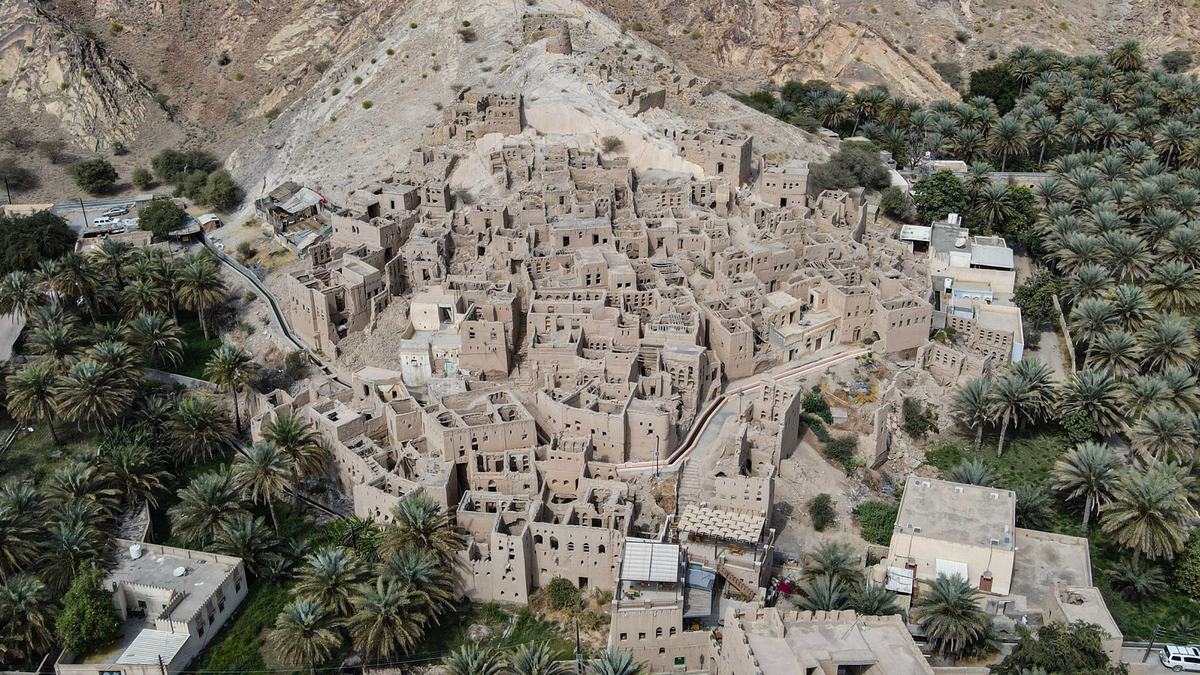
Most Americans I know couldn't place Oman on a map. They can find Dubai, sometimes Doha, but Oman sits quietly to the southeast of all that, wrapping around the corner of the Arabian Peninsula like it would rather not be noticed. That low profile is half the story. While its neighbors built skyline competitions and stadium districts, Oman spent the same decades restoring forts, planting trees, and keeping its old mud-brick villages standing. It's the Gulf country where the past did not get bulldozed.
A Coastline Longer Than People Realize
Oman has about 1,700 kilometers of coastline running from the Strait of Hormuz down to the border with Yemen, and that geography has done most of the heavy lifting in its history [1]. The country sits where the Arabian Sea meets the Persian Gulf, which means for thousands of years anyone sailing between East Africa, India, and the Middle East ended up touching an Omani port. Sur, Sohar, and Muscat were not sleepy fishing towns. They were stops on a maritime network that reached Zanzibar, the Indian coast, and even southern China.
The east coast around Ras al Jinz is one of the most important nesting sites for green sea turtles in the Indian Ocean, with thousands of females coming ashore every year to lay eggs in the same stretch of sand their grandmothers used [4]. Stand on that beach at night during nesting season and the whole shore moves. It is one of those things you read about and don't really believe until you see it.
Frankincense, Empires, and a Trade Older Than Writing
Interesting facts about Oman culture almost always start with frankincense. The dry, scrubby hills of Dhofar in the south grow Boswellia sacra, the tree whose resin produces the highest-grade frankincense in the world. People have been tapping these trees for at least 5,000 years, and the resin moved along caravan routes to Egypt, Mesopotamia, Greece, and Rome long before there were maps to draw them on [3]. UNESCO protects the old frankincense production sites and the caravan oasis of Shisr as a single World Heritage property called the Land of Frankincense.
Here's the thing about frankincense that nobody talks about - it didn't just make Oman rich, it gave it a kind of soft power. Roman emperors burned tons of it. Egyptian temples could not function without it. For long stretches of antiquity, an obscure corner of Arabia controlled a commodity that the whole Mediterranean world considered essential. The trade peaked, then faded with Christianity, then came back in smaller waves. You can still buy it in the Muttrah Souq in Muscat, sold by weight out of woven baskets.
Forts, Falaj, and a Country Built Around Water
Oman has more than 500 forts, towers, and castles scattered across the country, most of them restored in the past forty years [5]. Nizwa Fort, Bahla Fort, and the cliffside Jabreen Castle are the famous ones, but there are hundreds more sitting on hilltops in towns most outsiders never visit. The forts were never just military. They were grain stores, courts, irrigation control points, and meeting halls all rolled together.
Water is what tied everything together. Oman developed a system of stone and earthen channels called aflaj (singular falaj) that move water by gravity from underground springs and mountain wadis to villages and date palm groves. Some of these channels have been running continuously for more than 1,500 years, and UNESCO lists five of them as a single World Heritage site [5]. Walking along a working falaj in a village like Al Hamra feels less like seeing a historic monument and more like watching a piece of medieval engineering still doing its job.
A Sultanate That Reopened on Its Own Terms
For most of the twentieth century, Oman was essentially closed. Sultan Said bin Taimur ran the country with a heavy hand, banned things like sunglasses and bicycles in some periods, and let only a handful of foreigners in. That ended in 1970, when his son Qaboos bin Said took over in a bloodless palace coup and started what Omanis call the Renaissance, with a capital R. Roads, schools, hospitals, electricity, an actual functioning government - all of it built in a generation.
Qaboos ruled for 50 years and is the reason modern Oman exists in the shape it does. He died in 2020 and was succeeded by his cousin Sultan Haitham bin Tariq, who has continued a careful balancing act. Oman is famously the Gulf state that talks to everyone. It mediates between Iran and the West, hosts back-channel negotiations, and tries very hard not to pick sides. For a country with neighbors like Saudi Arabia, Iran, and Yemen, that diplomatic posture is not a luxury, it's a survival strategy.
Mountains, Deserts, and a Fjord Where No Fjord Should Be
Most of Oman is not desert in the cartoon sense. The Hajar Mountains in the north rise above 3,000 meters at Jebel Shams, the country's highest peak, and the canyons cut into them are deep enough that some Omanis call the area the Grand Canyon of Arabia. The temperature up there can drop below freezing in winter, which surprises people who came expecting only heat.
Then there's the Musandam Peninsula, an exclave separated from the rest of Oman by a slice of the United Arab Emirates. Musandam pokes into the Strait of Hormuz and is cut up by narrow inlets that look exactly like Norwegian fjords. Turns out they were formed by a completely different process - the Arabian plate is slowly sinking into the Iranian plate, and the old river valleys flooded - but the result is the same. Steep cliffs, deep water, dolphins, and almost no tourists.
And in the south, the Empty Quarter desert begins. Rub al Khali. The largest contiguous sand desert in the world, shared with Saudi Arabia, the UAE, and Yemen. Drive a few hours inland from Salalah and the asphalt just ends in dunes.
Frequently Asked Questions
Is Oman safe for tourists?
Yes, Oman is consistently ranked among the safest countries in the Middle East for travelers. Violent crime is rare, and the country has a long-standing policy of neutrality with its neighbors. Standard travel precautions apply, especially when driving in remote desert or mountain areas.
What is the best time to visit Oman?
October through March, when daytime temperatures in Muscat sit around 25 to 30 degrees Celsius. Summer in the north is extremely hot, but the southern Dhofar region around Salalah gets a unique monsoon season called the khareef from June to September, which is its own draw.
Do I need a visa to visit Oman?
Most travelers need a visa, which can be obtained online through Oman's eVisa system before arrival. Citizens of some Gulf countries enter without a visa, and a small number of nationalities qualify for visa-free entry. Always check current rules before booking.
Is Oman part of the United Arab Emirates?
No. Oman is a separate sovereign country, the Sultanate of Oman, with its own government, currency, and foreign policy. It borders the UAE and Saudi Arabia and is sometimes confused with its neighbors, but Omanis are quick to point out that the country has a distinct history, dialect, and cultural identity.
What religion is practiced in Oman?
Islam is the official religion, and most Omanis follow the Ibadi school, a branch that predates the Sunni-Shia split and emphasizes moderation and consensus. Sunni and Shia Muslims also live in Oman, along with smaller Christian, Hindu, and other expatriate communities, all able to worship openly.
Sources
- National Centre for Statistics and Information, Oman - Population and Area
- Ministry of Information, Sultanate of Oman - Official Country Profile
- UNESCO World Heritage Centre - Land of Frankincense
- International Union for Conservation of Nature - Green Sea Turtle Nesting Sites
- UNESCO World Heritage Centre - Aflaj Irrigation Systems and Bahla Fort