- Capital: Islamabad [1]
- Population: about 240 million, the fifth-most populous country on Earth [2]
- Area: 881,913 square kilometers, roughly twice the size of California [1]
- Official languages: Urdu and English [1]
- Currency: Pakistani rupee (PKR)
- Home to K2, the second-highest mountain in the world at 8,611 meters [3]
I grew up thinking the Himalayas were just one mountain range. Then I started reading about Pakistan and learned that three of the planet's great ranges - the Himalayas, the Karakoram, and the Hindu Kush - all meet inside its northern borders. Three. Meeting in one country. The locals call the junction point "where three giants embrace", and once you see a map of it, the phrase stops sounding poetic and starts sounding like a geological description.
Pakistan is one of those places Americans mostly know from headlines, which is a shame, because the actual country is wider and stranger than that. It's got beaches on the Arabian Sea, glaciers larger than some U.S. states, and a desert that bleeds into India. It's home to one of humanity's oldest urban civilizations and one of its newest nuclear powers. The contradictions aren't a bug. They're kind of the whole point.
The Indus Valley and a City That Predates the Pyramids
Here's the thing about Pakistan that nobody talks about in geography class: parts of it were already cities when most of the world was still figuring out farming. The Indus Valley Civilization flourished here from roughly 3300 to 1300 BCE, and the ruins at Mohenjo-daro - in what's now Sindh province - show a planned grid layout, drainage systems, and standardized brickwork that wouldn't be matched in most of the world for another three thousand years [4].
I had to look this up twice. They had public baths. They had sewers. The bricks were all the same size across hundreds of miles. Whoever ran this place had a code, and we still can't fully read their script. UNESCO put Mohenjo-daro on the World Heritage list in 1980, and standing there - I haven't been yet, but every photographer I know who's gone says the same thing - you get the strange sense that you're walking through the ghost of a future that already happened.
The name "Pakistan" itself is a 20th-century invention, coined in 1933 by a student in Cambridge as an acronym of the regions it would unite. But the land under that name has been continuously inhabited and built upon for over five millennia.
K2 and the Karakoram
Most people know Everest. Far fewer know K2. It's the second-highest mountain on Earth at 8,611 meters, and it sits on the border between Pakistan and China, right in the heart of the Karakoram range [3]. Climbers who've done both say K2 is harder. Steeper, more technical, and statistically far deadlier. For decades nobody summited it in winter at all. The first winter ascent happened in January 2021, and the team that did it was Nepali.
Around K2, Pakistan holds something the U.S. just doesn't have: five of the world's fourteen "eight-thousanders", peaks over 8,000 meters. Back home in Montana, we get excited about anything over 12,000 feet. Pakistan has dozens of peaks taller than that, and the Baltoro Glacier, which feeds the K2 region, runs longer than the city of Los Angeles is wide.
The Karakoram Highway, which links Pakistan to China through this terrain, is sometimes called the eighth wonder of the world. It climbs to 4,693 meters at the Khunjerab Pass, making it one of the highest paved international border crossings on Earth.
Five Rivers, One Province, and Where the Name Punjab Comes From
The Punjab region, split between Pakistan and India, takes its name from a Persian compound: "panj" meaning five, and "ab" meaning water. Five waters. Five rivers. The Jhelum, Chenab, Ravi, Beas, and Sutlej all flow through or near this land, and together they feed the Indus, which is one of the longest rivers in Asia.
Pakistan's Punjab province is home to over half the country's population, more than 110 million people in one province alone [2]. That's more people than France and Spain combined, living in an area smaller than the state of Utah. The agricultural plains here are some of the most fertile on the continent, fed by a network of canals that took the British a century to build and that Pakistan has spent the decades since expanding.
Pakistani Culture and a National Sport You've Never Heard Of
The national sport is field hockey, though cricket is what everyone actually watches. Pakistan won the 1992 Cricket World Cup, and the captain who lifted that trophy - Imran Khan - went on to become prime minister twenty-six years later. That kind of trajectory doesn't really happen anywhere else.
Facts about Pakistan culture often start with food, because Pakistanis love arguing about food. Lahore claims the best, Karachi disagrees, and Peshawar quietly serves what might be the best kebabs in the subcontinent. The country has over 70 languages spoken across its provinces, with Punjabi, Pashto, Sindhi, Saraiki, and Balochi all having millions of native speakers, even though Urdu is the unifying national language [1].
Pakistani weddings can run three to five days. The mehndi night, the baraat, the walima - each has its own dress code, its own music, its own food. A small wedding might host 500 people. A big one, 2,000. I asked a Pakistani friend in Portland once what a "normal" wedding size was, and he laughed for a solid thirty seconds.
Truck art is the visual signature of the country. Pakistani trucks aren't trucks so much as rolling murals, hand-painted with peacocks, poetry, calligraphy, and lights. Drivers spend the equivalent of months' wages decorating their rigs. Which, if you think about it, says everything about how people here feel about beauty in everyday life.
Geography, Climate, and a Country That Has Almost Everything
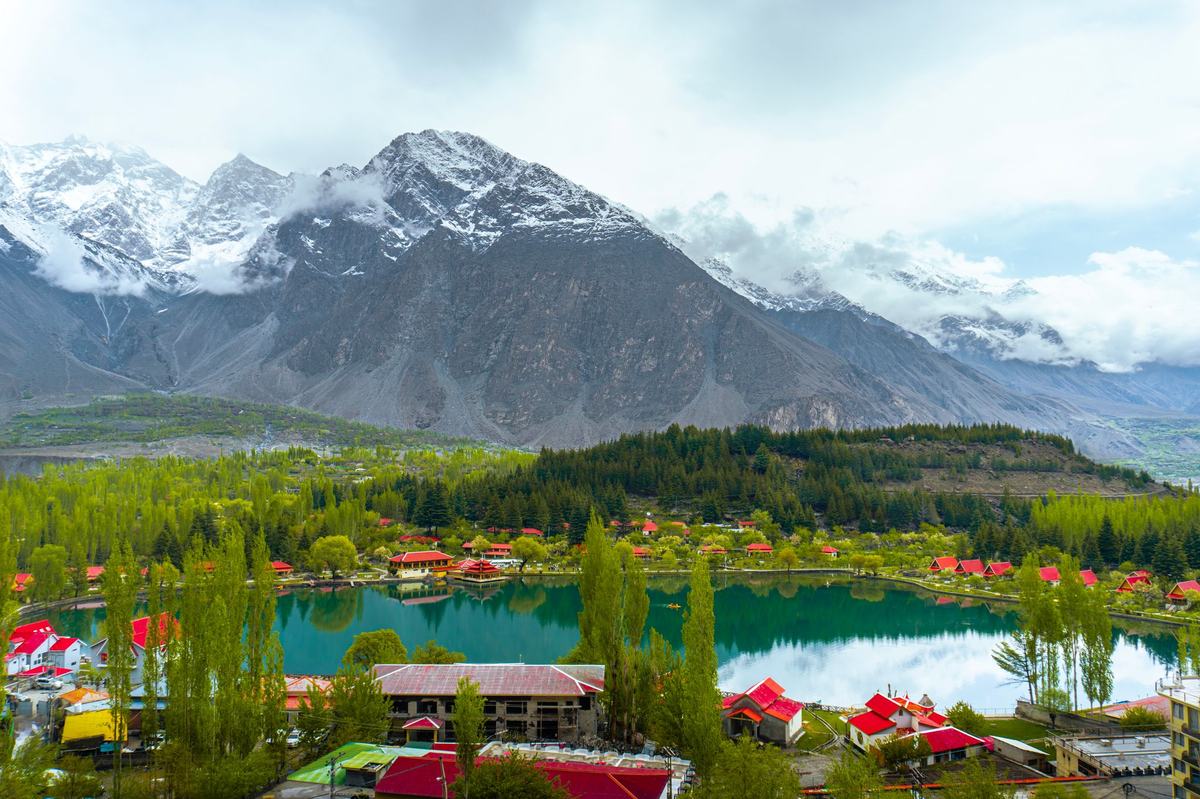
Pakistan covers about 881,913 square kilometers and contains nearly every climate zone except tropical rainforest [1]. There's the coastal Makran in Balochistan, where temperatures stay mild year-round. There's the Thar Desert in the southeast, which gets blistering hot. There's the Pothohar plateau in the north, where the seasons are sharp like a New England fall. And then there's Hunza Valley up near the Chinese border, with apricot orchards, snow-capped peaks, and people who routinely live past a hundred.
The Cholistan Desert in Punjab hosts an annual jeep rally that draws drivers from across South Asia. The salt mines in Khewra, the second-largest in the world, have been mined since Alexander the Great's army passed through in 326 BCE. The pink salt you've seen in fancy grocery stores - the kind that costs eight dollars a jar - mostly comes from here [5].
Pakistan is also one of the few countries with a meaningful coastline on the Arabian Sea, about 1,046 kilometers of it. Fishing villages in Balochistan look nothing like the bustling Karachi port a few hundred miles east. Karachi alone is home to around 17 million people, more than the entire population of the Netherlands.
For a country whose name didn't exist a century ago, Pakistan packs in an absurd amount of geography, history, and human variety. Three mountain ranges. Five rivers. Seventy-plus languages. A 5,000-year-old civilization underneath it all. Once you start looking, you realize the headlines were never the story.
Frequently Asked Questions
What is Pakistan famous for?
Pakistan is famous for K2 (the world's second-highest mountain), the ancient Indus Valley Civilization at sites like Mohenjo-daro, and being home to three major mountain ranges. It's also known for cricket, vibrant truck art, the pink Himalayan salt mined at Khewra, and being the world's fifth-most populous country.
Is Pakistan an Arab country?
No, Pakistan is a South Asian country, not an Arab country. It borders India, Afghanistan, Iran, and China. The official languages are Urdu and English, not Arabic, though Pakistan is Muslim-majority and shares cultural ties with the Arab world through religion and trade.
What languages do they speak in Pakistan?
Urdu and English are the official languages of Pakistan, but over 70 languages are spoken across the country. The biggest regional languages are Punjabi, Pashto, Sindhi, Saraiki, and Balochi. Most educated Pakistanis speak at least two or three languages fluently.
What is the capital of Pakistan?
The capital of Pakistan is Islamabad, a planned city built in the 1960s to replace Karachi as the capital. Karachi, on the Arabian Sea coast, remains the largest city and the economic center, while Lahore is the cultural capital in the Punjab region.
Is Pakistan safe to visit?
Travel safety in Pakistan varies by region. The northern areas like Hunza, Skardu, and the Karakoram have become popular with international travelers in recent years and are generally considered safe. Check current travel advisories from your government before planning a trip, and stick to established tourist routes.