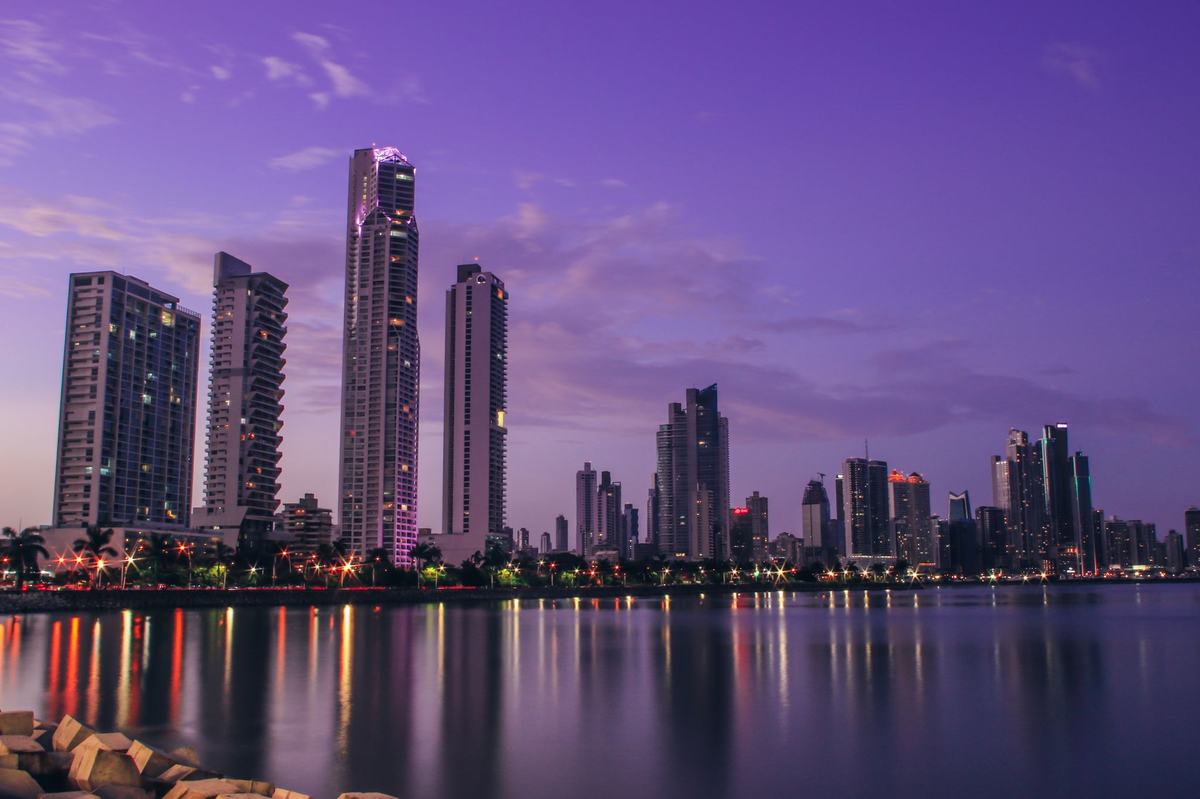
- Capital: Panama City [1]
- Population: about 4.5 million [1]
- Area: 75,420 square kilometers (29,120 sq mi) [1]
- Official language: Spanish [1]
- Currency: Panamanian balboa and U.S. dollar (both legal tender) [2]
- The big one: the only place on Earth where you can watch the sun rise over the Pacific and set over the Atlantic from the same country [3]
Here's something that'll ruin the next geography quiz you take: from a beach in Panama, the Pacific Ocean is to the east and the Atlantic is to the west. I had to look this up twice. The country bends like a sideways "S" across the isthmus, and in the canal zone the Pacific entrance actually sits east of the Caribbean entrance. Every map I'd ever stared at as a kid had the Pacific firmly on the left side of the Americas. Panama doesn't care about my mental map.
That weird geography is the whole reason the country exists in the form it does today. And once you start pulling on that thread, the rest of Panama unspools in a way that's genuinely hard to stop reading about.
The Canal Did Not Want to Be Built
The Panama Canal is 82 kilometers long, lifts ships 26 meters up into an artificial lake, and carries roughly 5 percent of all global maritime trade through a strip of jungle [4]. None of those numbers feel real until you remember the French tried to dig it first, lost more than 20,000 workers to yellow fever and malaria, and went bankrupt trying. The Americans took over in 1904, finished it in 1914, and lost another 5,600 workers in the process [4]. The price of the shortcut was paid mostly by laborers from the West Indies who never made the history books.
What nobody talks about is how the canal works. It is not a sea-level ditch. Ships are floated up into Gatun Lake, an artificial reservoir that was, for a while, the largest man-made lake in the world. The lake is freshwater. So every time a ship transits, roughly 200 million liters of freshwater flow out into the sea [4]. Panama is, in a real sense, spending its rain to move container ships.
In 2016 the country opened a second set of locks - the Neopanamax expansion - so the new generation of giant container ships could fit. Tolls for the largest vessels can run over a million dollars per transit [4]. Back home in Montana, my hometown's annual budget would not cover a single passage.
A Country Younger Than Some of Its Trees
Panama did not become Panama until 1903. Before that it was part of Colombia, which made the canal project a diplomatic mess. So the United States, with money and gunboats, backed a quick independence movement, and a brand new country signed away rights to the canal zone within two weeks of declaring sovereignty [4]. The treaty was signed by a Frenchman who had never lived in Panama. Panamanians did not get full control of the canal back until December 31, 1999.
Which, if you think about it, means the country's most defining feature was run by a foreign power for most of its modern existence. The handover is still celebrated every December. The canal is now managed by the Panama Canal Authority, and the tolls go to Panama.
The Darién Gap
If you tried to drive from Alaska to the southern tip of Argentina, you could do it almost the whole way on one road - the Pan-American Highway. Almost. There is a 100-kilometer stretch of jungle and swamp on the Colombian border called the Darién Gap, and the road just stops. No bridge. No tunnel. No through route. Drivers have to ship their vehicles around it by sea [5].
The Darién is one of the densest, wettest, most biologically intense rainforests in the Americas. It is also a UNESCO World Heritage site. And it is the only place on the entire Pan-American Highway that has defeated engineers for almost a century. Turns out you cannot pave everything.
Birds, Frogs, and a Hat That Is Not Panamanian
Panama is small. About the size of South Carolina. But because it sits at the narrow waist of two continents, species from both Americas funnel through it, and the country hosts more than 1,000 bird species - more than in the United States and Canada combined [6]. The harpy eagle is the national bird, a creature with talons the size of grizzly claws.
The golden frog, the national amphibian, is critically endangered. It is also extinct in the wild, kept alive only in captive breeding programs.
And the Panama hat? It's from Ecuador. The name stuck because nineteenth-century workers wore them while building the canal, and people assumed [3]. Two countries have been politely arguing about it ever since.
A Currency With Two Names
Panama uses the U.S. dollar. It has since 1904. The local currency, the balboa, exists only as coins and is pegged 1-to-1 with the dollar [2]. So a Panamanian wallet has American bills and Panamanian coins, and nobody finds this strange. The balboa is named for Vasco Nunez de Balboa, the Spanish explorer who in 1513 became the first European to see the Pacific Ocean from the Americas. He saw it from Panama.
This is also the country where the country code for phone numbers is +507, the dialing code for the Panama Canal Authority is the same number every ship calls in 24 hours a day, and where the Bridge of the Americas was, for decades, the only road link between North and South America.
Coffee You Will Probably Never Drink
The Boquete highlands in western Panama grow a coffee varietal called Geisha (or Gesha), originally from Ethiopia, that has repeatedly broken world records at auction. In 2019, a lot of Panamanian Geisha sold for over $1,000 per pound green - meaning before roasting [7]. A single cup at a specialty cafe in Tokyo or Oslo can run $50.
I have never had it. Most people never will. But the fact that the world's most expensive coffee comes from a country most Americans cannot quite place on a map says something about how much Panama is still hiding in plain sight.
Frequently Asked Questions
What is Panama best known for?
Panama is best known for the Panama Canal, an 82-kilometer shipping channel that connects the Atlantic and Pacific Oceans and handles around 5 percent of world trade. The country is also known for its rainforests, biodiversity, and use of the U.S. dollar.
What currency does Panama use?
Panama uses the U.S. dollar as its primary paper currency, alongside the Panamanian balboa, which circulates as coins pegged 1-to-1 with the dollar. The arrangement has been in place since 1904 and makes Panama one of the most dollarized economies in Latin America.
Is Panama in North or South America?
Panama is in Central America, which is part of the North American continent. It forms the narrowest point of the land bridge between North and South America, sharing borders with Costa Rica to the west and Colombia to the southeast.
Why is the Panama Canal so important?
The Panama Canal cuts roughly 13,000 kilometers off the journey between the U.S. east and west coasts by eliminating the need to sail around South America. Around 14,000 ships use it each year, carrying everything from grain and oil to consumer goods.
Is Panama safe to visit?
Most tourist regions in Panama, including Panama City, Boquete, and Bocas del Toro, are generally safe for visitors who take standard precautions. The Darien Gap on the Colombian border is dangerous and should be avoided by travelers under any circumstances.
Sources
- The World Factbook: Panama - CIA
- Panama Country Profile - World Bank
- Panama - Encyclopedia Britannica
- Panama Canal History and Operations - Panama Canal Authority
- Darien National Park - UNESCO World Heritage Centre
- Panama Biodiversity - Smithsonian Tropical Research Institute
- Best of Panama Auction Results - Specialty Coffee Association