- Capital: Asunción [1]
- Population: roughly 6.9 million (2023 estimate) [1]
- Area: 406,752 square kilometers (about the size of California) [1]
- Official languages: Spanish and Guaraní [2]
- Currency: Paraguayan guaraní (PYG)
- Distinguishing claim: the only country in the Americas where an Indigenous language shares official status with a colonial one, spoken by the majority of the population [2]
I had a geography teacher in Montana who used to say that Paraguay was the country tourists forgot. He meant it kindly. He'd been there once, in the 1980s, and the way he talked about it stuck with me. Not the ruins, not the sweeping landscapes. He talked about a man in a small town who refused to switch to Spanish when he realized my teacher only spoke English, because Guaraní was the language of his bones and Spanish was just for paperwork. That sentence, "Spanish is just for paperwork", followed me for years.
Turns out, that's a pretty good summary of Paraguay.
A Country That Speaks Guaraní
Most of South America was linguistically flattened by colonization. Indigenous languages survived in pockets, sometimes in mountain valleys, sometimes in the Amazon, but rarely as the everyday tongue of an entire nation. Paraguay is the exception. About 90% of Paraguayans speak Guaraní, and roughly half the country uses it as their primary daily language [2]. Spanish is the language of government and business. Guaraní is the language of jokes, lullabies, gossip, and grief.
What's strange and beautiful about this is that Paraguay didn't get there by accident. The Jesuits, in the 1600s, learned Guaraní, wrote it down, and taught it in schools. Even after Spain expelled the Jesuits, the language held on. By the time independence came in 1811, Guaraní had become a national identity marker. Today, kids learn it in school alongside Spanish. Road signs, songs, soccer broadcasts, even text messages move freely between the two. There's a word for switching mid-sentence: "jopara". It just means "mixed".
Two Cities Called Asunción
Asunción is one of the oldest cities in South America, founded in 1537. For a stretch of the colonial period, it was the most important Spanish settlement in the southern half of the continent, the launching point for the founding of Buenos Aires and other cities downriver. Then the empire's center of gravity shifted, and Asunción became quiet. That quietness is part of its charm now. Walk through the old town and you'll see pastel colonial facades, tiled courtyards, and government buildings that feel built for a country half the size.
The Paraguay River runs right along the city's edge. On a clear evening, you can stand on the riverfront and watch fishermen pull catfish out of the water the same way they have for centuries. The Chaco wilderness starts on the other side of the river, and within an hour of downtown Asunción you can be somewhere that feels like the edge of the known world.
The Itaipu Dam
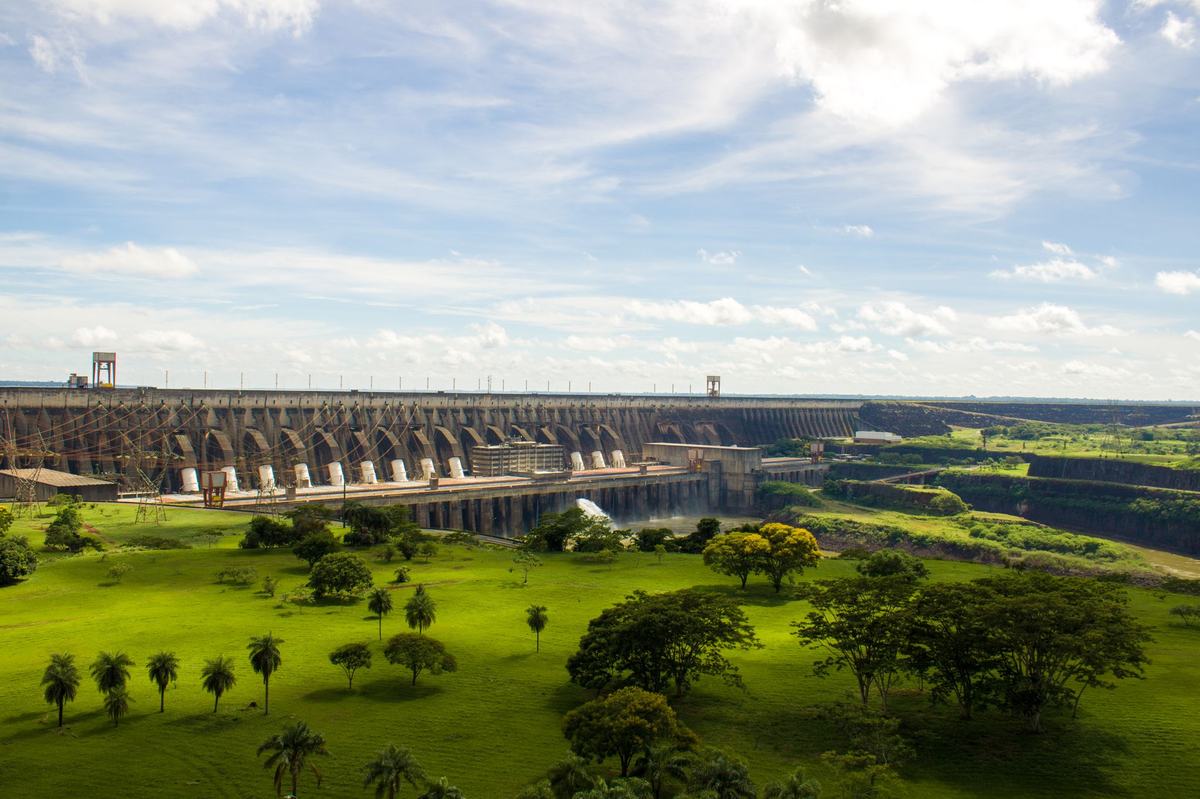
Here's the thing about Paraguay that nobody mentions at dinner parties. It co-owns, with Brazil, what was for decades the largest hydroelectric dam on Earth: Itaipu. The dam was completed in 1984 and held the title of largest by power generation until China's Three Gorges came online. Even now, Itaipu is one of the two biggest power plants in the world, and it provides nearly all of Paraguay's electricity plus a substantial chunk of Brazil's [3].
A country of seven million people produces so much clean energy that it sells the surplus to its giant neighbor. Per capita, Paraguay generates more hydroelectricity than almost any country on Earth. And almost none of it comes from fossil fuels. Which, if you think about it, is the kind of clean-energy stat that environmental ministers in much bigger countries would kill for.
A Tea Culture in the Tropics
Walk through any Paraguayan park in the morning and you'll see people carrying a thermos in one hand and a wooden or metal cup with a silver straw in the other. The drink is called tereré. It's yerba mate, the same plant Argentines and Uruguayans drink hot, but Paraguayans drink it cold, infused with iced water and often fresh herbs like mint, lemon verbena, or peppermint. The herbs are called yuyos, and they're sold in bundles at every market.
Tereré is more than a drink. It's how people socialize, mark out the morning, and weather the brutal summer heat. Sharing a tereré with someone is a way of saying you're not in a hurry. The cup, called a guampa, gets passed around a circle. Refusing a sip is unthinkable. In a country where summer afternoons regularly climb past 100 degrees, ice-cold mate is more sensible than any cocktail Hemingway ever invented.
A History of Wars That Reshaped the Country
Paraguay's modern history is shaped by two catastrophic conflicts. The first, the War of the Triple Alliance from 1864 to 1870, pitted Paraguay against Argentina, Brazil, and Uruguay. The country lost. By the end, estimates suggest Paraguay had lost more than half its population, and the adult male population was reduced to a fraction of what it had been. Demographers still call it the deadliest war in modern Latin American history. The country took generations to rebuild [4].
The second was the Chaco War in the 1930s, against Bolivia, over the dry scrubland of the Chaco region. Paraguay won, but at enormous cost. The Chaco is now part of Paraguay, and it's still one of the most sparsely populated places on Earth - a flat, thorny expanse where Mennonite settlers, Indigenous communities, and cattle ranchers share an austere landscape that feels nothing like the green eastern half of the country.
A Nation of Mennonites and Migrations
You don't expect to find German being spoken in the middle of South America. But drive into the Chaco and you'll hit towns where the bakery smells like Bavaria and the dairy products would be at home in a Wisconsin co-op. Mennonites from Russia, Canada, and Germany settled here starting in the 1920s, attracted by Paraguay's offer of religious freedom and farmland nobody else wanted. They built dairy industries from scratch and now produce a sizable share of the country's cheese and milk. Loma Plata and Filadelfia, the main Mennonite towns, still operate in Plautdietsch, German, Spanish, and Guaraní, often all in one conversation.
Frequently Asked Questions
What language do they speak in Paraguay?
Paraguay has two official languages: Spanish and Guaraní. About 90% of the population speaks Guaraní, and roughly half of Paraguayans use it as their primary daily language. Spanish is the language of government and business, while Guaraní is dominant in daily conversation, family life, and culture.
Is Paraguay a safe country to visit?
Paraguay is generally one of the safer countries to visit in South America. Petty theft can occur in cities like Asunción and Ciudad del Este, but violent crime is relatively low compared to regional neighbors. Travelers usually find the country welcoming, affordable, and easy to navigate with basic Spanish.
What is Paraguay famous for?
Paraguay is famous for the Itaipu Dam, one of the largest hydroelectric power plants on Earth, and for being the only country in the Americas where an Indigenous language, Guaraní, is widely spoken alongside Spanish. It's also known for tereré, a cold yerba mate drink that defines daily life.
What currency is used in Paraguay?
The currency is the Paraguayan guaraní, abbreviated PYG. It's named after the Guaraní people and language. Banknotes range from 2,000 to 100,000 guaraníes, and cash is still widely used, although card payments are common in cities and larger towns.
Is Paraguay landlocked?
Yes. Paraguay is one of two landlocked countries in South America, along with Bolivia. It has no coastline but maintains river access to the Atlantic Ocean through the Paraguay and Paraná rivers, which connect the country to ports in Argentina and Uruguay for trade and shipping.