- Capital: Lima [1]
- Population: about 34 million (2023) [2]
- Area: 1,285,216 square kilometers (496,225 square miles) [1]
- Official languages: Spanish, Quechua, and Aymara [3]
- Currency: Sol (PEN) [1]
- Home to Machu Picchu and the heart of the former Inca Empire, the largest pre-Columbian state in the Americas [4]
I grew up thinking the Andes were a mountain range. Turns out they are a whole country, and that country is Peru. The map looks simple from a distance, a wedge of South America facing the Pacific. Up close it splits into three different planets. There is the coastal desert in the west, dry as bone, where Lima sits and where it almost never rains. There is the spine of the Andes in the middle, snowcapped and folded, where Quechua is still spoken in the markets and where the old Inca terraces are still farmed. And there is the Amazon basin in the east, a green ocean of rainforest that takes up more than half the country. Most people picture Machu Picchu when they think of Peru. That picture is real. It is also less than one percent of what the country actually is.
The Inca Empire and What Came Before
The Inca built the largest empire in the Americas before Europeans arrived, stretching from southern Colombia down to central Chile and inland to the Bolivian altiplano [4]. The whole thing ran for less than a century before Spanish conquistadors arrived in 1532, but the infrastructure they left behind is staggering. The Qhapaq Ñan, the Inca road network, ran for about 40,000 kilometers across rugged mountain terrain, with rope suspension bridges woven from grass and rest houses placed a day's walk apart [5]. UNESCO recognized it as a World Heritage site in 2014.
Here is the thing about the Inca. They are the famous ones, but they were latecomers. Peru had civilizations going back at least 5,000 years before them. The Caral-Supe complex on the central coast dates to around 2600 BCE, which makes it roughly contemporary with the Egyptian pyramids and one of the oldest urban centers on Earth [6]. The Moche, the Nazca, the Chavín, the Wari, the Chimu - each built cities, irrigation networks, and ceramic traditions that the Inca inherited and adapted. The Nazca lines, those enormous figures of monkeys and hummingbirds and spiders drawn into the desert floor, were carved sometime between 500 BCE and 500 CE and are still visible from the air today.
Machu Picchu, the Mountain City
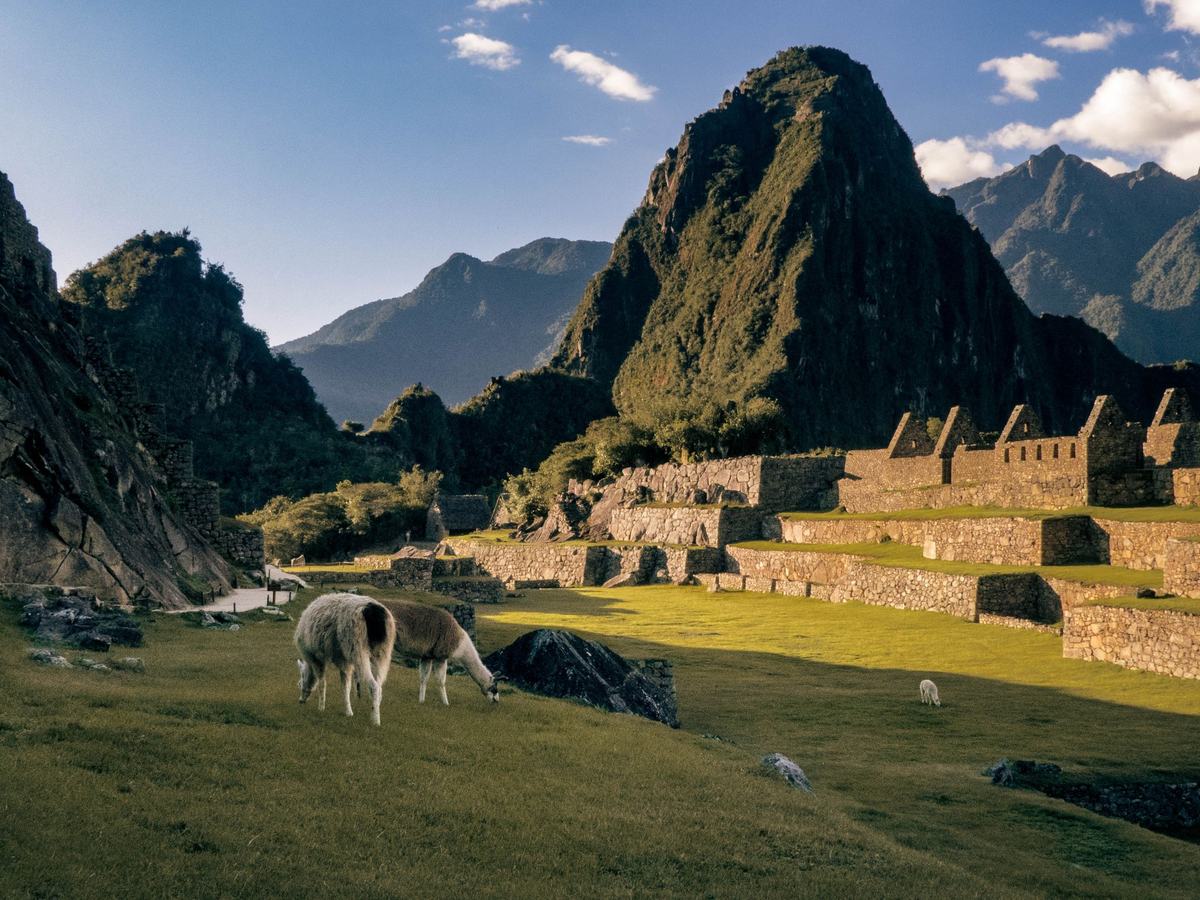
Machu Picchu sits on a ridge at 2,430 meters above sea level, hidden between two peaks above the Urubamba River [7]. The Spanish never found it, which is why it survived. Hiram Bingham, an American historian, was led to the ruins by local farmers in 1911 and brought the place to international attention. The site was probably a royal estate built for the emperor Pachacuti in the 15th century, then abandoned around the time of the Spanish conquest, then quietly farmed by local families for the next 400 years.
What gets you when you finally see it is not the buildings, which are impressive enough. It is the precision. The Inca cut stones to fit each other so tightly you cannot slide a credit card between them, without using mortar, in a region that gets serious earthquakes. The temples are aligned with solstice sunrises. The terraces are engineered to handle torrential rain without eroding. The whole place was designed by people who understood their mountain in a way most engineers today would have to relearn from scratch.
A Country Built on Potatoes
Peru is the original home of the potato. There are an estimated 4,000 native varieties grown in the Peruvian Andes, in colors that include purple, blue, pink, yellow, and almost black, with names in Quechua that often describe the shape or the way the plant looks in a field [8]. The International Potato Center, headquartered in Lima, keeps a genetic bank of more than 4,500 traditional varieties as insurance against the genetic narrowing of global agriculture.
Andean farmers have been domesticating potatoes for around 8,000 years. They invented freeze-drying long before any food scientist did, leaving potatoes out in the cold high-altitude nights and then stomping the water out of them in the morning sun, producing chuño that keeps for years. Which, if you think about it, is the entire reason the Inca could feed an army marching across mountain passes. No chuño, no empire. The potato is the foundation of Peruvian cuisine even now, and Peruvian food itself has become one of the most quietly celebrated cuisines in the world, with ceviche, lomo saltado, and ají de gallina showing up on serious restaurant menus from Tokyo to Toronto.
The Geography Nobody Expects
Peru holds the second deepest canyon on Earth, the Colca Canyon in the Arequipa region, which drops more than 3,400 meters from rim to river, roughly twice the depth of the Grand Canyon [9]. Nearby is Cotahuasi Canyon, which is even deeper. Andean condors nest along the cliffs and ride the morning thermals up into view of the tourists who get up before dawn to see them.
The country also includes part of Lake Titicaca, shared with Bolivia, which sits at 3,812 meters and is the highest navigable lake in the world. On the Peruvian side you can visit the Uros people, who live on floating islands they build themselves out of totora reeds, replenishing the surface as it rots from below. And then there is the Pacific coast itself, a long strip of desert hemmed in between mountains and ocean. Some places in the south, including parts of the Atacama, have not recorded measurable rainfall in decades. The reason is the Humboldt Current, which pulls cold water up from Antarctica along the coast and suppresses the rain that would otherwise fall there. That same current is also why the fishing off Peru is so rich, and why anchovies from Peruvian waters have made the country one of the largest fishmeal exporters in the world.
Three Languages, Many Peoples
Spanish, Quechua, and Aymara are all official languages of Peru [3]. Quechua, the language of the Inca, is still spoken by an estimated four million people, mostly in the highlands. The constitution of 1993 recognized the country's multilingual reality after decades of policy that pushed Spanish at the expense of everything else. You can now find Quechua-language radio stations, Quechua-language news bulletins, and rappers performing in Quechua to crowds in Cuzco and Ayacucho.
The Amazon side of the country is home to dozens of additional Indigenous languages and communities, some of which have had little contact with the wider world by their own choice. Peruvian law formally recognizes Indigenous territories in the Amazon basin and the right of those communities to live as they wish, though the practical enforcement against illegal logging and mining has been a long, difficult fight.
Frequently Asked Questions
Where is Machu Picchu located?
Machu Picchu sits on a ridge at 2,430 meters above sea level in the Cusco region of southern Peru, between the peaks of Huayna Picchu and Machu Picchu Mountain. It was built in the 15th century as a royal estate for the Inca emperor Pachacuti and went unnoticed by the Spanish.
What languages are spoken in Peru?
Peru has three official languages: Spanish, Quechua, and Aymara. Spanish is the most widely spoken and used in government and education. Quechua, the language of the Inca, is spoken by about four million people, mainly in the Andean highlands, while Aymara is concentrated near Lake Titicaca.
How many potato varieties does Peru have?
Peru is the original center of potato domestication and is home to an estimated 4,000 native potato varieties, grown mostly in the Andes. The International Potato Center in Lima preserves more than 4,500 traditional varieties in a global genetic seed bank.
What is the largest river in Peru?
The Amazon River begins in the Peruvian Andes, and Peru contains the headwaters and a long stretch of the western Amazon basin. More than half of Peru's land area lies within the Amazon rainforest, even though only a small share of the country's population lives there.
Why is the Peruvian coast a desert?
The Peruvian coast is a desert because of the cold Humboldt Current, which flows north along the shore from Antarctica. The cold water cools the air above it, which prevents the formation of rain clouds. This same current also supports one of the richest fisheries on Earth.
Sources
- Peru - The World Factbook
- Peru Population - World Bank
- Political Constitution of Peru, 1993
- Inca - Encyclopaedia Britannica
- Qhapaq Ñan, Andean Road System - UNESCO World Heritage
- Sacred City of Caral-Supe - UNESCO World Heritage
- Historic Sanctuary of Machu Picchu - UNESCO World Heritage
- Native Potato Varieties - International Potato Center (CIP)
- Colca Canyon - Encyclopaedia Britannica