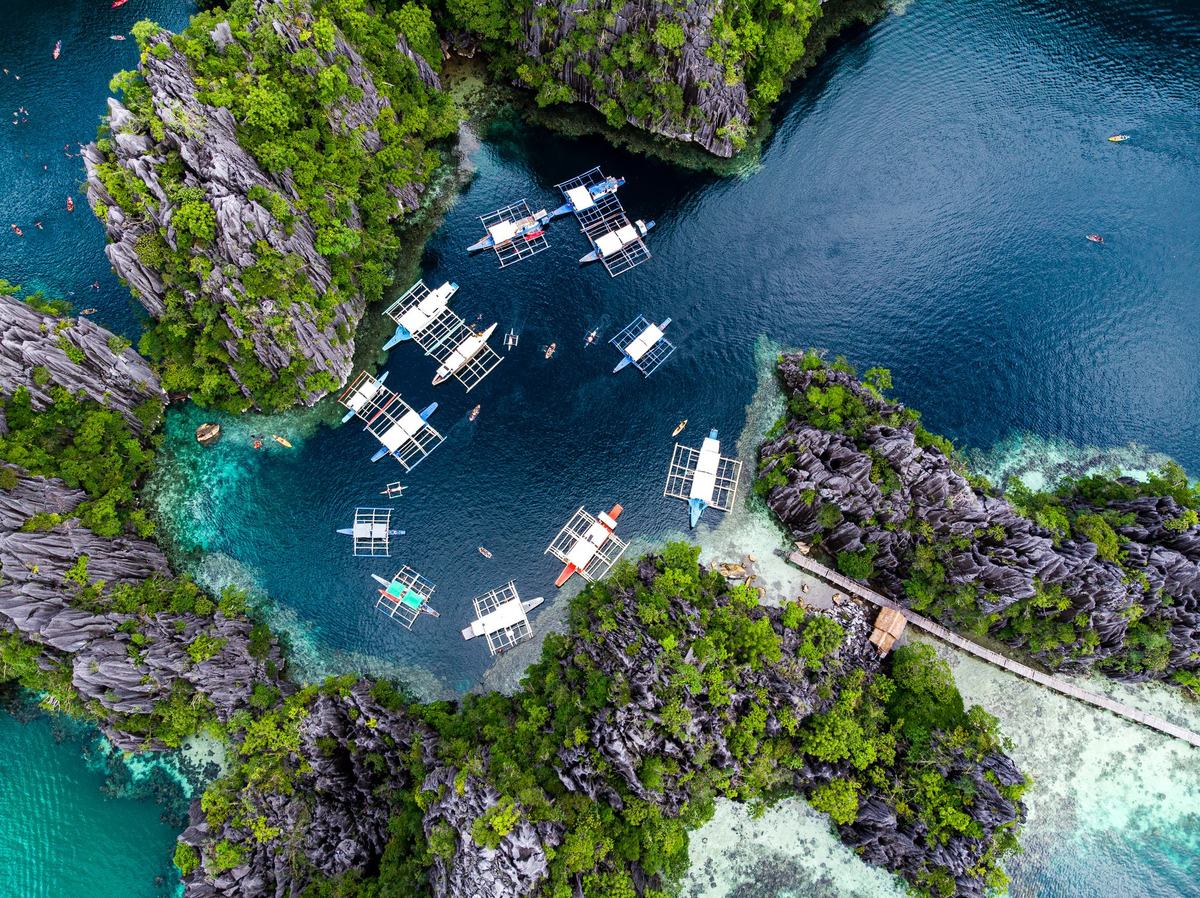
- Capital: Manila (with Metro Manila as the larger urban region) [1]
- Population: about 114 million (2024 estimate) [2]
- Area: 300,000 square kilometers spread across 7,641 islands [1][3]
- Official languages: Filipino and English [1]
- Currency: Philippine peso (PHP)
- Distinguishing fact: home to the world's longest Christmas season, running from September through January [4]
Here's something that'll ruin the next geography quiz you take: the Philippines is not made up of 7,107 islands like every old textbook says. It's 7,641. The extra 534 were found in 2016 when the government finished a new mapping survey using better satellite imagery. I had to look this up twice. A country can apparently misplace five hundred islands for decades and then quietly add them back to the count.
That single fact tells you most of what you need to know about the place. The Philippines is enormous in a way that flat maps refuse to show. If you laid the country end to end, it would stretch from Montana to the Gulf of Mexico. Most of it is water. About 2,000 of those islands are inhabited, and the rest are doing whatever islands do when nobody's looking.
The Geography Nobody Sees on the Map
The country sits squarely on the Pacific Ring of Fire, which is geology's way of saying things move a lot here. There are around 24 active volcanoes, and Mount Pinatubo's 1991 eruption was the second-largest of the twentieth century. It cooled the global climate by about half a degree Celsius for two years. Half a degree may not sound like much until you remember the whole world was the thermostat.
Then there's the Philippine Trench off the eastern coast - over 10,000 meters deep. That's deeper than Mount Everest is tall, by more than a kilometer. Stand on Samar Island and you're maybe 70 miles from one of the deepest places on the planet. Nobody talks about this, but the Pacific floor right there is closer to the center of the Earth than the summit of Everest is to sea level.
Palawan, on the western edge, has an underground river that runs five miles through a limestone cave system before it empties into the South China Sea. UNESCO named it a World Heritage site in 1999. You can paddle a boat through parts of it. The ceiling drips and the bats argue overhead and there's a moment where you realize you've gone past the point where any natural light could reach you. Back home in Montana the closest equivalent was Lewis and Clark Caverns, which is genuinely cool, but you don't paddle through them on a river that eventually meets the ocean.
A Language Map That Refuses to Behave
There are over 180 living languages in the Philippines. Tagalog is the basis for the standardized Filipino, and English is co-official, but a third of the country speaks Cebuano at home, and after that you've got Ilocano, Hiligaynon, Bikol, Waray, Kapampangan, Pangasinan, and a long list more. Cross an island, the language can change. Cross a mountain on the same island, it can change again.
The interesting facts about Philippines culture really live in this language thing. Filipinos code-switch the way Americans breathe. A single sentence in Manila might contain Tagalog, English, and a Spanish loanword that's been in the language for 400 years. They call it Taglish, and it isn't lazy - it's a working solution to a country with this much linguistic plurality. The trade-off is that almost everyone can talk to almost everyone else, somehow.
English fluency is high. The Philippines is one of the largest English-speaking countries in the world by population, which is why the call center industry took off here in the 2000s and why Filipino nurses, sailors, and teachers work in every corner of the globe. Over 10 million Filipinos live and work abroad. The remittances they send back account for nearly 10 percent of the country's GDP. That's a fact that hits differently when you remember it represents a parent in Saudi Arabia or a nurse in Texas, paying for a sibling's tuition back home.
Food That Predates the Country
Filipino cuisine is what you get when an archipelago spends 333 years under Spain, almost 50 under the United States, and centuries trading with China, Malaysia, and the Middle East. Adobo - chicken or pork braised in soy sauce, vinegar, garlic, and bay leaves - is the unofficial national dish, but every region has its own version. Some add coconut milk. Some add turmeric. The Bicol region adds enough chili to remind you that the country is much closer to the equator than its colonial cuisine sometimes lets on.
Lechon, the whole roasted pig, shows up at every major celebration. Anthony Bourdain once called Cebu's lechon the best pig he'd ever tasted, and that opinion has held up. Then there's halo-halo, which means "mix-mix", a dessert of shaved ice, sweetened beans, jelly, fruit, leche flan, and ube ice cream piled in a glass. It looks like a state fair experiment and tastes like the perfect answer to 95-degree heat.
Balut - a fertilized duck embryo boiled in the shell - is the one that gets all the YouTube reaction videos. It's also a normal evening street snack here, like ordering chicken wings. Turns out the only weird foods are the ones you didn't grow up with.
Jeepneys, Tricycles, and the Sound of a City
The jeepney is what happens when Americans leave behind military jeeps after World War II and Filipinos turn them into stretched, chrome-plated, hand-painted, religion-bumper-sticker-covered public buses. They've been the country's main form of mass transit for 80 years. Each one is unique. Some have horses on the hood. Some have full murals of basketball stars or the Virgin Mary or both.
Tricycles - motorcycles with attached sidecars - handle the routes the jeepneys can't reach. Together they make Filipino cities sound like nowhere else. There's a constant rumble of small engines, the slap of slippers on pavement, a karaoke machine running in someone's open garage. Which brings me to the karaoke part.
Karaoke was invented in Japan but the Philippines made it a way of life. Roberto del Rosario, a Filipino inventor, patented the Sing-Along System back in 1975. Today, almost every neighborhood has a karaoke machine going by Saturday afternoon, and "My Way" by Frank Sinatra has gotten so many people into arguments that bars sometimes refuse to play it. That is a real and documented thing. Filipinos have a name for it: the "My Way killings".
The Longest Christmas Season on Earth
Christmas starts on September 1. Not figuratively. The first day of the "ber months" - September, October, November, December - is when Filipino radio stations begin playing carols, and they keep going until the Feast of the Three Kings in early January. That's four solid months of Christmas. The country is about 80 percent Catholic, the legacy of Spanish missionaries who arrived in 1521 with Magellan, and the religious calendar still anchors the year.
The most beautiful piece of all this is the parol, a star-shaped lantern made of bamboo and translucent paper, lit from inside, hung in windows and over streets. Some are small. Some are the size of a car. The city of San Fernando, north of Manila, holds a Giant Lantern Festival every December with parols up to twenty feet across, electrified and spinning. It looks like the Northern Lights got a Catholic upbringing and learned to dance.
Frequently Asked Questions
How many islands does the Philippines have?
The Philippines has 7,641 islands, confirmed by a 2016 government mapping survey. Older sources cite 7,107, which was the figure from a 1940s American survey. Roughly 2,000 of these islands are inhabited, and only about 5,000 have been formally named.
What language do they speak in the Philippines?
Filipino and English are the two official languages, with over 180 living regional languages spoken across the country. Cebuano, Ilocano, Hiligaynon, and Bikol are among the largest. Most Filipinos are at least bilingual, and English fluency is among the highest in Asia.
Is the Philippines safe to visit?
Most tourist destinations in the Philippines, including Palawan, Cebu, Bohol, and Boracay, are considered safe for travelers and welcome millions of visitors a year. Travel advisories typically focus on specific areas in the southern Mindanao region, so it's worth checking current guidance before booking.
What is the Philippines famous for?
The Philippines is famous for its beaches, the Banaue Rice Terraces, jeepneys, karaoke culture, and food like adobo, lechon, and halo-halo. It's also known for the world's longest Christmas season, which runs from September through early January each year.
What religion is most common in the Philippines?
About 80 percent of Filipinos are Catholic, making the Philippines the largest Catholic-majority country in Asia. Islam is the second-largest religion, concentrated in the southern Mindanao region, alongside smaller Protestant, Iglesia ni Cristo, and Indigenous faith communities.