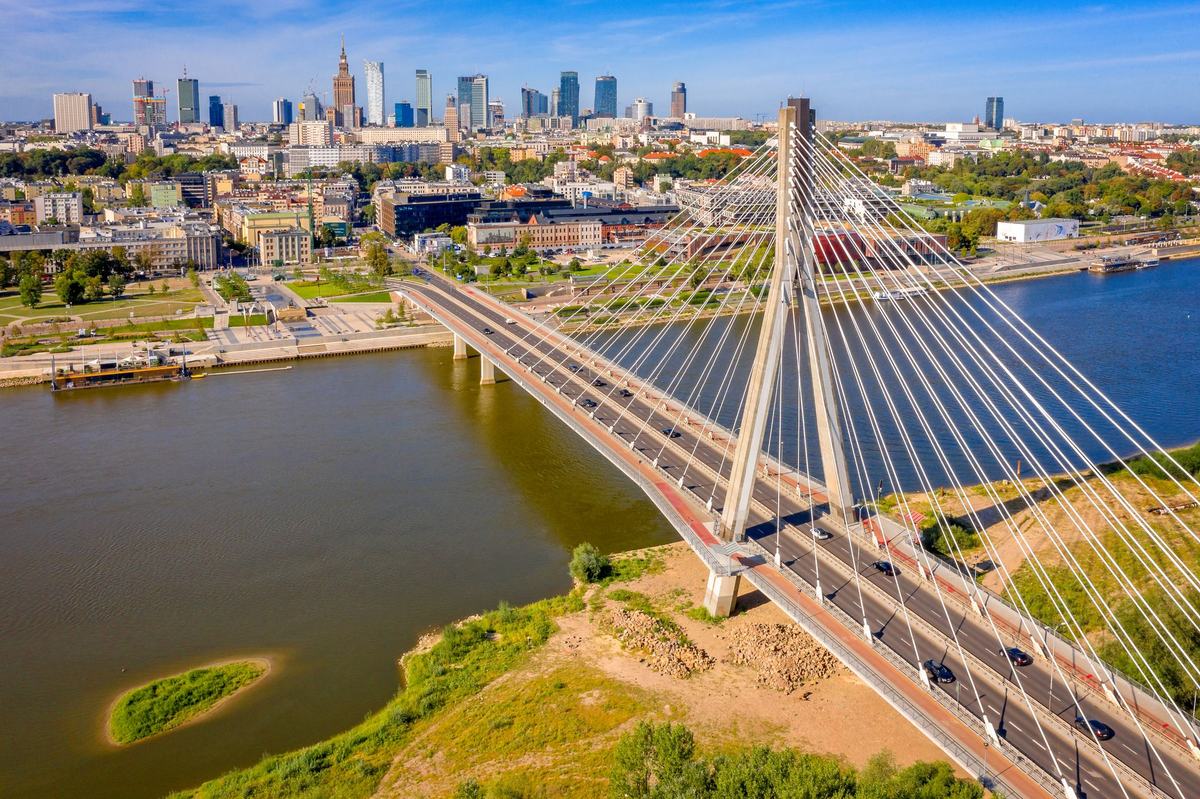
- Capital: Warsaw, rebuilt from rubble after World War II [1]
- Population: about 38 million (2024 estimate) [2]
- Area: 312,696 square kilometers, the ninth-largest country in Europe [1]
- Official language: Polish [1]
- Currency: Polish zloty (PLN)
- Distinguishing fact: Poland disappeared from European maps for 123 years and came back [3]
Here's something that'll ruin the next geography quiz you take: Poland wasn't on any map of Europe between 1795 and 1918. For 123 years, the country existed only in the heads of the people who lived there. Three empires - Russia, Prussia, and Austria - had carved it up and divided the pieces among themselves. The Polish language, schools, even Polish names were banned in different regions at different times. And then, after World War I, the country just walked back onto the map like it had stepped out for a long lunch.
I had to look this up twice. Most countries that get erased that completely don't come back. Poland did, then got flattened again in World War II, then came back a second time. There's a stubbornness here that you can feel walking around Warsaw or Krakow. It's in the buildings, most of which are younger than they look, because somebody made the choice to put them back exactly the way they were.
A Capital That Was Rebuilt Brick by Brick
Warsaw was leveled in 1944. Not damaged, not partially destroyed - leveled. After the Warsaw Uprising, Nazi Germany systematically demolished about 85 percent of the city as a punishment. Photographs from January 1945 show miles of nothing but rubble and broken chimneys, like the negative of a city.
What happened next is the part that always gets me. Poland's postwar government decided to rebuild the Old Town exactly as it had stood. They used eighteenth-century paintings by Bernardo Bellotto, prewar architecture students' sketches, and salvaged fragments of stone and ironwork to recreate the old market square down to the curling baroque details on the eaves. UNESCO eventually named the rebuilt Old Town a World Heritage site in 1980, which was a weird and lovely thing to do. They were honoring a copy. But the copy is also the original idea, made twice. Walk through Plac Zamkowy now and you cannot tell what was rebuilt and what survived, which is exactly the point.
A Salt Mine That Became a Cathedral
About a half-hour outside Krakow, you can take an elevator nine stories down into the Wieliczka Salt Mine. People have been digging salt out of this place since the thirteenth century, and at some point the miners decided that since they were spending most of their lives underground, they might as well make it beautiful. So they carved chapels into the salt. Chandeliers made of salt crystal. Statues of saints, carved from rock salt by miners who weren't trained sculptors, just patient.
The Chapel of Saint Kinga is the biggest of them. The floor looks like polished marble but is solid salt. The walls have salt bas-reliefs of biblical scenes. Even the chandeliers are made from dissolved and re-crystallized salt for clarity. You can lick the walls. People do. It's the strangest thing back home in Montana I had to compare it to and I came up empty.
The mine goes down 327 meters and stretches more than 300 kilometers in tunnels. Only a small fraction is open to visitors. Wieliczka was one of the original twelve UNESCO World Heritage sites named in 1978, on the same first list as the Galapagos and the pyramids at Giza.
A Restaurant Open Since 1275
In Wroclaw's market square sits Piwnica Swidnicka, which has been serving food and beer continuously since 1275. That's not a marketing claim. The restaurant has documents in the city archive going back to the thirteenth century. Goethe ate there. Chopin ate there. The restaurant has weathered the partitions, two world wars, communism, and the post-1989 transition. It briefly closed for renovation in the 2010s but reopened.
There are a few European restaurants that claim a similar lineage, but Piwnica Swidnicka has the paperwork to prove it. The interesting facts about Poland culture stack up like this all over the country. The oldest university in Central Europe still operating, Jagiellonian University in Krakow, opened in 1364 and counted Copernicus among its students. The royal castle on Wawel Hill has been a center of Polish power for a thousand years. Things in Poland tend to be older than they look.
Pierogi, Bigos, and the Question of What to Eat First
Polish food is the cooking of a country that has had to feed itself through long winters and longer occupations. Pierogi are the obvious starting point - dumplings stuffed with cheese and potato, meat, sauerkraut and mushroom, or, in summer, blueberries with sour cream. You can order them boiled or fried. The fried version with caramelized onions on top is the move on a cold day.
Bigos is the hunter's stew, simmered with sauerkraut, fresh cabbage, sausages, smoked meats, dried mushrooms, prunes, and a glug of red wine. Old recipes say it tastes best on the third reheating, which is the kind of patience that runs through most Polish cooking. Zurek is a sour rye soup served with sausage and a hard-boiled egg in the middle. Then there's the sweet end: paczki are filled doughnuts traditionally eaten on Fat Thursday before Lent, and Warsaw alone consumes millions of them on that single day.
Vodka here is taken seriously and treated correctly. Poland and Russia have argued for centuries about who invented it, but the oldest written reference to wodka comes from Polish court records in 1405. The good stuff is sipped, not slammed, and almost always with food.
A Forest Where European Bison Still Walk
In the northeast corner of the country, on the border with Belarus, is Bialowieza Forest. It is one of the last remaining fragments of the primeval forest that once covered most of the European lowlands. Trees here have been growing without interruption for thousands of years. Some of the oaks are over 500 years old.
And then there are the bison. The European bison, known here as the zubr, was hunted to extinction in the wild by 1919. The species was kept alive only by a handful of animals in zoos. Polish and international scientists began a careful breeding program, and starting in the 1950s they released bison back into Bialowieza. Today, around 700 wild European bison live in the Polish part of the forest, and about 2,000 across the wider region. The species came back from twelve animals. Which, if you think about it, is what Poland tends to do. Vanish, come back, keep going.
Frequently Asked Questions
What is Poland best known for?
Poland is best known for pierogi, Chopin, the historic city of Krakow, Auschwitz-Birkenau, the Wieliczka Salt Mine, and Bialowieza Forest with its European bison. It's also widely recognized for surviving 123 years off the map of Europe and rebuilding Warsaw stone by stone after World War II.
Is Poland in the European Union?
Yes, Poland joined the European Union on May 1, 2004, in the largest single expansion in EU history. The country uses the Polish zloty as its currency rather than the euro, and it's part of the Schengen Area, which means open borders with most other EU countries.
What language do they speak in Poland?
Polish is the official language and is spoken by nearly the entire population. It's a West Slavic language closely related to Czech and Slovak. English is widely understood by younger Poles and in tourist areas, while German and Russian are also common in older generations and border regions.
How old is the city of Krakow?
Krakow has been continuously inhabited for over a thousand years and served as Poland's capital from the eleventh century until 1596. The Old Town and Wawel Castle survived World War II largely intact, and the entire historic center was named a UNESCO World Heritage site in 1978.
Is Poland safe for travelers?
Poland is generally considered one of the safer countries in Europe for tourists, with low rates of violent crime against visitors. The major cities like Warsaw, Krakow, Wroclaw, and Gdansk are welcoming to travelers, and public transport is reliable. As anywhere, watch for pickpockets in crowded tourist areas.