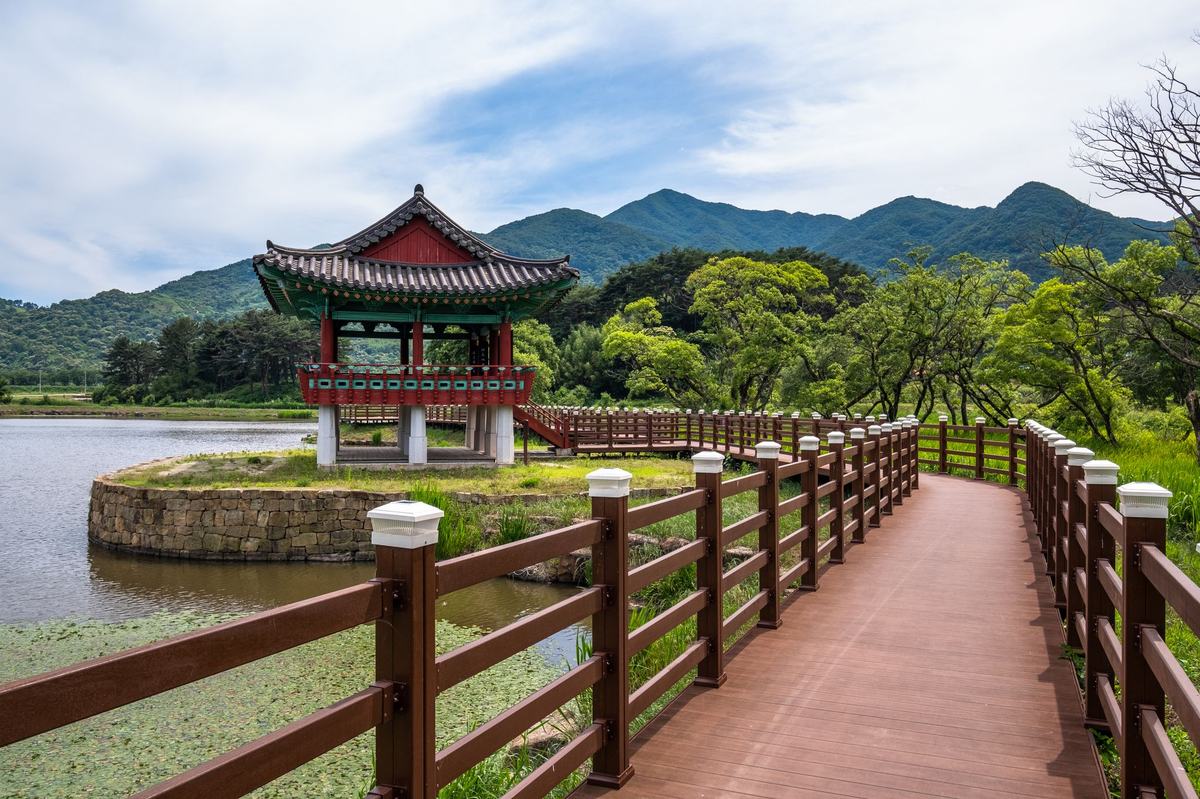
- Capital: Seoul, with about 9.4 million people in the city proper and roughly 26 million in the greater metro area, nearly half the country's total population [1]
- Total population: about 51.7 million, with a fertility rate of 0.72 (the lowest in the world) [2]
- Area: 100,363 square kilometers, mostly mountainous, with around 70 percent of the land considered uninhabitable for dense settlement [3]
- Official language: Korean, written in Hangul, a phonetic alphabet invented in 1443 by King Sejong the Great
- Currency: South Korean won (KRW)
- Literacy rate: above 99 percent, one of the highest figures recorded anywhere on Earth [4]
Most people couldn't have placed South Korea on a map fifty years ago. That's not an exaggeration. In 1960 the country's GDP per capita was around $158, lower than Ghana's, and Seoul was still rebuilding from a war that had flattened it twice. Then something happened that economists still write papers about. By the time my generation was in college, Korean phones were in everyone's pockets, Korean cars were in driveways across Montana, and a song called Gangnam Style had become the first YouTube video to break a billion views. The country didn't just catch up. It started setting the pace.
Here's the thing about Korea: the transformation is so fast that the story keeps getting reduced to a slogan. The Miracle on the Han. K-pop. Samsung. But the actual texture of how a peninsula goes from one of the poorest places on the planet to one of the most connected, in living memory, is wilder than any tagline gives it credit for.
A Language Designed on Purpose
Most writing systems evolved over centuries. Hangul was invented. King Sejong the Great commissioned it in 1443 and published it in 1446 with the goal of giving common people, who couldn't afford the years required to learn Chinese characters, a way to actually read and write. The introduction to the official document said, more or less, that anyone could learn it in a morning. Linguists today mostly agree.
The alphabet has 14 consonants and 10 vowels, and the consonant shapes were modeled on the position of the tongue and mouth when you make each sound. It's the only major writing system whose origin is fully documented and whose design is deliberately phonetic from the ground up [5]. The 99 percent literacy rate Korea posts year after year isn't a coincidence. It's partly because the script itself is engineered for fast learning.
A Country Mostly Made of Mountains
Korea looks small on a map, but the geography is more complicated than the outline suggests. About 70 percent of the peninsula is mountainous, which is why population packs into the river valleys and the western coastal plain. The Taebaek Range runs down the east like a spine, and the country's interior is corrugated enough that even short drives often involve a tunnel. Seoul itself is ringed by mountains that residents hike on weekends, and the city limits include forested peaks higher than anything in my home county in Montana.
The peninsula has more than 3,000 islands, most of them off the southwestern coast, and Jeju in the south is its own volcanic anomaly. Jeju was formed by eruptions starting around two million years ago, has a UNESCO listed lava tube system, and sits at the same latitude as North Carolina, which gives it a subtropical climate the rest of the country doesn't get [6]. Locals call it the Hawaii of Korea, which undersells both places, but you get the idea.
Seoul Is a City That Doesn't Sleep, Literally
The Seoul metropolitan area holds roughly half of all South Koreans, which is one of the highest urban concentrations of any large country. Walking around the city late at night feels like a different relationship with time than I'm used to. Restaurants open at midnight. Cafes stay open until 4 AM. The subway has its own polite shutdown only because the trains have to be cleaned and serviced.
Seoul also runs on internet that doesn't really compare to anywhere else. Average broadband speeds are among the fastest in the world, and the country's mobile networks have been first to roll out almost every standard from 3G onward. You can stream 4K video on a subway car going through a tunnel. The free public Wi-Fi works on the bus. Coming home from a trip to Korea always feels like a small downgrade in connectivity, no matter where home is.
The Demilitarized Zone, Which Is Anything But
The border with North Korea sits about 35 miles from downtown Seoul. The Demilitarized Zone is 250 kilometers long and 4 kilometers wide, and despite the name it's one of the most heavily armed borders on the planet. It's also, by accident, become one of the best preserved nature reserves in East Asia. With humans kept out for over 70 years, the strip has filled in with old growth forest and become a refuge for endangered species, including red-crowned cranes and Asiatic black bears [7].
Tourists can visit parts of the DMZ on day trips from Seoul. The vibe is hard to describe. You're looking at concrete tank traps and observation posts, and a guide is pointing out propaganda villages across the border, and somewhere in the trees a leopard cat is hunting. It's the strangest piece of geography I've ever read about, and I've read about a lot of strange geography.
Food That Goes Far Beyond Korean BBQ
If you grew up in America in the last 20 years, Korean BBQ is probably your reference point. It deserves the love, but it's a small slice of what actually happens at a Korean table. The center of the cuisine is banchan, the small side dishes that come with every meal: kimchi, of course, but also pickled radish, seasoned spinach, marinated bean sprouts, anchovies, eggs steamed in earthenware. A modest restaurant might put out 8 or 10 banchan with a basic order. A formal Korean meal can have 30.
Kimchi alone has hundreds of regional varieties. The country eats around 1.5 million tons of it a year [8], and in November families and neighborhoods still do kimjang, the communal kimchi-making before winter, which UNESCO added to its Intangible Cultural Heritage list in 2013. There's a National Folk Museum kimchi exhibit. There's an industrial science institute called the World Institute of Kimchi. Turns out a fermented cabbage can be a whole research field.
And then there's the soup culture. Koreans eat hot stew in summer because the theory is that sweat cools you. Jjigae, guk, tang. Whole categories of liquid food. The country probably has more spoon-eaten dishes per capita than anywhere I've cooked in.
Pop Culture That Conquered the World, Slowly Then All at Once
Hallyu, the Korean wave, is the export story everyone now knows. K-pop, K-drama, K-cinema. But the buildup was longer than the breakout suggests. Korea started seriously investing in cultural production in the late 1990s, after the Asian financial crisis, partly as an industrial strategy. Government money seeded studios. Tax incentives pulled in producers. By the time BTS hit the Billboard 200 in 2018 and Parasite won Best Picture in 2020, the infrastructure had been building for two decades.
The numbers are loud. The Korean wave generates tens of billions of dollars in exports a year, and tourism boards in Seoul track visitors who came specifically because of a drama or a music video. There's a whole sub-economy of fans flying in for concerts, and a parallel one of locals selling photo cards and merch. Squid Game became the most watched Netflix series ever within a month of release. The country writes the playbook now.
A Demographic Cliff Coming Into Focus
The harder story is the one nobody talks about as much. South Korea has the lowest birth rate in the world, currently around 0.72 children per woman, which is well below the 2.1 needed just to keep a population stable [2]. By the late 2060s, projections show the population could fall under 40 million unless the trend reverses, which it shows no sign of doing.
This isn't an abstract demographic note. Schools in rural provinces are closing. Universities are merging. The country is automating service work faster than almost anywhere else, partly because there won't be young workers to do it. Robots serve coffee in chain cafes. The government has tried cash bonuses for new babies, housing subsidies, expanded parental leave. Nothing has moved the needle so far. What happens next is the question Korea is going to spend the next 50 years answering.
Frequently Asked Questions
What is the capital of South Korea?
Seoul is the capital of the Republic of Korea and has been since 1394, with a brief interruption during the Korean War. The Seoul metropolitan area holds about 26 million people, roughly half the country's total population, making it one of the most concentrated capital regions in the world.
What language is spoken in South Korea?
Korean is the official language, spoken by nearly the entire population. It is written in Hangul, an alphabet invented in 1443 by King Sejong the Great. Hangul has 14 consonants and 10 vowels and is widely considered one of the most learnable writing systems ever designed.
Is South Korea safe to visit?
South Korea is one of the safest countries in the world for visitors, with very low rates of violent crime. Public transit runs late at night, lost belongings are commonly returned, and most travelers find Seoul and other major cities easy to navigate. Standard travel precautions still apply.
What is the currency in South Korea?
The currency is the South Korean won (KRW), with no decimal subunits in everyday use. Cards and mobile payments are accepted nearly everywhere, including small shops and taxis. Foreign currency exchange is straightforward in major cities, though cash is still useful at traditional markets.
Why is the Korean birth rate so low?
South Korea's fertility rate, currently around 0.72, is the lowest in the world. Causes include high housing costs in Seoul, intense education spending per child, long working hours, and changing expectations about marriage and career. Government cash incentives have not yet reversed the trend.
Sources
- Statistics Korea: Population Census and Estimates
- Statistics Korea: Vital Statistics and Fertility Rate
- Ministry of Land, Infrastructure and Transport, Republic of Korea
- UNESCO Institute for Statistics: Republic of Korea Country Profile
- UNESCO Memory of the World: Hunmin Chongum Manuscript
- UNESCO World Heritage: Jeju Volcanic Island and Lava Tubes
- World Bank: Republic of Korea Country Overview
- UNESCO Intangible Cultural Heritage: Kimjang