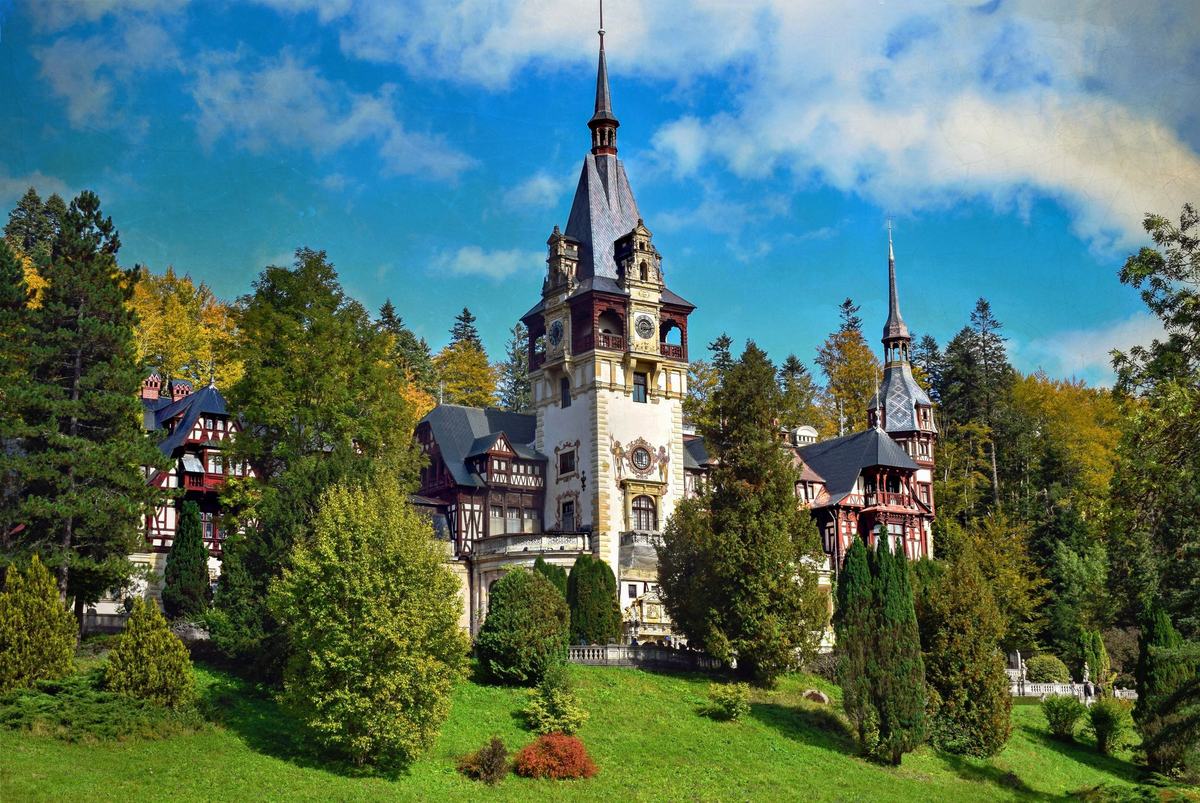
- Capital: Bucharest, often nicknamed "Little Paris" for its early 20th century architecture before the Communists got hold of it [1]
- Population: about 19 million, having dropped by roughly 3 million since 1990 due to emigration and a low birth rate [2]
- Area: 238,397 square kilometers, slightly smaller than Oregon
- Official language: Romanian, the only Romance language in Eastern Europe, descended from the Latin spoken in Roman Dacia [3]
- Currency: the leu (RON), which literally translates to "lion"
- Distinguishing claim: home to the world's second-largest administrative building, the Palace of the Parliament, weighing in at around 4 million tons of steel and concrete [4]
Here's something that'll ruin the next geography quiz you take: Romania speaks a language closer to Italian than to anything spoken by its neighbors. Slavs to the north, south, and east, Hungarians to the west, and right in the middle, a country that says "noapte bună" for good night and means it the same way a Roman legionary would have, two thousand years ago. I grew up assuming language followed geography. You're near Russians, you sound like Russians. Then I read about Romania and had to redraw the whole map in my head. The Carpathians cut the country roughly in half, the Danube empties into the Black Sea through one of Europe's wildest wetlands, and somewhere between Dracula and the Ceaușescu years is a country most Americans couldn't place within 500 miles. That's a shame, because it's one of the more interesting places on the continent.
A Latin Island in a Slavic Sea
In 106 CE, the Roman emperor Trajan finished conquering a kingdom called Dacia, which covered most of present-day Romania. The Romans stayed for about 165 years, brought their language, mixed with the local Dacians, and left behind a Latin-speaking population that somehow held on through every wave of invasion that followed [3]. Goths, Huns, Avars, Bulgars, Magyars, Mongols, Ottomans. The Romance language survived all of them.
That's a wild thing to think about. If you speak Italian, you can pick out chunks of Romanian on a menu. Pâine for bread. Vin for wine. Apă for water. Familia for family. The grammar got more complex, the vocabulary picked up Slavic and Turkish loanwords, but the bones are unmistakably Latin. There are about 24 million Romanian speakers worldwide, counting Moldova where it's also the official language under a different name.
The Carpathians and Their Bears
Romania holds about 60 percent of Europe's brown bear population, somewhere around 8,000 animals, almost all of them in the Carpathian Mountains [5]. For comparison, the entire lower 48 states of America have roughly 1,500 grizzlies. There are villages in Transylvania where bears wander into yards looking for plums in late summer, the way deer do back home in Montana. The country also has Europe's largest populations of wolves and lynx.
The Carpathians arc through the middle of the country like a backwards letter J, dividing Transylvania from Moldavia and Wallachia. They're not the tallest mountains, topping out at about 2,544 meters on Moldoveanu Peak, but they're vast and old and roadless in a way that surprises Western Europeans. There are still shepherds who spend summers in highland pastures with their dogs and flocks, doing essentially what their great-great-grandfathers did. The shepherd dogs, by the way, are called Carpathian Sheepdogs, and they were bred specifically to face down wolves. They are not pets.
Dracula, Vlad, and a Confusion of Castles
Bram Stoker, an Irishman who never visited Romania, wrote Dracula in 1897 based on travel books and a vague memory of a Wallachian prince named Vlad III. The prince, who ruled in the 15th century, was known as Vlad Țepeș, meaning Vlad the Impaler, and he had a habit of dealing with enemies, criminals, and Ottoman envoys by impaling them on tall wooden stakes. He killed somewhere between 40,000 and 100,000 people during his reign, which by medieval standards was on the high end of brutal [6].
Vlad never lived at Bran Castle, the dramatic Gothic fortress near Brașov that gets sold to tourists as Dracula's Castle. The connection is mostly marketing. His actual fortresses were elsewhere, including Poenari Castle, which sits on a cliff above the Argeș River and requires climbing about 1,480 steps to reach. Bran is the prettier photo, though, so Bran gets the tourists. Romanians have mixed feelings about Vlad. Outside Romania he's a horror villain. Inside Romania he's a national hero who kept the Ottomans out and ran a tight ship, if you weren't on his bad side.
The Palace of the Parliament
Nicolae Ceaușescu, the Communist dictator who ran Romania from 1965 until he was executed by firing squad in 1989, decided in the 1980s that Bucharest needed a building to match his ego. He bulldozed roughly a fifth of the historic city center, displaced about 40,000 people, and built what is now called the Palace of the Parliament. It has 1,100 rooms, 12 stories above ground, 8 below, and floor space of around 365,000 square meters. By weight it's the heaviest building on Earth, around 4.1 million tons. By floor area, it's second only to the Pentagon [4].
The construction used 1 million cubic meters of marble, 700,000 tons of steel, 3,500 tons of crystal for the chandeliers, and 200,000 square meters of carpet, much of which had to be woven inside the building because it was too big to bring in through the doors. Ceaușescu was shot before it was finished. Today it houses the Romanian parliament, a few museums, and a lot of empty hallways. Tours are cheap. You can walk through rooms the size of football fields.
The Danube Delta
The Danube ends in Romania, fanning out into a 4,000 square kilometer wetland where it meets the Black Sea. The Danube Delta is the second-largest river delta in Europe, after the Volga, and one of the most biodiverse spots on the continent [7]. UNESCO put it on the World Heritage list in 1991. There are over 300 species of birds, including most of the world's pelicans during breeding season, more than 160 species of fish, and a labyrinth of reed channels you need a flat-bottomed boat to navigate.
The villages out there are barely connected to the rest of the country. The roads end somewhere before Tulcea and you continue by water. People still fish for a living, still smoke carp over reeds, and a fair number of them are Lipovans, descendants of Russian Old Believers who fled the reforms of Patriarch Nikon in the 17th century. They've been speaking an archaic dialect of Russian on the Romanian side of the Danube for about 350 years now.
A Country of Small Surprises
The Merry Cemetery in the village of Săpânța, up in the north, has over 800 wooden grave crosses painted bright blue and carved with cheerful, often funny rhymes about the lives of the people buried beneath. One epitaph essentially says, "I liked to drink, and now I'm here". Romanians sometimes laugh at death rather than tiptoe around it.
Romania is also where Henri Coandă, a Romanian inventor, designed and flew an early jet-propelled aircraft in 1910. The Coandă-1910 may have been the first jet-powered plane in history, depending on who you ask and how you define jet. He didn't fly it well, crashed it on the first try, and quietly walked away from aviation for decades. The Coandă effect, where a fluid flow attaches itself to a nearby surface, is named after him.
And the country gave the world Nadia Comăneci, who at age 14 scored the first perfect 10 in Olympic gymnastics history at the 1976 Montreal Games. The scoreboard wasn't built to display a 10. It read "1.00" because nobody had programmed for the possibility.
Frequently Asked Questions
What is Romania most famous for?
Romania is most famous for Transylvania and the Dracula legend, the Carpathian Mountains with their large populations of brown bears, the Palace of the Parliament in Bucharest, and being the only Romance-speaking country in Eastern Europe. The Danube Delta and medieval Saxon towns are also major draws.
Is Romania part of the European Union?
Yes. Romania joined the European Union on January 1, 2007, alongside Bulgaria. It uses the Romanian leu as its currency rather than the euro, though euro adoption remains a long-term goal. Romania joined the Schengen Area for air and sea travel in March 2024.
What language do they speak in Romania?
The official language is Romanian, a Romance language descended from Latin and the closest major language to Italian. Hungarian is widely spoken in parts of Transylvania, and German and Romani are recognized minority languages. English is common in cities among younger Romanians.
Is Romania safe for tourists?
Yes, Romania is generally a safe country to visit. Violent crime against tourists is rare, and major destinations like Bucharest, Brașov, Sibiu, and Cluj-Napoca are well-policed. Standard precautions against pickpocketing in crowded places and caution on rural mountain roads are recommended.
Is Dracula's castle real?
Bram Stoker's Dracula is fictional, but Bran Castle in Transylvania is marketed as "Dracula's Castle" due to a loose visual resemblance to the novel's setting. The historical figure who inspired the name, Vlad III the Impaler, never lived there. His real strongholds were at Poenari and Târgoviște.
Sources
- Bucharest Historical Architecture - Romania Tourism Board
- Romania Population - World Bank
- Romanian Language and Roman Dacia - Britannica
- Palace of the Parliament - Guinness World Records
- Brown Bear Population in the Carpathians - WWF
- Vlad the Impaler - Britannica
- Danube Delta - UNESCO World Heritage Centre