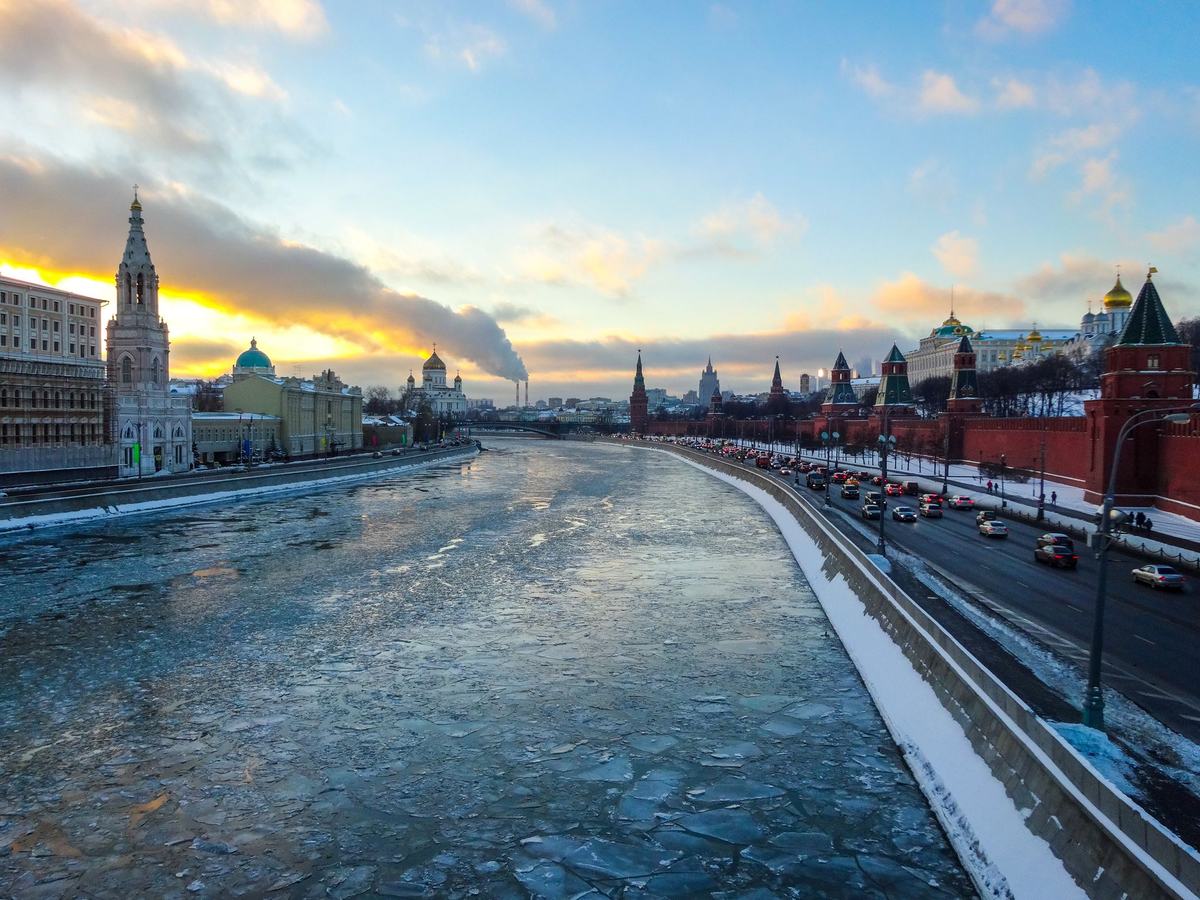
- Capital: Moscow [1]
- Population: About 144 million [1]
- Area: 17,098,242 square kilometers (6,601,665 sq mi) [1]
- Official language: Russian [1]
- Currency: Russian ruble (RUB) [1]
- Distinguishing claim: The largest country in the world by land area, covering more than 11 percent of Earth's total land surface and spanning eleven time zones [1]
I grew up thinking the United States was big. Then I tried to actually picture Russia on a globe and had to sit down for a minute. You could fit the entire continental U.S. inside it almost twice and still have room left over for most of Western Europe. It crosses two continents. It touches twelve seas. It borders fourteen other countries, the most of any nation on the planet. The thing about Russia that nobody really prepares you for is the sheer scale of it. Most of the country is empty. The cities are clustered in the west, and east of the Ural Mountains the population thins out into vast forests, frozen tundra, and small towns that sit on permafrost. The story of Russia is partly a story of figuring out how to live across that much land, in that much cold, for that long.
Eleven Time Zones in One Country
Russia stretches across eleven time zones, more than any other country on Earth [1]. When kids in Kaliningrad on the Baltic Sea are sitting down to breakfast, kids in Kamchatka on the Pacific are already asleep. The country covers about 6,000 miles east to west, which means a domestic flight from Moscow to Vladivostok takes about nine hours and crosses seven time zones. That's roughly the same as flying from New York to Tokyo, but you never leave home.
The Trans-Siberian Railway, the longest single rail line in the world, runs 9,289 kilometers from Moscow to Vladivostok and takes about seven days end to end [2]. It crosses sixteen rivers, passes through eighty-seven towns and cities, and is still the only practical way for most Russians to travel across the country by land. People who do the whole route describe a kind of dreamlike rhythm where you wake up in a different climate every morning. Birch forests give way to steppe, steppe gives way to taiga, and somewhere around day five the cell signal disappears for hours at a time.
The Deepest Lake on the Planet
In southern Siberia sits Lake Baikal, a crescent of water so deep that it holds more freshwater than all five North American Great Lakes combined [3]. About 5,387 feet at its deepest point. It contains roughly 20 percent of the world's unfrozen surface freshwater. It is the oldest lake on Earth, somewhere between 25 and 30 million years old, and it's so clear in winter that ice skaters glide over what looks like glass with fish swimming a hundred feet beneath them.
Baikal is home to species you won't find anywhere else, including the nerpa, the world's only freshwater seal, which scientists still can't fully explain. How a seal ended up living in a lake thousands of miles from any ocean is one of those mysteries that gets a new theory every decade. The water itself is so pure in some places that boats appear to float on air. Local Buryat communities consider the lake sacred, and there are still ceremonies around it that go back centuries.
The Coldest Inhabited Place in the World
Up in the Sakha Republic in northeastern Siberia is a small village called Oymyakon, with about 500 residents and the lowest officially recorded temperature for any permanently inhabited place on Earth: minus 67.7 degrees Celsius, or about minus 90 degrees Fahrenheit [4]. Winter days in Oymyakon get only about three hours of sunlight, and the schools stay open until the temperature drops past minus 52. Cars are left running 24 hours a day in winter because the engines won't restart if they cool down. Funerals require digging a hole in the permafrost with fire, because no shovel will break the ground.
Most of Russia sits on permafrost. About 65 percent of the country's territory has ground that stays frozen year round, which complicates pretty much everything you'd want to build [5]. Houses are constructed on piles driven deep into the ice so that heat from inside the building doesn't melt the foundation. Pipelines are insulated and elevated. Whole cities, like Yakutsk, were engineered around the fact that the dirt under them is not really dirt at all.
A Country with Active Volcanoes
The Kamchatka Peninsula in the Russian Far East has 160 volcanoes, 29 of which are still active. The whole place is part of a UNESCO World Heritage site recognized for its concentration of volcanic activity, geysers, and intact wilderness [6]. The Valley of Geysers, discovered only in 1941, has the second largest concentration of geysers in the world after Yellowstone. Steam rises out of the ground in a hundred different vents along a narrow river canyon, and brown bears walk through the mist like it's perfectly normal.
Kamchatka is also one of the most remote inhabited places in the northern hemisphere. There are no roads connecting it to the rest of Russia. You can only get there by plane or ship. About 300,000 people live across a peninsula roughly the size of California, which makes the population density about one person per square mile in most of the interior. Salmon fisheries support most of the local economy, and brown bears outnumber humans in some districts.
The Cultural Capital and the Political Capital
Most countries have one big city that does most of the cultural and political heavy lifting. Russia has two, and they don't really get along. Moscow is the political capital and the biggest city, with about 13 million people in the metro area, the Kremlin, the parliament, the financial center, and most of the country's wealth [1]. Saint Petersburg is the cultural capital, founded by Peter the Great in 1703 as Russia's "window to Europe", built on a swamp by tens of thousands of conscripted workers, many of whom died in the process [7]. The whole historic center of Saint Petersburg is a UNESCO World Heritage site.
The Hermitage Museum in Saint Petersburg, housed partly in the old Winter Palace, holds about three million items in its collections. If you spent one minute looking at each piece, eight hours a day, it would take you over fifteen years to see all of it. The museum is also famous for its cats. About 70 of them have lived in the basement since the time of Catherine the Great, employed to control mice, and they have their own dedicated press secretary [8].
A Language with a Different Alphabet
Russian is written in the Cyrillic alphabet, which was developed in the 9th century by the followers of Saints Cyril and Methodius for use in the Slavic Orthodox church. It has 33 letters, including some that look like familiar Latin letters but make completely different sounds. The Russian "P" is your English "R". The Russian "C" is your English "S". Once you sort that out, reading street signs gets a lot easier, but the grammar is its own challenge. Russian uses six grammatical cases, which is why even native speakers sometimes pause to think about which ending a word should take.
Russian is one of the six official languages of the United Nations. It's spoken as a first or second language by an estimated 260 million people, mostly in Russia and former Soviet republics, but also in immigrant communities all over the world [9]. Back home in Montana there was one Russian family in my town and the kids spoke it at home with their grandparents. That was the first time I really registered that an alphabet can be a kind of home, even thousands of miles away.
Folk Tales, Onion Domes, and the Bear
The image most Westerners carry around of Russia, like onion domes, fur hats, and bears in the forest, isn't really wrong, but it's not the whole story either. Saint Basil's Cathedral, the wildly colorful church on Red Square that everyone recognizes, was completed in 1561 under Ivan the Terrible, and legend says he had the architect blinded so that nothing so beautiful could ever be built again. Historians mostly think that story is invented, but it has stuck for 450 years for a reason [10].
Russia has more than 11 million square kilometers of forest, the largest forested area of any country on the planet. About a fifth of the world's trees are in Russia. There really are brown bears in those forests (more than 100,000 of them), and folk tales about bears are still part of how children learn the woods. Matryoshka dolls, the wooden nesting dolls that everyone calls "Russian dolls", were actually invented relatively recently, in the 1890s, inspired by a similar Japanese toy. Which, if you think about it, is a pretty good summary of Russian culture in general: deeply traditional in feel, surprisingly modern in origin, and always borrowing something unexpected from somewhere else.
Frequently Asked Questions
How big is Russia compared to the United States?
Russia is about 1.8 times the size of the United States. Its land area is 17.1 million square kilometers, compared to about 9.8 million for the U.S. Russia is the largest country in the world by area, covering more than 11 percent of Earth's total land surface, and spans both Europe and Asia.
How many time zones does Russia have?
Russia has eleven time zones, more than any other country on Earth. They range from UTC+2 in Kaliningrad on the Baltic Sea to UTC+12 in Kamchatka and Chukotka on the Pacific. A domestic flight from Moscow to Vladivostok takes about nine hours and crosses seven of those time zones.
What is the capital of Russia?
The capital of Russia is Moscow, which is also the country's largest city, with a metro area population of about 13 million. Moscow has been the political and economic center of Russia for most of its history. Saint Petersburg, in the northwest, served as the imperial capital from 1712 until 1918.
What language is spoken in Russia?
The official language is Russian, written in the Cyrillic alphabet with 33 letters. Russian is the first language of about 150 million people and is widely spoken across the former Soviet republics. There are more than 100 minority languages spoken across Russia, including Tatar, Chechen, Bashkir, and dozens of indigenous Siberian languages.
What is the deepest lake in Russia?
Lake Baikal in southern Siberia is the deepest lake in Russia and in the world, reaching about 1,642 meters (5,387 feet) at its deepest point. It holds roughly 20 percent of the world's unfrozen surface freshwater and is the oldest lake on Earth at around 25 to 30 million years old.
Sources
- The World Factbook: Russia
- UNESCO World Heritage Centre: Trans-Siberian Railway
- UNESCO World Heritage Centre: Lake Baikal
- BBC News: Life in Oymyakon, the coldest inhabited place
- Encyclopaedia Britannica: Russia
- UNESCO World Heritage Centre: Volcanoes of Kamchatka
- UNESCO World Heritage Centre: Historic Centre of Saint Petersburg
- The State Hermitage Museum: Official site
- Ethnologue: Russian language
- Encyclopaedia Britannica: Saint Basil's Cathedral